| Calendar | Add A Class | College Degrees | Online Classes | DVDs & CDs | On-site Classes | Advertising | Contact Us |


Sign up for FREE training articles & class updates Your Email:


cleardot.gif (807 bytes)


cleardot.gif (807 bytes)

August 2014

Important: To ensure future delivery of the Policetraining.net newsletter to your inbox (not bulk or junk folders) please add our "From" address info@policetraining.net to your address book or e-mail whitelist.

in this issue . . .


- Sponsored By -


line-small.gif (227 bytes)

Let Them Shine


Rather than feeling threatened, leaders should recognize talent, hard work & creative energy

By Dale Stockton Law Officer Magazine

“We eat our own,” he said.

I clearly recall my former chief making this comment several years ago. Law enforcement has a tendency to embrace the negative and minimize the positive when it comes to our own people, he was saying. This would seem out of place in a profession that claims to encourage personnel to improvise and empower them with autonomy.

While at the ILEETA (International Law Enforcement Educators and Trainers Association) conference, I had lunch with a trainer who’s been in law enforcement for almost 30 years, having spent 20 of those years patrolling one of America’s most crime-ridden cities. He’s earned his stripes. Now approaching the big “R” in life—retirement—he was noticeably negative about his agency and his current role. He clearly felt he’d been relegated to a position of irrelevance. As we talked, he showed me a small booklet entitled 48 Laws of Power and said he wished he’d understood the first law when he began his career. “What’s that first law?” I asked.

“Never outshine the master,” he said. In other words, don’t look better than your boss or else you’ll pay the price.

I have to admit to being initially a little skeptical but then I remembered the comment about “eating our own” from my former chief. I thought back on the people I’d known over the years who’d been taken for granted or held back by their agency. As the week at ILEETA unfolded, I became aware of several superb trainers who’d been minimized or outright disenfranchised by agencies that they’d served for most of their adult lives. How could this be? Why do we do this?

Let Them Shine
I’ll acknowledge up front that there’s a certain degree of human nature involved and this tendency isn’t entirely unique to LE. In fact, there’s even a relevant Biblical reference (John 4:44): “A prophet has no honor in his own land.” Maybe we’re just hardwired to embrace the negative and slow to acknowledge the positive, let alone believe that someone with whom we work with might actually be really good at what they do. As a sage once told me, “No one shoots at a burned-out light bulb.”

I kept reflecting on what the 30-year veteran had said about outshining the master and how it could deal a death blow to your career. Are there really LE leaders out there who are so insecure, so self-indulgent, that instead of supporting individual growth, they stifle and discourage? Unfortunately, I’ve concluded the answer is yes.

This is wrong. It counters everything that good leadership demands. Those who have a position of authority have a responsibility to their subordinates and their organization to encourage development of expertise. They must expand skill sets to improve the overall capabilities of the agency. Rather than feel threatened because they might not know as much as a developing specialist, leaders should recognize talent, hard work and creative energy. Doing so motivates others, and nothing improves the reputation of an agency more than quality people with specialized skills that can benefit other departments when needed.

This is doubly true of trainers. If you have a valuable resource within your agency—and most of us do—let them shine.

Conclusion
Think of individual proficiency and capability as a resource that can pay tremendous dividends—not as competition. Give your personnel opportunities for growth and exposure, and they’ll reward you with loyalty and productivity. When they begin to flourish, encourage them to train others and share their expertise. Rather than feeling threatened, leaders should be proudly promoting those who excel. Doing otherwise isn’t only selfish and short-sighted, it’s foolish
           .

 line-small.gif (227 bytes)

Fitness Tip from 

First responders often have limited workout time, so it’s important to get the most out of workouts by starting with an appropriate warm-up. Using only static stretching, or lift specific exercises like push-ups prior to a bench press, as a warm-up may not increase muscle temperature and improve performance as well as exercises in this video.
read more >
 

    line-small.gif (227 bytes)

What I Learned From 25 Years of Police Work


Follow these six tenants for a successful law enforcement career.

By Craig Medon

Reprinted from Police Magazine.

A couple of months before I retired as a patrol officer from a suburban Detroit police department, I took on the challenge of training a new recruit. During that training, I passed on to the recruit some of the most important lessons that sustained me through my career and kept me motivated to cross the finish line to retirement.

I'd like to continue to pass along these lessons so other officers can benefit from what I've learned. Here are six core tenants to follow.

Do your job to the best of your ability. We've all heard the saying that it's not about steering the ship in calm waters, it's about steering the ship during rough seas. Regardless of what's taking place around you, strive to perform at your best. I've also learned that taking shortcuts can come back to haunt us.

Follow your moral compass. Along with a badge, police work comes with a lot of power that causes a few officers to think that they're immune and above the average citizenry. Ask yourself, "If I do what I'm considering, would I want my family to know about it?" If something doesn't feel right, avoid it.

Be careful what you say and to whom. Sometimes we can be our own worst enemy when we don't think before we speak. When that happens, we later regret what we've said. Seek out someone you can completely trust and confide in.

Propose solutions, rather than dwelling on challenges. Is the glass half empty or is it full? We all know officers who complain about anything and everything. They don't take any action to improve their situation. Seeing ourselves as part of the solution and not the problem is important in improving ourselves as well as our police agencies.

There's no "I" in team. This is about taking care of each other in times of need because sooner or later you'll need the help of another co-worker. Comradery and bonding on a given shift strengthen this concept when it's carried out by fellow officers. It's about an officer taking a call for you so you can go to lunch. Perhaps you need someone from another shift to come in early to cover a few hours so you can leave. It's a great feeling knowing that officers will step up and help you because they know you'll do the same for them.

Embrace change. When I started police work, there were no computers, patrol rifles, cameras, defibrillators or KIEWS in patrol cars. Officers didn't carry cell phones and reports and tickets were handwritten. My duty weapon was a .357 Magnum six-shot revolver and fingerprints were taken with ink. Companies and organizations change to remain competitive as well as to deliver improved products and services. Policing is no different. While change sometimes isn't easy for cops, know that the world around us is always changing. Even an old dog can learn a new trick.

Craig Medon retired from the Auburn Hills (Mich.) Police Department.

line-small.gif (227 bytes)

Understanding the OODA Loop

The key to acting more quickly than your adversary is to make it an unconscious response.

by Derek Stephens
Reprinted from
Police Magazine

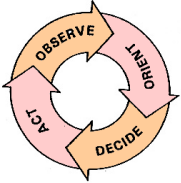
The more you study law enforcement training, the more you are likely to see the term "OODA loop." This term was coined by U.S. Air Force Col. John Boyd to explain the dynamics of fighter combat and why some pilots succeed when others fail. Boyd concluded that the outcomes of aerial engagements were often determined by how quickly a fighter pilot can process through the OODA, which meant to observe the enemy, orient to the stimulus presented by the enemy, decide to take action, and then act on that decision. Boyd added "loop" to signify that the process was continuous as long as combat was engaged.

Today, Boyd's combat theory is being applied to military engagements, to business strategy, to litigation, and of course to law enforcement operations and individual officer defense.

The OODA Loop has its place in law enforcement, but unfortunately, the concept has become something of a training catch phrase that is often misunderstood.

What It All Means

The OODA loop is a simple yet complex summation of how the human brain processes information and how humans react. First, you observe what is going on around you using your senses. Next, you orient to what is going on around you and put it into context with information rooted in your long-term memory, including training—both good and bad—life experiences, and your genetic heritage. After processing this information you must come to a conclusion about your surroundings, and you must make a decision to act or react. The final stage, if there truly is one, is the physical action. In order to process through the OODA loop, you must perform a physical action to implement the decision you have made. If your action is appropriate and effective you begin to gain the upper hand and can often process through more OODA loop cycles at a faster tempo than your adversary, which ultimately leads to victory.

Failing to act, or failing to act quickly and appropriately, will often result in defeat. The more defeat you suffer without being able to gain an advantage, the less likely you are to have an effective physical and mental performance. This puts you behind the reaction curve, where you process information more slowly and every time you cycle through the OODA loop you are at even more of a disadvantage.

Boyd understood how people process information in combat and the role that training, experience, and forethought play in maximizing  your ability to be victorious.

The Way to Victory

One of the most important things that Boyd's OODA loop can teach you as law enforcement officers is that your survival skills such as firearms training and defensive tactics training must be properly encoded into memory.

In a life or death situation, you need to be able to process through the OODA loop as quickly and effectively as possible in order to increase your odds of survival and triumph. The fastest way to process through the OODA loop is to quickly orient to what is happening and virtually bypass the decision-making process by already knowing what action to take based on the stimulus. Boyd called the process of bypassing steps of the OODA loop "implicit guidance and control."

Implicit guidance and control is an unconscious preplanned physical response to a known threat stimulus, which is often referred to by psychologists as a "learned automatic response." Some experts also refer to this as a "threat stimulus response pairing."

Mental Bridges

In order for survival skills training to truly be effective, training needs to be capable of rooting its goal, purpose, tactic, or maneuver into your long-term memory. Psychologist E.R. Guthrie wrote that "A skill consists of the ability to bring about some end result with maximum certainty and minimum outlay of energy, or of time and energy." For our purposes in law enforcement this seems to be a perfect definition of a skill because we must continue to face countless dangers, seen and unseen, and be able to bring about a proper end result with maximum certainty as quickly and safely as possible. Failure for us to do so can end in tragedy and/or unnecessary danger to the public at large.

Building these skill sets can often be accomplished by using repetitive, emotionally based interactive training that utilizes at least two human senses and is relevant to the trainee. When a skill set is encoded into your long-term memory, the body is physically building synaptic connections between brain cells. These connections help form your unconscious memory and, much like the physical training itself, the more you exercise your brain the stronger the connections become. This process can include both physical and mental training.

An easy way to understand this is to imagine two bridges as representing these synaptic connections in your mind.

The first bridge is a rickety old rope bridge with missing planks. The bridge sways high above the bottom of a deep cavern and it creaks in the wind. This rickety bridge is there because you built it in one day, and you did not put the proper effort into building it. The failure to properly maintain the bridge over the years has also caused it to become more and more unstable; the ropes are rotting and the connections are weak. Unfortunately, the only reason you built the bridge was because you were told to do so by a skill set instructor, and you only had to walk across it one time by taking baby steps in order to show you could. This happens all the time in law enforcement when officers and trainers don't think the training will actually have to be used to survive.

On the other hand, the second bridge is a large, multilane highway span that you and your brain can race across. When you built this bridge you put lots of time, effort, and physical expense into its completion, and you understand that you must properly maintain it so that it too does not deteriorate. You had expert help in building it to make certain all the connections are correct and the bridge does not fail you. You built it because you understood the need to do so, and you have most likely raced across it at least once at work, or have at least envisioned racing across it often while mentally preparing for your survival.

To understand why we want the skill sets built into your long-term unconscious memory, you should be familiar with the Theory of Schema, which states that "The conscious mind is slow and the unconscious mind is fast."

According to this theory, if you have to think before reacting, your body will suffer an approximately half-second delay. On the other hand, if you unconsciously react to a threat or stimulus, your reaction time is a small fraction of a half second.

With these pictures in your mind, simply think about which bridge you want your brain and your trained survival skill set to have to race across while engaging someone who is determined on taking your life in a cold, dark alley.

When you have a greater understanding of how the OODA loop works, how skills training is set into your long-term unconscious memory, and how these can affect your physical response to a threat stimulus, it is easier to understand the need for proper skills training. Not only can the training assist you in properly orienting and responding to a threat, it can help you avoid improper responses.

Unfortunately, officers are sometimes improperly trained, and habits are not corrected and allowed to continue in training. When this happens officers are unfairly placed in situations that may lead to ultimate failure and loss. Take, for example, the tragic story in Colorado where an officer was involved in a deadly gun battle with an armed assailant and reportedly fired at the assailant at distance from the high-tuck position. This improper, most likely unconscious response, allowed the firearm to entangle with the officer's uniform, causing the officer's gun to jam. Unable to quickly fix the jam, the officer then reportedly raised a hand and appeared to wait momentarily for assistance, only to be executed by an advancing assailant who was more than willing to take advantage of the situation.

The tragic loss of an officer's life in this situation may have stemmed from both improper training, shooting from the high-tuck position while the assailant was not in close quarters, and from a bad, uncorrected habit of raising a hand for assistance on the firing range. When trainers allow officers to do such things on the range they allow them to become a learned automatic response to a malfunction.

In order to help prevent future tragedies, we owe it to ourselves and our families to ensure that we, as officers, trainers, and supervisors, know and understand how the OODA loop works and how to maximize our training for survival. Take time to look at your physical traits and habits at work. Could you be unknowingly setting yourself up for failure?

Are your trainers presenting training because they are required to, or are they presenting well thought out training that is more likely to help you survive life and death struggles?

Derek Stephens has been an officer in Colorado since 1997. He is the founder of Rally Point Training Consulting, specializing in OODA loop-based officer survival instruction.


line-small.gif (227 bytes)


(


< < jump to the policetraining.net home page>ge>