|

|
|

July
2015
Important: To ensure future delivery of
the Policetraining.net newsletter to your inbox (not bulk or junk folders)
please add our "From" address
info@policetraining.net to your address book or e-mail whitelist.
|
- Sponsored By -
|
|
 |
|

The Stress-Proof Career
|
Stress comes with the territory, but these three
habits will ensure it doesn't end your career (or your
life...)
By:
Jeff Shannon
Calibre Press
Highly publicized events of the last year confirm for me
that these are difficult times to be a cop. In addition to
the usual family, organizational and personal stress we
carry with us, we’re now up against
homegrown violent extremists.
Additionally, antipathy for law enforcement is particularly
high in many communities throughout the country. Not
surprisingly, more cops on more skirmish lines facing more
hatred from the public stresses us out. Bottom line: It’s
more important than ever to cope with our stress in ways
that are life enhancing rather than personally destructive
(i.e., more stress = more booze).
As a stress and wellness law enforcement instructor, part of
my job is converting behavioral science research into
practical steps officers can take away and use immediately.
Working on our “stress hardiness” is a perfect example.
What happens to a bunch of male executives when the company
they work for breaks apart? Pretty stressful stuff! What
happens when their world is rocked and their future is up in
the air? Researchers Suzanne Kobasa and Salvatore Maddi
asked these questions when they studied the divestiture of
the Illinois Bell Telephone Company. What they found was
some of the 200 executives got sick and some didn’t. Kobasa
and Matti then studied the people that didn’t get heart
disease, cancer and panic attacks. What was it that
protected them from such intense stress?
Apparently, they had developed a mental habit that turned
stressful events on their head, making them not just
survivable, but life enhancing. They have what the
researchers called the “stress-hardy personality.”
LEOs who do well share with these executives the three Cs:
control, challenge and commitment. These are words I invite
you bring into your life, learn about and practice. The
longer you’re able to stick with it, the more likely they’ll
become natural coping strategies.
Challenge: Understand (at a deep level) that our jobs and
the expectations of our bosses and the public are always
changing. Like the reactionary curve, we want to anticipate
change rather than get caught reacting to it.
Example:
You may find yourself dealing with angry protesters and you
might feel yourself the victim. The alternative: You
let go of what you’re “supposed to be doing” and take it as
an opportunity to develop your personal flexibility. Rolling
with change is a skill. It’s a skill that will help keep us
sane and healthy throughout our law enforcement career.
Control: Actively, consciously, and regularly remind
yourself to let go of the things you have no control over.
Instead, focus your energy and effort on what you do
control. After being laid off, some of the executives at
Illinois Bell sat at home ringing their fingers, fretting,
or punching their walls. They wanted to control what was
already settled. And it took their health.
Others spent little time on this. They immediately turned
their attention to what they could do … and did it.
Two areas law enforcement officers always control is our
level of professionalism and our attitude.
Commitment: Commitment is not forgetting what’s important in
the big picture. Too many of us don’t reflect regularly on
why we became cops or what kind of person we want to be, and
so we lose the bigger picture. If you wanted to be a cop to
help people,
remind yourself of that. Last I checked people still need
your help. If you wanted to put bad guys in jail, remember
that’s what brought into the job and work toward making that
happen.
What are you committed to? What’s really important to you in
this work? Answer these questions. Okay, now keep the
answers close to your chest and try not to forget it when
life’s challenges start to get in the way.
Conclusion
You won’t find the three 3 Cs in your favorite TV shows. You
can’t take them as pills. It takes dedication and work not
to forget them. I used to write a small “C” in the webbing
between my right thumb and first finger. I picked that spot
because it would often come into view without my effort.
When I glanced down and saw the C, it would remind me to see
where in my current situation I could apply challenge,
control and commitment.
Stress kills. It kills overtly, by making us do stupid
stuff, and it kills covertly, by destroying our health.
Despite the challenges we face in law enforcement, there are
proven ways to reduce the impact stress has on our bodies
and minds. The three Cs are tools. Deploy them often to
ensure a long and healthy career.
Jeff Shannon
Jeff Shannon is a police officer, law enforcement instructor
and a licensed marriage and family therapist. He teaches
Wellness and Crisis De-Escalation as part of the Alameda
County, Calif. Crisis Intervention Training program. Jeff is
recognized by the California Commission on Peace Officer
Standards and Training (POST) as a subject matter expert in
the area of stress management for law enforcement. He can be
reached at
jeffshannonmft@gmail.com
|
|
Fitness Tip from

Build strength to stand your ground while being pushed laterally.
The exercise in
this video
is not only appropriate for a variety of fitness levels but provides
a challenge with a partner—no equipment needed!.
Investigating Issues of Intent

By John Reid &
Associates
(Please Note: If you wish to print and share an Investigator Tip
with your colleagues, the John E. Reid 'credit and permission'
statement following the article must be included.)
Two recent news events have centered around a person's intentions.
The first was the shooting of Trayvon Martin by George Zimmerman.
The second was a White house correspondent named Neil Munro who was
accused of heckling President Obama by interrupting the President's
speech.
Neither individual is denying the primary accusation; George
Zimmerman openly acknowledges shooting and killing the unarmed
victim. President Obama's news conference was televised and Mr.
Munro does not deny that he is the reporter yelling out questions
while the President was speaking. Yet both individuals are denying
guilt because of lack of intent. Zimmerman stated that he believed
his life was threatened and he acted properly under the "stand your
ground" legal doctrine. Munro stated, "I timed the questions
believing the president was closing his remarks because, naturally,
I have no intention of interrupting the President of the United
States."
In presenting their explanations, both Zimmerman and Munro may
appear plausible and credible. However, unlike behaviors, which are
concrete and fixed in time, a person's intentions often represent a
personal cognitive assessment that can be manipulated with time and
motivation. Under this circumstance, a person's exhibited behavior
symptoms may serve as a poor indicator of credibility.
To be sure, some claims relating to legal intent directly involve
specific behaviors such as a man claiming that he shot his neighbor
in self-defense after the neighbor first fired a gun at him, in
which case he would know if he was telling the truth. However, many
of these claims are based on subjective cognitive assessments such
as personal perceptions, beliefs, or claiming lack of knowledge.
When a suspect's claim of lack of intent starts with the statement,
"I thought", "I believed", or, "I felt", the investigator is dealing
with a cognitive assessment.
To illustrate the difference between behaviors and cognitive
assessments, consider a hit and run where a pedestrian was struck
and killed. The owner of the vehicle denies driving at the time of
the collision. This represents a behavior. He certainly knows
whether or not he was driving and, consequently, whether or not he
is lying or telling the truth.
But let's change the facts where the owner openly acknowledges
driving the vehicle at the time of the collision, but states that he
is not legally responsible for the pedestrian's death because the
pedestrian walked right out in front of the vehicle and the
collision was unavoidable. This explanation represents a cognitive
assessment by the driver. In his mind, of course, he will perceive
the collision as unavoidable and therefore, that the explanation is
a truthful statement. This internal belief will persist despite the
fact that the driver knew he was speeding, trying to find a decent
station on the car radio and talking on his cell phone at the time
of the collision.
Behaviors can be proven through evidence. Fingerprints or DNA can
directly place a person at a particular location, surveillance video
can show a person engaging in a particular behavior and biological
evidence can prove that two individuals were sexually intimate.
However, intentions often can only be inferred. A homicide suspect
may claim that a gun discharged inadvertently resulting in the
victim's death; a fraud suspect may state that at the time he wrote
the check he believed there were sufficient funds in his account to
cover the check or a man may claim the he believed the girl whom he
had sexual relations with was 18 years old. These types of claims,
typically made by suspects implicated by overwhelming evidence, each
involve cognitive assessments which cannot be directly proven or
disproved. Rather, the investigator can develop investigative
information that may reveal the suspect's claim to be improbable,
e.g., that a death was probably not accidental considering that the
gun was fired three times.
With this in mind, the first lesson when investigating issues of
intent is to appreciate that assessing the credibility of a person's
stated intentions through behavior symptom analysis may be quite
misleading. A better approach to assess the true intentions behind a
person's actions is through factual analysis. In other words, the
investigator will attempt to support or refute a person's stated
intentions by identifying behaviors and events surrounding the
incident, as well as evaluating the person's propensity to form
wrongful intent.
To illustrate, consider a woman caught shoplifting a pair of
sunglasses. A loss prevention investigator observed the woman place
the sunglasses on top of her head and leave the store. When
approached, the woman appeared confused and bewildered, and
explained that she had fully intended to pay for the sunglasses, but
forgot that they were on top of her head.
If the woman placed the sunglasses on her head and shopped for
another 20 minutes before going through a checkout line to purchase
12 other items in her cart while casually talking to the cashier,
her explanation is fairly credible. Further, if the woman was a
regular customer who was elderly and had occasional episodes of
forgetfulness the explanation becomes even more credible.
However, if the woman was seen carrying the sunglasses in her hand
and, after noticing long check-out lines, placed the sunglasses on
her head and briskly left the store, her explanation does not sound
very credible. Add to this the fact that the woman lived in a
different community and had no reason for shopping at that
particular store and had three prior convictions for shoplifting,
her explanation becomes even less credible.
To develop information for factual analysis the investigator should
ask questions that address specific behaviors ("What did you do",
"When did you do it"). Anything falling outside of normal behavior
should be followed up with "why" questions, e.g., "Why did you wait
30 minutes to report the shooting?", "You already have 4 pair of
sunglasses why did you want to buy a fifth?"
In addition, questions that address propensity (behavioral
tendencies) should be asked. While propensity does not prove guilt,
it can go a long way in establishing a person's true intentions. The
following questions each address propensity:
"How many times have you shoplifted merchandise from a store?"
"Have you been questioned about shoplifting from a store?"
"Have you been convicted of shoplifting ?"
"Has anyone ever approached you asking you to (engage in crime)?"
"Have you thought about (committing crime)?"
For reasons previously discussed, "Did you intend to ..." type
questions may not reveal valid behavior symptoms. However, this
issue can be addressed by asking questions pertaining to the
suspect's knowledge. Addressing a person's recent knowledge is a
more concrete concept, and a better gauge of credibility, than
addressing that person's intentions. The following are examples of
questions that address the suspect's knowledge:
"When you went to the store that day, did you already have a plan in
mind to steal a pair of sunglasses?"
"When you put those sunglasses on your head did you already have a
plan in mind to walk out of the store without paying for them?"
"When you walked past the cashier, did you know the sunglasses were
on top of your head?"
Finally, conversations or communication with others may provide
useful insight about the credibility of a suspect's explanation for
behaviors. This is particularly true if it is established that the
suspect changed his stated intention at some point in time, e.g.,
initially the driver said the sun glare caused him not to see the
pedestrian but now claims the pedestrian ran out in front of him.
Examples of questions that address communication include:
"Did you tell anyone that (you purposefully engaged in behavior)?"
"Did you send any emails indicating that you (purposefully engaged
in this behavior)?"
"Did you leave any voice mails indicating that you (purposefully
engaged in this behavior)?"
"Did you write in a note or diary that you (intentionally engaged in
this behavior)?"
"Did you change your explanation for why (incident happened) at any
point in time?
Finally, an investigator needs to distinguish between intentions and
motives. Criminal intent may or may not be required to satisfy the
elements of a particular charge. Establishing the true motive behind
a crime rarely is an element required to prove guilt. In fact, many
guilty suspects mentally distort the true motive behind their
crimes. For example, it is not necessary that a child molester
acknowledge receiving sexual gratification through his sexual
contact with the victim. It is likely that the molester has
convinced himself that the contact with the victim was to express
love and affection. In the eyes of the law, it makes no difference
to the judge why the suspect had sexual contact with the victim, the
defendant is still guilty of child molestation.
In conclusion, not all claims relating to lack of criminal intent
involve cognitive assessments. However, when dealing with those that
do, behavior symptoms of truth or deception are less valid and may
be quite misleading. Rather, the best means to assess the
credibility of these claims is through factual analysis. To
accomplish this, the investigator needs to elicit information
surrounding the crime to establish a probability estimate that the
stated intention is credible. In particular it is productive to ask
follow-up "why" questions, questions that develop propensity and
questions relating to communications by the suspect.
Credit
and Permission Statement:
Permission is hereby granted to those who wish to share or copy this
article. In those instances, the following Credit Statement must be
included "This Investigator Tip was developed by John E. Reid and
Associates Inc. 800-255-5747 / www.reid.com."
Inquiries regarding Investigator Tips should be directed to Janet
Finnerty jfinnerty@reid.com.
How to Ensure Your Arrest and Control Training is Effective
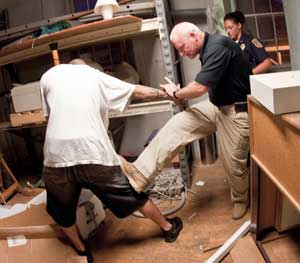
A physical engagement of officers attempting to control a large
suspect — and the subsequent grand jury decision — have people
marching in the streets and agencies looking at their arrest and
control training
How do you know that your arrest and control physical tactics are
effective? While making presentations on police use of force —
either physical combative training or in lecture format — I’ve
observed that many officers believe they are being trained
ineffectively, or trained in tactics they feel are not effective in
their real world engagements. Meanwhile, a small minority of
officers feel they are receiving effective training, a perception
for which they may or may not have the experience to make an
accurate assessment.
I’ve witnessed a lack of continuity of training across law
enforcement agencies. Further, I haven’t encountered any person or
agency that can produce quantifiable evidence about the level of
effectiveness of their arrest and control tactics training in the
field.
In fact, more than 90 percent of agencies that I have trained — or
polled — do not take steps to analyze or evaluate the effectiveness
of their empty hand arrest and control training. That doesn’t mean
that the training is ineffective. It means that there is no
established measure of its effectiveness. How can we legitimize any
specific training if we cannot support its effectiveness with
evidence of success (or lack of success) once implemented?
Stop Training Based on Trainers’ Perceptions
The implementation of sound training measures should be preceded by
careful consideration of how we develop the correct curriculum for
our personnel. Do we base our training on what we know the officer
needs or on that which we think — or which the officers think — they
need? Once the needs are determined, how do we choose the material
to be included in the instruction of officers?
Each agency has skilled individuals whose backgrounds vary. Some
have extensive training in martial arts, wrestling, boxing, or
specific police-oriented tactics. This can present both advantages
and disadvantages, and individuals will tend to teach a discipline
specific to their own knowledge base and skills. The training may
then necessarily become rooted in their own perception of what works
best.
All of the aforementioned training styles may coalesce in effective
and efficient training. However, without a standard of measure of
effectiveness in the field, it is difficult, at best, to know if we
are serving the real needs of law enforcement officers. Further, if
we cannot know if we are best serving those needs, we may be
handcuffed in our efforts to develop — or redevelop — truly
effective training protocols.
We cannot manage that which we do not measure.
Quantifiable evidence can reveal if what we’re teaching is actually
used by officers in the field. Hard data can help us create a
concrete plan to ensure that our training is what it really needs to
be. Continuing to rely on perception of what we think the officer
needs in terms of training is just no longer good enough.
Gather Accurate Data from Real-World Encounters
We’ve all heard statements like “most fights go to the ground”
followed by “so we should teach ground fighting.” But in order to
develop effective ground training, we need to accurately document
how fights go the ground in the first place. Causes may include:
•
A tackle
• A slip
• A takedown
• A slick surface
• A knockdown
Supervisors should be asking themselves (and their officers): Was
going to the ground initiated by the officer or suspect? Were
multiple officers involved or a single officer? Was it due to
tremendous size differential or the skill of the suspect?
What are the different circumstances for which we should be well
trained? Often we teach officers what we believe they should know
without any evidence to show why we are instructing the material. If
we can quantify the circumstances we can teach them what we know
they need and, importantly, measure the effectiveness of the
outcomes.
We’ve also heard trainers say “With the rise of MMA in this country,
officers need to learn MMA techniques.”
Really? Have you really fought numerous MMA suspects on the street?
To validate the assertion that officers should learn MMA techniques
it should first be determined through use of force analysis and
assessments that officers are being faced with MMA-type assaults.
Otherwise it is only a perception of the instructor. What do sport
MMA skills have to do with arrest and control? Was there research
conducted that underlies the belief that we need to teach an officer
MMA skills?
The two prior examples — which are not uncommon — show us what can
happen when we fail to track, measure, and evaluate the training we
implement. Our training time is crucial to success and time spent in
training is time not spent in the field.
Relying on Data Beyond Your Own Agency
The practice of perception-based training is unacceptable and
negligent for both the agency and the officers. To continue down any
path that wastes time and money is bad business, not to mention that
it puts the officers and agencies in harm’s way. Tracking and
trending is not only designed to measure the success of your
training but to measure the inadequacies. Doing a better job of
documenting results of our training will help us improve our
training. We can better understand if use-of-force incidents are
justifiable and reasonable. We can track whether our officers are
relying on ‘not-trained’ maneuverers.
Bear in mind too that you don’t have to design your system based
solely on your own agency’s use of force evidence — you may not have
enough data. Start there because it develops a solid understanding,
but look to data gathered elsewhere as well. Remember, we’ve changed
the way we conduct our firearms training because the research and
analysis of nationwide data on shootings revealed how the majority
of shooting occur and how we should modify our training.
Gathering and analyzing quantifiable evidence will support your
training. It will ultimately improve your officers’ performance.
Quantifying your use of force also validates — or doesn’t validate —
your training programs. This will help determine if the training you
are providing your officers is flawed or on track.
About the author
Lieutenant Kevin Dillon (Ret) is a twenty-five year veteran law
enforcement officer. Dillon retired from the Wethersfield (Conn.)
Police Department — a suburb of the state’s capitol of Hartford —
after serving as the Detective Bureau Commander. Lieutenant Dillon
also has commanded the department’s patrol division and served as
training supervisor. As a SWAT team member since 1993, he served as
an Operator, Team Leader and Commander of the regional thirty-five
member SWAT team (Capitol Region Emergency Services Team.) and
remains a consultant with the team. Lieutenant Dillon is a National
Academy graduate of the F.B.I. session 223. He has also received
certification from Force Science Institute in Analysis in Use of
Force incidents. Dillon developed and teaches the L.O.C.K.U.P.
Police Combat System, a comprehensive fighting approach
based on gross motor skill concepts that reduce injuries to citizens
and police officers. L.O.C.K.U.P. teaches empty-hand maneuvers
(Defensive Tactics) that can be deployed effectively during violent
physical encounters and adapts the fighting maneuvers to the
officer's physical and physiological changes to maximize
effectiveness.
|
|
