
By
John Reid & Associates
As a general guideline, an investigator should not address
consequences during an interrogation. In fact, the investigator goes
to great length to avoid discussing any possible consequences the
suspect faces if he or she decides to tell the truth. After all, it
is precisely because of those consequences that the suspect is
lying. However, there are occasions where it may be appropriate or
even necessary to discuss possible consequences with a suspect.
Obviously the focus of this discussion should not be on the severity
of consequences, but rather on the possible benefits of
consequences.
So what possible benefits can the investigator offer a suspect who
is facing a fifteen year prison sentence or the loss of a $120,000
annual salary? Pat McCarthy, who teaches a three day course on
street crime investigations, is a master at making a lengthy prison
sentence sound like a stay in a five star hotel. His tactic at
selling the benefits of prison resembles the following:
"Tim, I'm not going to lie to you and tell you that you're going to
walk on this one. If you are found guilty you're probably going to
end up doing some time. But some good can come from this. For one
thing, you can get your GED and other technical training so you'll
be able to get a decent job, maybe pulling down $60 or $70 grand a
year. Then you won't even be tempted to fool around with selling
drugs or gang activity anymore. You'll get free dental and health
care so you can get your teeth fixed and get regular checkups so you
can stay healthy. You won't have any monthly bills to pay; you won't
have to shop for food, cook meals or even do dishes. Plus, you'll
get free cable and internet!
After hearing his "prison spiel", suspects ask Pat where they can
sign up. Especially when a suspect is debating whether or not to
tell the truth (Step Six in the Reid Technique) it may be very
persuasive for the investigator to introduce the possible benefits
of confessing. Examples of other benefits of confessing include:
1. Embezzlement:
"Sally some good can come from this. Because this happened, the
company now knows that they need better controls and need more
frequent audits so other honest employees won't be tempted to do the
same thing you did. If someone else had found these problems
earlier, I'm sure you never would have done this."
2. Treatment for an addiction:
"George, If you think back on why this thing happened, and you were
completely honest about it, you would have to acknowledge that it
really boils down to the fact that you do not have control over your
(gambling, drinking, drug use, sexual urges). What that means is
that there is something happening in your brain that you cannot
control. Because of this abnormal brain activity you did something
you normally would not have done. There are advances being made
every day in treatment programs. George, some good can come from
this. The state has treatment programs that you can take advantage
of so you will no longer be tempted to (engage in criminal
behavior). I could give you dozens of examples of people who did
something wrong because of the same problem you have. Because they
expressed a willingness to cooperate and get the matter resolved,
they were able to get into a treatment program and almost all of
them were able to turn their life around. But the first step is to
tell the truth."
3. Juvenile interrogations:
"Johnny, it's really fortunate that you got caught this
early. Right now we're just looking at taking someone's car. But if
you don't get this resolved you're going to go out and do more
serious things in the future, like breaking into homes. During one
of those burglaries you're going to steal a gun and use it to rob
someone. During a robbery either you're going to shoot the clerk or
a clerk or cop is going to shoot you. If you play this thing out,
your future consists of two options. Either you're going to end up
in the morgue with a tag tied around your big toe or I'll be talking
to you about murder and you'll be looking at spending the rest of
your life behind bars. Right now we're just looking at taking
someone's car. Either you can learn from what you did and promise me
that you will not get involved in further criminal behavior or you
can play the tough guy and sit in that chair and continue to tell me
that you didn't do it. The choice is yours. If you want to turn your
life around I want a promise from you right now that you will stop
taking things that don't belong to you. Can you make me that
promise?"
4. Theft interrogation:
"Mary, lets look at this thing practically. What the company
wants is to have their money back. I'm sure you needed this money
for something important and no one expects you to be able to pay it
back all at once but it will be important for them to know that you
are sorry about what you did and that you are willing to work with
them to reimburse these funds. I mean, if you're not even willing to
pay this money back that tells me you're simply a dishonest person
and I'm just wasting my time talking to you. You are willing to
eventually pay them pack, aren't you?"
Legal Caution
One of the reasons we teach not to bring up consequences during an
interrogation is because once the investigator mentions treatment
for a drug problem, counseling, or a willingness to reimburse stolen
funds it opens the door to an allegation that the investigator
transmitted a promise of leniency to the suspect. In fact, some
courts have prohibited statements that even imply a promise
of leniency such as telling a suspect, "I would like to help you
out on this thing," or, "The best thing you can do is
tell the truth."
When discussing the possible benefits of telling the truth, it is
imperative that the investigator never suggest or imply that a
suspect may avoid punitive consequences if he or she agrees to
receive counseling, treatment for their addiction, or reimburse
stolen funds. These incentives can be mentioned as a possible future
benefit to telling the truth, but not in lieu of incarceration or
job termination.
Especially in light of the trend toward electronic recording of
interrogations, investigators need to protect themselves against
claims of implying a promise of leniency. An effective technique to
accomplish this is by incorporating a prophylactic statement
within an interrogation theme. This is simply a statement that
removes any doubt as to the fact that the investigator is not
offering a promise of leniency, as the following dialogue
illustrates:
"Larry, if you did this because you got hooked on some sort of drug,
that would be darn important for people to know. When someone takes
money to feed a drug habit that's a lot different than a dishonest
person who steals money and blows it on a fancy car or a vacation to
the Bahamas. If this happened because you needed money to buy
cocaine or heroin I want to be able to include that in my report so
people understand that this is something that can be fixed. I mean,
I've talked to dozens of people who were hooked on a drug and were
able to get into treatment and completely turn their life around.
That's what I want to see happen to you. Now don't get me wrong.
I'm not saying that if you get treatment nothing else will happen to
you. I don't have any control over what happens to the people I
investigate. But what I am saying is that we need to focus on
the positives here. One positive is that you can get your drug
problem treated which will allow you to get on with your life.
Conclusion
An investigator certainly does not have the authority to
offer the suspect any sort of plea bargain or other promise of
leniency in exchange for a confession. However, it is permissible to
make truthful statements to a suspect during an interrogation. An
investigator is not lying when he tells the suspect that he can
receive counseling and therapy in prison; it is an accurate
representation when the investigator says that the suspect will not
have to pay room or board while in prison and it is a fact that
stolen money can be reimbursed.
It is a basic principle of persuasion to focus on the
positive aspects of an argument. During an interrogation, however,
the investigator must be careful that the proposed benefits of
confessing do not cross the legal line of transmitting an implied
promise of leniency. Therefore, we would recommend that when an
investigator discusses the possible benefits of telling the truth, a
concluding prophylactic statement should be made which clearly tells
the suspect that the investigator is not offering a promise of
leniency and that the investigator does not have control over what
may happen to the suspect.
Credit and Permission Statement: This
Investigator Tip was developed by John E. Reid and Associates Inc.
Permission is hereby granted to those who wish to share or copy the
article. For additional 'tips' visit
www.reid.com;
select 'Educational Information' and 'Investigator Tip'. Inquiries
regarding Investigator Tips should be directed to Janet Finnerty
johnreid@htc.net.
For more information regarding Reid seminars and training products,
contact John E. Reid and Associates, Inc. at 800-255-5747 or
www.reid.com


by
Olivia N. Johnson, DM*
Diseases of the soul are more dangerous and more numerous than those
of the body.
~Cicero
For additional information reference Dr. Johnson's training
programs, please visit
www.pg-ti.com
or call 847-875-3620.
The National Institute of Mental Health (2009) estimated at any
given time, one-quarter of American adults (over 18) experienced at
least one psychological disorder. In fact, research suggests the
United States is on the verge of becoming the global leader of
mental disorders (Weiss, 2005). One of the most common and
concerning mental disorders in the U.S. is depression.
Depression is “a medical illness that involves the mind and
body… it affects how you feel, think, and behave” (Mayo Clinic,
2011, p. 1). Described by bouts of sadness, numbness, sleep
disturbances, weight loss or gain, altered moods, feelings of
emptiness, irritability, fatigue, worthlessness, anxiety,
hopelessness, helplessness, and an overall loss of interest in once
pleasurable activities; this often debilitating illness is
categorized by levels of severity ranging from mild to severe.
Nearly 35 million Americans will suffer from some type of
depression in their lifetime (Kessler, Chiu, Demler, & Walters,
2005), with depression as the leading cause of disability and
suicide worldwide (World Health Organization [WHO], 2011).
Nationwide, 60-90% of individuals completing suicide are diagnosed
with depression (“Treating depression”, 2009, p. 580). Based on the
World Health Organization’s “Disability Adjusted Life Year” [DALY]
scale, projections indicate by 2020, depression will be the second
leading cause of death for all ages and sexes worldwide (2011). The
DALY scale equates “life lost to premature mortality” and “years of
productive life lost due to disability” (WHO, 2011). DePaulo &
Horvitz (2002) suggested:
One of the most disabling aspects of depression is that often
you don’t know that you
have it at all. That doesn’t happen with most other
painful diseases that are usually
quick to announce their presence and location. But depression
can sneak up so
insidiously that you literally don’t know what it is,
sometimes until years later. (p. 10)
Depression sufferers should remain optimistic, as depression
is highly treatable. However, less than one-third of depressed
individuals ever seek treatment (Washington University School of
Medicine, n.d.). The large numbers of individuals refusing to seek
treatment is a direct result of stigmatization of mental health
issues (Department of Mental Health, 2006). “Atypical manifestations
of depression often mask the underlying disease” (Johnson, 2010).
Self-medication contributes to difficulties in a proper diagnosis
and treatment of depression.
Depression alone does not have a single origin, but rather,
has been linked to an assortment of causes (i.e., genetic
predispositions, learned behaviors, biochemical changes,
prescription drugs, a life changing event, psychological issues, and
can be present in conjunction with other illnesses) (All Family
Resources, 2005; U.S. Department of Health and Human Services,
2010).
Besides the multiple origins of depression; certain occupations are
at greater risk for acquiring this debilitating illness.
According to Christopher Willard, Psy.D., Tufts University,
Clinical Psychologist, occupations experiencing the worst of society
(i.e., police officers, judges, and lawyers) are at increased risk
for depression, due in part to the repetitive and negative nature of
the job and changes in world perspectives (Worth, 2010). Diamond
(2003) explained there was “no reason to expect law enforcement
officer possess any special immunity from this disease [clinical
depression], or its fatal consequence” (p. 55).
[C]ertain jobs, like law enforcement … have the paradoxical
effect of the fact that to
be good at them, a pessimism bias is adaptive…that becomes
problematic in other areas
of life. Law enforcement is also an unfortunate combination
unpredictable, boring,
sometimes dangerous, and often without room for much
autonomy, and often interactions
with people at their worst (either perpetrators of crimes, or
people who have just been
victimized by crimes) all of which are known contributors to
unhappiness. (C. Willard,
personal communication, June 20, 2011)
Occupational hazards for law enforcement personnel are far
reaching. The appearance of physical ailments, injuries, and
accidents are much easier to detect. However, occupational hazards
resulting from trauma, exposure to death and violence, and grotesque
forms of death, often result in emotional and psychological injuries
- much more difficult to identify. Mental functioning and decline
are influenced by extended exposure to stress and trauma (Heim et.
al., 2009).
As a result of trauma and exposure, law enforcement personnel also
experience “… repetitive adrenaline dumps in the body where the
fight-or-flight response is triggered” (Wasilewski & Olson, 2010).
This automatic response is the body’s internal defense against real
or perceived threats of harm (Siddle, 1995). Nevertheless, frequent
releases of these stress hormones (i.e., adrenaline, nor-adrenaline,
and cortisol) contribute to numerous physical, emotional, and
psychological ailments, including depression.
Initially, adrenaline produces a natural painkilling effect,
resulting in feelings of almost super-human strength, power, and
ability. Subsequently, numerous adrenaline dumps can be
catastrophic. As alluded to by Wasilewski & Olson (2010), (e.g.,
Einstein’s Theory of Relativity and Newton’s Law of Gravity), “what
goes up must come down” (p. 3). Individuals are left dealing with
the adrenaline high and ultimate crash. Adrenaline dumps occur
hundreds, maybe thousands of times in the average law enforcement
career. Residual affects resulting from these ups and downs leave
dangerous chemical deposits in the body, contributing to illness,
susceptibility to injury, increased pain, stress, and burnout
(Benjamin & Werner, n.d; Smith et al., 2011.). Prevention limits
exposure, while brining attention to such occupational hazards.
Smith et al. (2011), provided three key factors for the prevention
of stress and burnout (i.e., recognize, reverse, and resilience),
which can and do contribute to depression and other mental
disorders.
-
Recognize: signs and symptoms of stress and burnout
-
Reverse: understand the effects of stress and burnout and seek
assistance
-
Resilience: being accountable for your personal health and
well-being.
Depression is a debilitating illness, affecting millions of
Americans every year. The largest detriment for individuals seeking
treatment for depression is stigmatization. In addition,
manifestations of atypical symptoms replicating other illnesses and
self-medication with drugs and alcohol make diagnosing depression
difficult. However, those suffering from depression should remain
optimistic; as this devastating illness is highly treatable. The
debilitating effects of depression are far reaching and can affect
anyone at anytime in life. Occupations, which experience “the worst
in people and circumstances,” such as law enforcement, seem to have
higher than normal rates of depression. The nature of police work
places officers in danger of many occupational hazards, including
physical injury, depression, stress, and burnout. Law enforcement
personnel possess no extraordinary resistance to depression or the
effects of this deadly disease. Acknowledging and understanding the
occupational hazards faced by law enforcement personnel will better
prepare them for the immediate and residual effects of stress,
trauma, and burnout on their bodies and their minds.
About the author:
During her research on police safety issues, Dr. Olivia Johnson
discovered the leading cause of officer death was not accidents or
homicide, but rather suicide. This compelled her to refocus in the
area of officer suicide and through her research was named the
Illinois State Representative for the National Police Suicide
Foundation. In March 2010, she received her doctorate degree in
Organizational Leadership Management, from the University of
Phoenix. In June 2010, she was invited to speak at the Beyond
Survival Toward Officer Wellness [BeSTOW] Symposium sponsored by the
FBI Behavioral Science Unit. Dr. Johnson is the founder and
President of Blue Wall of Silence, an organization aimed at
providing hope, help, and support to those behind the badge. She
currently collaborates with several journals regarding law
enforcement and military issues and is the expert in police
leadership write for Law Enforcement Today. Her services were
contracted out by Crisis Systems Management to train military
personnel worldwide on Critical Incident Peer Support (CIPS). Dr.
Johnson is a current member of the International Law Enforcement
Educators and Trainers Association (ILEETA).
References
All Family
Resources. (2005). Depression: A serious but treatable illness.
Retrieved June 20,
2011, from http://www.familymanagement.com/aging/depression.html
Benjamin, B.E., &
Werner, R. (n.d.). You and your nervous system: How stress affects
your
body. Health Touch News, 6, 1-4.
Department of
Mental Health. (2006). Erasing the stigma of mental illness.
Retrieved June 22,
2011, from http:www.state.sc.us/dmh/erasing_stigma.htm
DePaulo, J. R.,
Jr., & Horvitz, L.A. (2002). Understanding depression: What we
know and what
you
can do about it.
Hoboken, NJ: John Wiley & Sons, Inc.
Diamond, D.
(2003). Departmental barriers to mental health treatment: A
precursor to police
officer suicide. In D.P. Hackett & J.M. Violanti. Police suicide:
Tactics for prevention (pp.
54-65). Springfield, IL: Charles C. Thomas.
Heim, C., Nater,
U.M., Maloney, E., Boneva, R., Jones, J.F., & Reeves, W.C. (2009).
Childhood
trauma and risk for chronic fatigue syndrome: Association with
neuroendoctrine
dysfunction. Archives of General Psychiatry, 66(1), 72-80.
Johnson, O.
(2010). Blue wall of silence: Perceptions of the influence of
training on law
enforcement suicide.
Minnetonka, MN: Global Health Care Systems.
Kessler, R.C.,
Chiu, W.T., Demler, O., & Walters, E.E. (June, 2005). Prevalence,
severity, and
comorbidity of twelve-month DSM-IV disorders in the national
comorbidity survey
replication. Archives of General Psychiatry, 62(6), 617-27.
Mayo Clinic.
(February, 2011). Depression (major depression): Definition.
Retrieved June 19,
2011, from http://www.mayoclinic.com/heath/depression/
National Institute of Mental Health. (2009). The numbers count:
Mental disorders in America.
Bethesda, MD:
Author.
Siddle, B.K.
(1995). Sharpening the warrior’s edge: The psychology & science
of training.
Millstadt, IL: PCT
Research Publications.
Sipkoff, M.
(2006). Depression in the workplace costs employers billions per
year: Employers
take lead in
fighting depression. Managed Care Magazine, 1(1), 1-22.
Smith, M.,
Jaffe-Gill, E., Segal, J., Segal, R. (2011). Preventing burnout:
Signs, symptoms, and
coping strategies.
Retrieved June 22, 2011, from
http://www.helpguide.org/mental/burnout_signs_symptoms.htm
United States
Department of Health and Human Services. (2010). Depression.
Retrieved June 20,
2011, from
http://www.athealth.com/Consumer/disorders/nih_depression.html
Washington
University School of Medicine. (n.d.). Depression facts. Retrieved
June 16, 2011,
from
http://www.psychiatry.wustl.edu/depression/depression_facts.htm
Wasilewski, M., &
Olson, A. (August, 2010). Depression in law enforcement: What is it
& what
do you do about
it? Retrieved June 20, 2011, from
http://www.lawofficer.com/article/leadership/depression-law-enforcement
Weiss, S. (June,
2005). Study: U.S. leads in mental illness, lags in treatment.
Retrieved June 21,
2011, from
http://www.washingtonpost.com/wp-dyn/conetent/article/2005/06/06/
AR2005060601651.html
World Health
Organization. (2011). Mental Health: Depression. Retrieved June 22,
2011, from
http://www.who.int/mental_health/management/depression/definition/en/
Worth, T.
(October, 2010). Why is your job making you depressed? Retrieved
June 20, 2011,
from
http://www.cnn.com/2010/HEALTH/10/01/health.job.making.depressed/index.html

I realize that this is a great deal of information to learn.
However, it is the foundation on which ethical decision are
made. A firm ethical foundation, on which one can build a
personal ethical system, for making decisions and explaining
those decisions to administrators or in court, is absolutely
necessary.
In addition, law enforcement agencies normally
delineate a code of ethical behavior to guide their
officers. This should be compared to the IACP code and if
there are any differences an officer’s supervisor should be
able to explain the lack of congruity.
Officers will have the laws, statues and regulations
that apply in their jurisdiction. Updates are supplied if
these change. Constitutional law, which is relatively
stable, is taught at all training academies.
All of this information is essential in forming the
underpinning of one’s decision making process.
Here is an example of an ethical dilemma. What will you do,
quick, time is passing...
Oscar is taking his daily walk near the train tracks when he
notices that the train that is approaching is out of
control. Oscar sees what has happened: the driver of the
train saw five men walking across the tracks and slammed on
the brakes, but the brakes failed and the driver fainted.
The train is now rushing toward the five men. It is moving
so fast that they will not be able to get off the track in
time. Fortunately, Oscar is standing next to a switch, which
he can throw, that will temporarily turn the train onto a
side track. There is a heavy object on the side track. If
the train hits the object, the object will slow the train
down, thereby giving the men time to escape. Unfortunately,
there is a man standing on the side track in front of the
heavy object, with his back turned. Oscar can throw the
switch, preventing the train from killing the men, but
killing the man. Or he can refrain from doing this, letting
the five die.
Yes or No?
(Source:
http://www.press.uchicago.edu/Misc/Chicago/1932594019.html)
Always do right—this will gratify some and astonish
others.—Mark Twain
The Ethical Dilemma
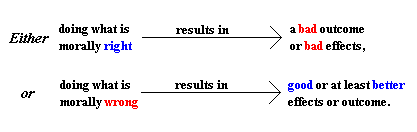
An ethical dilemma forces you to choose a solution you do
not entirely like. Hence the dilemma: If doing what is
right produces something bad, or if doing what is wrong
produces something good, the force of moral obligation may
seem balanced by the reality of the good end. We can
have the satisfaction of being right, regardless of the
damage done; or we can aim for what seems to be the best
outcome.
(source: http://www.friesian.com/dilemma.htm)
Assuming that you had all of the time in the world to
resolve an ethical dilemma, how could you make an informed,
logical decision? A possible course would include asking who
would be helped and who would be harmed. Also to what degree
would they be helped or harmed? What if the harm were a
broken finger nail?
We can probably agree that a broken finger nail is
less harmful than a broken arm.
Saving someone’s life is a few degrees higher than
bandaging his or her knee.
What will be the consequences of your actions in the long
run as compared to the short run? Long term positive
consequences are more desirable than short time positive
consequences.
Would actions be likely to engender feelings of guilt?
Dishonesty? Cowardliness? Insensitivity? Disloyalty?
Unscrupulousness? Inhumanity?
Remember, negative, self-deprecating emotions are
also injurious.
Use this model to decide on a course of action for Oscar as
he sees the runaway train rambling toward him at breakneck
speed, with an unconscious engineer at the wheel.
After you resolve Oscar’s problem lets look at a law
enforcement ethical decision.
Various student and colleague answers to this question are
in the index.
Case Study
A rookie police officer smelled alcohol on his partner's
breath as he entered the squad car at the beginning of the
shift. The senior officer admitted he drank one glass of
wine with dinner but insisted that he could drive safely. To
avoid a confrontation, the rookie did not protest. Shortly
thereafter, the squad car driven by the senior officer
collided with another vehicle. The driver of the other
vehicle died 3 weeks later from the severe injuries
sustained in the accident. The traffic officer investigating
the accident smelled alcohol on the senior officer's breath
but did not report this fact nor did he ask the senior
officer to take a breath test. A subsequent lawsuit alleged
that the senior officer caused the accident because he drove
under the influence of alcohol. During the internal affairs
inquiry, the rookie faced a high-stakes ethical dilemma,
tell the truth or lie to protect the senior officer. Because
the rookie failed to take action when he encountered his
first ethical dilemma, he struggled with an even greater
ethical quandary. If the rookie lies, he gains immediate
trust and acceptance from fellow police officers. If the
rookie tells the truth, he risks alienation and the
possibility of administrative action.
Discussion:
-
What do you think should be done?
-
What would you do?
-
On what do you base your decision?
-
What if your decision is unpopular
-
What do you think the average officer would do?
This is a great opportunity for students to question their
beliefs about integrity. A discussion in small groups would
be especially helpful. This is one of the controversial
subjects to which I refereed in another chapter.
Unfortunately, some students will not be entirely truthful
when answering the questions.
However, the exercise still gives those students an
opportunity to learn to think in a more critical and ethical
way.
Ethical conflict is created when we ask ourselves four
questions. What Should I do? What will I do? How will my
decision affect my future? How will my decision affect other
people? I think the conflict also asks, “What would others
think of me if they knew my decision?” These last two
questions include many subtle sub-questions, such as, “How
will my character and my self-respect be affected if I do
the popular thing?” Will I like myself?
“Will I lose my reputation as a “good” (one of the
guys) cop if I chose the unpopular decision?” “What will my
wife/husband think about me?”
Rules Based Theory
This model of decision making is relatively easy to
understand. It simply says, “Follow the rules.” You know the
rules, because we have already covered them.
Using this model you refer to the rule that coverers
the specific behavior you are considering.
If we use our case study as an example, you will find some
help if you look under the first “I Will” at the bottom of
the IACP Ethical Standards for Law Enforcement.
It reads:
… I will be exemplary in obeying the laws of the land and
the regulations of my department.
If the senior officer was impaired, as it appears that he
was, he has broken the rule, I
will be exemplary in
obeying the laws of the land, and thereby “the law.” It
is unlawful to drink and drive.
Also, rule 1.4 under the IACP Ethical Standards says:
-
1.4
--Police officer, whether on or off duty, shall not
knowingly commit any criminal offense under any laws of
the United States or any state of local jurisdiction in
which the officer is present, except where permitted in
the performance of duty under proper authority.
In
addition, rule 2.6 requires officers to report violations of
law or policy. Therefore, according to this rule the rookie
is required to report his senior officer even if an accident
had not occurred.
-
2.6
Police officers learning of conduct or observing conduct
which is in violation of any law or policy of this
Department shall take necessary action and report the
incident to the officer's immediate supervisor, who
shall forward the information to the Chief of Police. If
the misconduct is committed by the officer's immediate
supervisor, the officer shall report the incident to the
immediate supervisor's supervisor.
Rule 4.1 specifically address drinking on duty or in
uniform.
-
4.1
Police officers shall not consume alcoholic beverages or
chemical substances, while on duty, except as permitted
in the performance of official duties, and under no
circumstances while in uniform, except as provided for
in Rule 4.3 below.
In this case, the rules defined what behaviors were or would
be ethical. In
summary,
·
Drinking on duty and/or in uniform is unethical
·
Breaking the law is unethical
·
Failing to report unethical or illegal behavior is unethical
The rookie may still choose unethical behavior, nonetheless
he would, after reviewing the ethical rules, know that his
decision and behavior were unethical.
A mentor with strong ethical values would be
invaluable to this new officer as he/she struggled to make a
choice.
Critical Thinking and Ethical Decision Making
Here is a very simple model of a decision tree used in
critical thinking:


Decision trees allow you to enter data (information) and
plot paths and dead ends. As you see, in the drawing above,
we have a frog on a lily pad. Our frog is attempting to
capture his supper.
The satellites tell us everything we need to know
about frogs.
Many lines radiate from the central “issue,” in this
case—frog. You will also notice that lines connect some of
the satellites. Tadpoles also live in ponds and ponds have
lily pads. In
addition, you were told that frogs are amphibians and they
are related to salamanders.
In a formal decision tree the sign for a decision is
the rectangle and the sign for a chance event is the circle
without the smiley face.
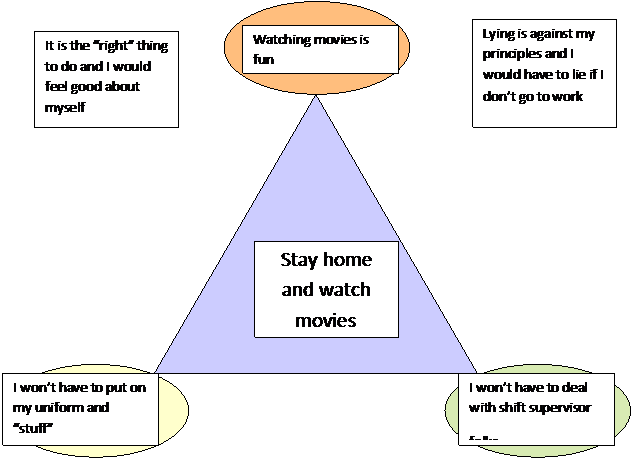
 Let’s
use a very simple example of a modified decision tree.
What if Officer George is trying to decide whether to
say home from work and watch movies or get dressed and
equipped and work his shift?
Let’s
use a very simple example of a modified decision tree.
What if Officer George is trying to decide whether to
say home from work and watch movies or get dressed and
equipped and work his shift?
Work the Shift Diagram:
|
|
If I go another
officer won’t have to work in my place
|
|
Stay home and watch movies Diagram:
|
|
|
|
|
|
Work my shift as assigned
|
|
|
|
|
Though these simple diagrams provide only three reasons in
favor of each decision, this decision making tool hits the
important points for Gomez.
Naturally, he can make the diagram as large (as many
variables) as he needs it to be. Officer Gomez may be able
to make his choice based on the two diagrams.
In other words, which set of reasons are most
important to him. If he cannot, then he may need to add more
reasons. Or, he can add weight to each reason.
Weight shows how important that particular reason is
to Gomez. The weights are:
5
most important
4
very important
3
moderately important
2
slightly important
1
not important
Decision Weighted Chart
Go to Work
Stay Home and Watch Movies
I won’t have to lie (5)
I won’t have to put on my uniform (3)
It is the right thing to do (5)
I won’t have to deal with supervisor (4)
Another office will not have
Watching movies is fun (1)
work in my place (4)
Total 14
Total 8
It looks as he is going to work. Good choice, Officer.
Personal Standards
Every officer will have his or her personal standards
of behavior. He
or she will base decisions on those standards.
However, using the IACP ethical code and asking his
or her mentors for advice in making professional decisions
if a more objective and ethical guide.
Ethical Puzzle
The ethical puzzle is another way of looking at decisions
(still using the above ethical guide).
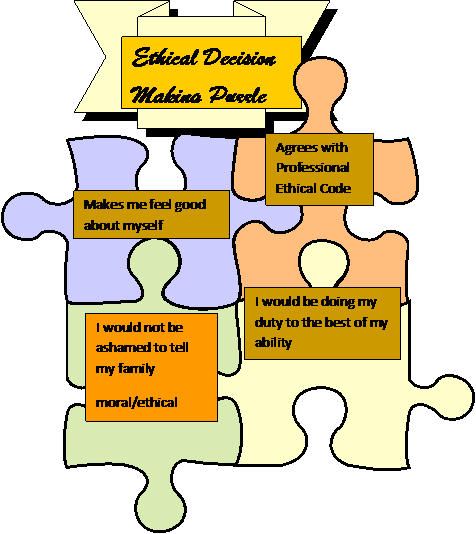
If any of the pieces of the ethical puzzle are missing, it
may not be an ethical decision. Ethical
decisions generate and sustain trust; demonstrate respect,
responsibility, fairness and caring; and are consistent with
good citizenship. If we lie to get something we want and we
get it, the decision might well be effective, but it is also
unethical.
If Possible, Take As Long As You Need
Sometimes an ethical answer to a question requires time.
Often with subsequent information we regret our actions but
we also realize that we make decisions with the information
available at the time. If the decision does not need to be
made immediately, then take the time to evaluate the
variables and gather adequate information before you act.
Ask yourself, “Have I given my proposed action enough
reflection and do I feel confident about the outcome?”
Three More Ways to Make a Decision
If I was Transparent
When making a tough decision, ask yourself what you would do
if all parties involved knew your true intentions and your
true desires.
Imagine you lived in a world where everyone could tell if
you were speaking the truth, or lying, or hiding something.
What actions would you take then?
My Obituary
If you were at the end of your life and you must decide on a
message for your tombstone. You decide that you want
everyone to know what had been most important to you in your
life. Therefore
your values will be written on the tombstone for God and
everyone to see. What would be written? Would your behavior
be congruent with your values?
Plan C
You have been anguishing over whether you should choose plan
A or plan B and you cannot come to a decision. Perhaps there
is a plan C that would work better for you. Spend some quiet
time thinking about a third course of action.
Recognizing the Moral Dimension
The
only tyrant I accept in this world is the ‘still small
voice' within.—Mahatma
Gandhi
The
first step in ethical decision making is recognizing the
decision as one that has moral importance. Important clues
include conflicts between two or more values or ideals.
This decision making process can be used by law
enforcement officers and instructors.
-
Who are the interested Parties? What are their
relationships?
arefully identify who has a stake in the decision. In this
regard, be imaginative and sympathetic. Often there are more
parties whose interests should be taken into consideration
than is immediately obvious.
Look at the relationships between the parties. Look
at their relationships with yourself and with each other,
and with relevant institutions. Do those relationships bring
special obligations or expectations?
-
What Values are involved?
Think
through the shared values that are at stake in making this
decision. Is there a question of trust? Is personal
autonomy a consideration? Is there a question of
fairness? Is anyone to be harmed or helped?
-
Weigh the benefits and the burdens
Benefits
– are rewards or behaviors that create positive emotions or
take away negative emotions.
Burdens might include causing physical or emotional pain to
various parties, imposing financial costs, and ignoring
relevant values. Burdens normally create negative emotions.
Can
you think of other similar decisions? What course of action
was taken? Was it a good decision? How is the present case
like that one? How is it different?
-
Discuss with relevant others
The merits of discussion should not be underestimated,
because we can talk ourselves into doing something which is
not in our best interest.
Logic and ethics can be sacrificed to emotional
thinking. A trusted “other” will question us about important
considerations and self delusion.
Time permitting; discuss your decision with as many persons
as have a stake in it or are trusted advisors. Gather
opinions, and ask for the reasons behind those opinions.
Remember that your ability to discuss with others may be
limited by the other person’s expectations of
confidentiality and their ability to make ethical decisions.
-
Does this Decision Accord with Legal and Organizational
Rules?
Some
decisions are appropriately made based on legal
considerations. If one option is illegal or unethical, we
should think very
seriously before taking that option.
Normally, the consequences of illegal behaviors are
dangerously high.
Decisions should also be affected by rules set by your
agency and the organizations that set ethical guidelines for
police officers.
My basic principle is
that you don't make decisions because they are easy; you
don't make them because they are cheap; you don't make them
because they're popular; you make them because they're right—Theodore
Hesburgh
Am I Comfortable with this Decision?
Sometimes
your “gut reaction” will tell you if you have missed
something. There will be that nagging little voice that
says, “If you do this you will be very, very sorry.”
Questions to be asked in this regard might include:
1) If I carry out this decision, would
I be comfortable telling my family about it? My clergyman?
My mentors?
2) Would I want children to take my behavior as an example?
3) Is this decision one which a wise, informed, virtuous
person would make?
4) Can I live with this decision?
(Source: Inspired by Chris McDonald, 2002, A Guide to Moral
Decisions)
Summary
There are no easy answers for ethical decisions. However,
the path less traveled is normally the moral high road.
Several guides to making ethical decisions are included in
this chapter. Perhaps, you did not see one that worked for
you. In that case more reading may be necessary.
Recommended Reading
A Guide to Moral Decisions, Chris McDonald, 2002
Ethical Dilemmas and Decisions in Criminal Justice, Joycelyn
Pollock, 2006
Making Ethical Decisions, Michael, Josephson, 2002
< <
jump to the policetraining.net home page



