|

|
|

May
2015
Important: To ensure future delivery of
the Policetraining.net newsletter to your inbox (not bulk or junk folders)
please add our "From" address
info@policetraining.net to your address book or e-mail whitelist.
|
- Sponsored By -
|
|
 |
|

Essential Fitness
|
Reprinted from
Calibre Press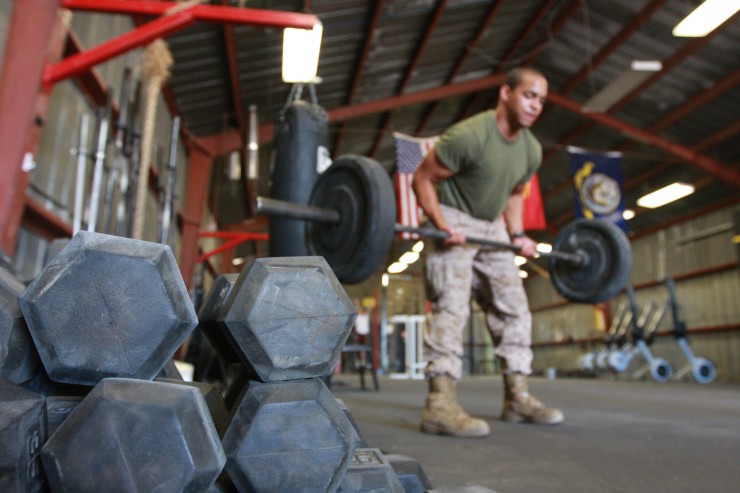
In 2001, I was fresh out of the South Bay
(Calif.) Regional Police Academy with my Field Training
Officer (FTO) Program behind me. I was ready to hit the
street. Or so I thought …
Within one week of being a “solo deputy” with the Santa Cruz
County Sheriff’s Office, I got my ass handed to me in a
fight. Good thing my former FTO arrived on scene to
help subdue the suspect. I told my FTO it felt like I’d been
breathing through a straw, that my muscles were moving in
slow motion, and that it felt like I was about to die.
Although I prided myself on being physically fit, this
experience showed me that something was missing. I knew I
needed more—something entirely different. A new way of
training my mind, body and spirit to ensure my victory on
the street against the unknown and unknowable threats to a
law enforcement officer.
Shortly after the “fight for my life” I heard a rumor
circulating through the Brazilian Jiu Jitsu community of
Santa Cruz about a little gym with some hardcore workouts. I
found the phone number to the gym, called “CrossFit,” and
dialed none other than Greg Glassman, the founder of
CrossFit. Glassman invited me to try a workout the next day.
Following my first workout, I knew I’d found the Holy Grail
of fitness. From the moment the workout started, to the
moment I crumbled into a heap on the gym floor, it felt like
I was on the street, fighting for my life. I intuitively
knew the more often I subjected myself to the feeling of
entering a fight, and coming out the other side victorious,
the better I would be. The training was giving my mind and
body the winning edge, and I knew it.
Within a few months of training with Coach Glassman, friends
from San Jose Police Department started to join me at 6:00
a.m. for the workouts. I’ll always remember the interesting
chain of events that started to unfold one morning.
A professional soccer player had joined the 6:00 a.m. crew
for a workout. The soccer player asked Coach Glassman if he
needed special programming for his sport. Coach said
“Yes, you need to do thrusters and pull-ups.” (A “thruster”
is a traditional and original CrossFit movement, involving a
full front squat into a press, usually performed with
a weighted barbell.) The soccer player was excited that he’d
received this “special programming” from Coach Glassman.
Later on, a similar interaction took place, this time with a
professional basketball player. Once again, the “secret
programming” that Coach Glassman prescribed was
“thrusters and pull-ups.”
After hearing this advice for both the soccer and basketball
player, I decided to ask Coach if, as a cop, I needed
special programming. “Hey Coach, what should I do? Let me
guess: thrusters and pull-ups, right?”
Coach looked at me and said, with the utmost seriousness:
“Yes kid, you need to do thrusters and pull-ups also. But
unlike those soccer and basketball players, you need to
go as hard as you can, every single time. You need to train
like your life depends on your fitness, because it does.”
Those words stuck with me, and to this day, every time I
train, my mindset is this: This is my last workout before
the fight for my life. If I win here, I can win anywhere.
Are you training with that level of commitment? Train hard
today, my friend. Train as if your life depends on it
because, I can tell you, it does.
Greg Amundson
Greg Amundson, the CrossFit Law Enforcement Liaison, is a
graduate of U.C. Santa Cruz, the U.S. Army Officer Candidate
School, South Bay Regional Public Safety Academy and the DEA
Federal Academy. He started his CrossFit training in Dec.,
2001, at the original CrossFit Headquarters gym in Santa
Cruz, Calif., where he was coached and mentored by CrossFit
founders Greg and Lauren Glassman for over seven years. He
is a frequent contributor to the CrossFit Journal, teaches
at the CrossFit Level-I Certificate Course and CrossFit
Kettlebell Trainer Course, and is the founder and lead
instructor of the CrossFit Goal Setting Course and the
originator of the apparel company Firebreather Athletics. He
serves as an adjutant instructor for Krav Maga Worldwide on
the FORCE Training Division for Military and Law Enforcement
Combatives and is the owner and Lead Instructor of Krav Maga
Santa Cruz. Greg’s contributions to CrossFit and the law
enforcement community have been chronicled in the
bestselling books Inside The Box and Learning To Breathe
Fire. Greg has also been featured in Podcasts with Mark
Divine from SEALFIT and Kenny Kane from the Positivity
Project. He is also the author of the international best
selling book Your Wife is NOT Your Sister. Greg served in
state and federal law enforcement for over fourteen years.
Greg served in numerous capacities, including SWAT with the
Santa Cruz County Sheriff’s Office and Drug Enforcement with
the Drug Enforcement Administration (DEA) on the Southwest
Border. Greg was the DEA Liaison to the highly regarded
Border Enforcement Security Task-Force (BEST) Team. Greg
also served as a U.S. Army Captain in numerous capacities,
including as a TAC Officer (Teach–Access–Counsel), where he
instructed combatives, fitness and leadership at the U.S.
Army Officer Candidate School at Camp San Luis Obispo, CA.
In October 2012, He continues to serve as a Reserve Peace
Officer in Santa Cruz, CA
|
|
Fitness Tip from

Improve anaerobic conditioning while providing variation to your
workouts with strongman events like the tire flip.
Click here
for tips on how to perform safely and effectively as well as for
some suggested variations.
Addressing the Suspect's Behavior
By John Reid &
Associates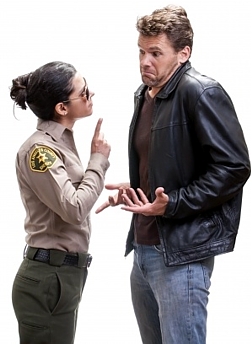
(Please Note: If you wish to print and share an Investigator Tip
with your colleagues, the John E. Reid 'credit and permission'
statement following the article must be included.)
It is human nature to cite a person's behavior as evidence to
support some underlying premise. It is an enticing argument to state
that because one exhibits an observable behavior it is proof of some
consequent conclusion. Consider the following examples of reaching
conclusions based on observed behavior:
"If you were in proper shape you wouldn't be huffing and puffing the
way you are."
"I could tell by the way you two were looking at each other that it
was love at first sight."
"You're really quiet tonight. Something's got to be bothering you."
"You can't even look at me when you answer my questions. What are
you not telling me?"
"Why are you smiling? Do you think this is funny?"
"Only guilty people run from the police!"
This web tip is not about interpreting another person's observed
behavior, but rather whether or not it is appropriate or productive
to bring a suspect's attention to his or her observed behavior.
During the course of a typical interview or interrogation, an
investigator has many opportunities to openly address the suspect's
behavior. Some of these efforts will be productive and lead to
developing additional information or even a confession. In other
instances, this same tactic may cause a suspect to resent the
investigator or to psychologically withdraw, resulting in
non-cooperation and an unsuccessful resolution of the investigation.
The following are guidelines as to when it is appropriate to address
the suspect's observed behavior:
Guideline #1 Addressing a suspect's behavior to draw out observed
emotions or physical condition is often productive.
It is critical for an investigator to seek out the underlying cause
of emotions or other observed physical conditions during an
interview. Therefore, it is entirely appropriate to specifically
address a suspect's apparent distress, fatigue, anger, or
resentment. An exception to this rule is nervousness or anxiety
which will be addressed later. Examples of addressing a suspect's
emotions or physical condition include:
"I can see that you are upset and I'm sorry to have to ask you these
questions but you need to understand that I have a job to do and
that this is not at all personal."
"You seem angry. Why are you upset?"
"Is that you're stomach growling? When is the last time you've
eaten?"
"You seem tired. How much sleep have you had in the last 24 hours?"
Guideline #2 During an interview it is appropriate to address the
suspect's apparent uncertainty.
A suspect's uncertainty may be revealed by a delayed response, a
shoulder shrug, eyes looking up to the ceiling or a decrease in
volume. These behaviors do not mean that the suspect is necessarily
lying, but rather is uncertain of his answer. Therefore it is often
beneficial to address these observed behaviors as the following
examples illustrate:
(1) "You seem a little uncertain. Let me explain that our
investigating will continue and we will be looking at all sorts of
forensic and testimonial evidence. It's really important that
everything you tell me today is consistent with what other evidence
shows. With that in mind, let's go back over this area one more
time..."
(2) "It is apparent that you're not telling me everything you know.
Your silence may make this thing last a lot longer than it has to
and it could cause innocent people to be hurt. Please, tell me
everything you know."
Guideline #3 It is appropriate to address the suspect's use of
memory or omission qualifiers.
There are many words used within a response that qualify or modify
the meaning of the statement. Examples include memory qualifiers
such as, "To the best of my knowledge," or omission qualifiers,
"generally", "as a habit", or "typically." An investigator should
not bring up the suspect's use of qualifiers as an indication of
guilt or deception, but rather that the suspect's use of these
phrases implies something that requires clarification. For example:
Q: "Did you fight with your wife that night?"
R: "We rarely fought."
Q: "When you say that you rarely fought it tells me that you have
fought on occasion. What did you two usually fight about?"
Q: "Did you have sexual contact with your niece?"
R: "As far as I remember I didn't have that kind of contact with
her."
Q: "So you're not completely sure. What is the probability that you
did have some sexual contact with her? ... 95%... 90% ... what do
you think?"
Guideline #4 It is appropriate to bring factual inconsistencies to
the suspect's attention.
There may be innocent explanations for inconsistencies between a
suspect's statements and other information and it is absolutely
appropriate to offer a suspect the opportunity to offer an
explanation for the inconsistency. Two examples of this include:
(1) "You told me that you didn't leave your office on January 12th.
I have a credit card charge on your Visa account indicating a $15.34
purchase at 12:33 that afternoon at a restaurant 4 miles from your
office. When did you leave your office that day?"
(2) "Last week you told me that you didn't recognize the photo of
this woman. This woman's name is Sue Grahams. Sources tell me that
you dated Sue Grahams on several occasions. When is the last time
you've seen Sue?"
Guideline #5 During an interrogation it is often productive to
comment on the suspect's observed behavior and use the suspect's
behavior as an indication that the suspect is ready to tell the
truth.
In an effort to persuade a suspect to tell the truth it is often
effective to comment on the suspect's observed behavior because the
suspect is aware that, in fact, he is engaging in the behavior cited
by the investigator. Some examples of this include:
(Observed tears or crying) "Jim, those tears tell me that you care
about this thing and want to get it resolved. For a while there I
didn't think you cared about anything, but I see I was wrong. Let's
put this whole thing behind you..."
(Suspect is silent and appears withdrawn) "Mike, I can tell from
looking at you that this has been bothering you for a long time.
Your silence tells me that you are debating whether or not to tell
the truth. Let me just ask you. What is the worst thing that could
happen to you if you told me the truth today?"
Guideline #6 Do not specifically address a suspect's apparent
nervousness during an interview.
Both innocent and guilty suspects may appear to be initially nervous
during an interview. Under this circumstance the suspect may offer
little eye contact, exhibit a tremor, frequently clear their throat
or speak quietly. While it is appropriate to extend the period of
time establishing rapport with such a suspect, it is inappropriate
to specifically address their nervousness with statements such as,
"I can see you're nervous - what are you afraid of?" or, "If you're
innocent you have nothing to be nervous about." The reason for this
is if an innocent suspect's nervousness is brought to their
attention, directly or indirectly, often this has the effect of
increasing the suspect's level of anxiety which can result in
misleading behavior symptoms, poorer recall and less information
learned during the course of the interview.
A much more effective response to a clearly nervous suspect is for
the investigator to sit back in his chair, reflecting a relaxed
posture, and start the interview by engaging in several minutes of
casual conversation, allowing the suspect to talk about safe topics
that give him/her a sense of control and, physiologically, the
somatic behavior of talking relieves anxiety. Once the investigator
observes that the suspect appears more comfortable within the
interview environment questions relating to the issue under
investigation can be asked.
Guideline #7 Do not mention the suspect's use of bolstering phrases
or poor eye contact as evidence of his guilt.
An innocent suspect who is interrogated concerning a crime he did
not commit certainly may bolster his denials in some manner. After
all, the investigator is not accepting the denial as the truth so
the suspect feels the need to reinforce his denial. Similarly, there
are many causes for innocent suspects to exhibit poor eye contact
when answering an investigator's question. To comment on the
suspect's lack of eye contact often increases the suspect's feelings
of guilt and helplessness which results in less communication and
poorer eye contact. Neither of these responses are typically
productive, as the following examples illustrate:
S:" I swear - honestly I didn't do this!"
I: "Only guilty suspects swear they didn't commit the crime. Stop
lying to me!"
S: "I want an attorney."
S: "I'm telling you the truth! (break of gaze)
I: "You can't even look me in the eye when you deny doing this. How
do you think that's going to look to a jury?" [The suspect spends
the rest of the interrogation staring at the investigatory and says
nothing.]
Guideline # 8 Do not use the suspect's nonverbal or paralinguistic
behaviors as evidence of his guilt.
The statements, "Your crossed arms tell me that you were involved in
this thing!" or, "You know what your laugh is called? It's called
erasure and it is used by suspects who lie!" are unlikely to cause a
guilty suspect to blurt out a confession. In response to comments
like these it is much more likely that the guilty suspect will
either withdraw and remain silent for the rest of the interrogation
or overcompensate and spend the rest of the interrogation leaning
forward toward the investigator in an aggressive posture. In either
event, by bringing the suspect's attention to his "deceptive"
behavior certainly has not made it easier for the suspect to tell
the truth and is, therefore, counterproductive.
In conclusion, social learning teaches us that addressing another
person's observed behavior can be an effective persuasive or
empathetic technique. However, there are occasions when the tactic
backfires and causes a person to be more withdrawn and less
cooperative. It is often productive to use this tactic to elicit
information about the suspect's general well-being, uncertainty or
explanations for inconsistencies. Conversely, it is often
counterproductive to use this tactic in an effort to elicit a
confession by bringing to the suspect's attention his apparent
"deceptive behavior." Consider the following as a basic guideline:
bring the suspect's behavior to his attention to develop rapport and
learn information but do not use this tactic as leverage to induce a
suspect to confess. Credit
and Permission Statement:
Permission is hereby granted to those who wish to share or copy this
article. In those instances, the following Credit Statement must be
included "This Investigator Tip was developed by John E. Reid and
Associates Inc. 800-255-5747 / www.reid.com."
Inquiries regarding Investigator Tips should be directed to Janet
Finnerty jfinnerty@reid.com.
|
|
