Disturbing Video of Suspect Crashing into Patrol Vehicle. Officer is Thankfully OK.

HUMAN FACTORS:
Threat & Error Management
RESEARCH STATISTICS REVEAL THAT OVER 85% OF ALL PRIMARY
CAUSE FACTORS IN MISHAPS ARE RELATED TO HUMAN ERROR.
Human Factors
training provides participants with a key set of individual
and team-based risk management skills and strategies that
have been developed to reduce human error and enhance
teamwork in high-risk settings. Your organization can use
these proven strategies to effectively reduced negative
incidents and mishaps which can lead to a significant
reduction in litigation and associated expenses.
The program is essential in developing an
understanding of the nature of human behavior with respect
to error and emphasizes a
pro-active response to error discovery and/or threat of
human error within an organization.
Designed for
both management and line employees.
RELEVANT FOR A BROAD RANGE OF LAW ENFORCEMENT AND
NON-LE PROFESSIONALS INCLUDING:
Sworn Officers
Dispatch
SWAT
Critical Incident Teams
Rangers
Police Psychologists
Internal Affairs
Police Trainers
Administration
Fire
EMTs
Aviation Crews
Participants learn how to apply the principles of TEM to
predict and identify human error potential encountered in
law enforcement, military and aviation operations, and
emergency situations.
Topics of discussion include Organizational Culture, The
Human Factor, Stress and Performance, Fatigue, Decision
Making, Effective Communications in High Stakes Situations,
and Leadership Skills.
Tuition ranges from $205 to $250 depending on location.
CA POST PLAN 3, fully reimbursable, #1095-10801-15005, and
STC Certified, #8803-072916
COURSE LEARNING OBJECTIVES:
Leading Human Performance Analyst, Craig E. Geis, (LTC.
Ret.) MBA, MA, is Co-Founder of California Training
Institute and director of curriculum development and
training. Craig has extensive background in risk management
and Human Factors Threat & Error Management. LTC. Geis was a
career army pilot, developed the military's Crew Resource
Management (CRM) training program to address human error,
and is a former instructor for the U.S. Military Academy at
West Point, Embry Riddle Aeronautical University, University
of Maryland, and the University of San Francisco. He has
served as an Associate Professor at the University of
Southern California, providing instruction in numerous
courses on Safety Management and Human Factors. Craig holds
an M.A. in Psychology from Austin Peay State University, a
B.A. in Management from C.W. Post College in New York, and
an MBA in Management from Georgia Southern College. At the
time of his military retirement, Lt. Col. Geis was the US
Army's Lead Safety Specialist in Aviation Human Factors.
CA POST PLAN 3, fully reimbursable, #1095-10801-15005, and
STC Certified, #8803-072916 Homeland Security Grant Program funds may be available to cover registration, travel, lodging, per-diem, and over-time. https://www.dhs.gov/state-homeland-security-and-emergency-services to find your state representative.
Interrogation Themes: 5 Strategies for Selecting Interrogation Themes March-April 2016 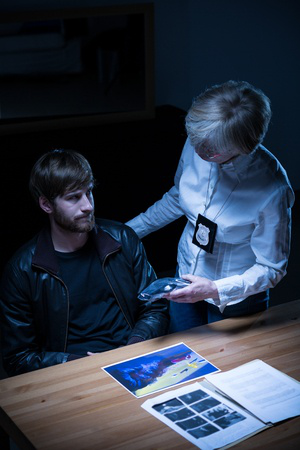 (Please Note: If you wish to print and share an Investigator Tip with your colleagues, the John E. Reid 'credit and permission' statement following the article must be included.) by Louis Senese Identifying the most effective arguments to present to a suspect during an interrogation will help you elicit the truth A frequent question I'm asked by cops during my interviewing and interrogation training programs is, "What if I'm using the wrong interrogation theme?" This is often followed by, "How do I change themes? And if I'm using the wrong theme, won't the suspect know that I'm not sure that he committed the crime?" Answer: No. In the course of your interrogation, the suspect's responses will help you choose your themes. Strategies for interrogation theme selection include:
The following scenario is based on an actual case. Jacob, age 26, babysat his 25-year-old girlfriend Sophia's 4-year-old daughter, Isabella. At the last minute, Sophia asked Jacob if he could watch Isabella that evening because her mother just called to say she couldn't babysit. He agreed and arrived moments later at 1700 hours, and Sophia immediately left for work. She returned at about 2300 hours from waitressing, and Isabella was sleeping. The next morning, Isabella told her that Jacob gave her a bath because she wanted to play with her toys in the bathtub. Isabella then said, "Mommy, when Jacob gave me my bath, he kept putting his finger in and out of my pee-pee hole and asked me how it felt. It was a long , and it hurt. Why did he do that, Mommy?" Sophia talked to Jacob, and he admitted giving Isabella a bath for the first time, but denied ever inserting his finger in Isabella's vagina. Sophia reported this incident to the police. Following the theme selection strategies listed above, there are more than 10 probable themes for the interrogation of Jacob. These theme approaches will be italicized in the following text. Case Facts Theme Analysis A sexual act occurred between an adult and a 4-year-old girl. The victim knew the suspect and acknowledged that this was the only time he did this to her. We will use the one time vs. many times as a theme and also suggest that it was more spontaneous vs. planned, as the suspect was asked by the mother to babysit the child on short notice. Additionally, we could further minimize the behavior by acknowledging that the suspect did not initiate the act, since the victim asked for a bath. Interview Theme Analysis During his interview, Jacob denied committing the act - but when asked, the key Reid behavior-provoking questions his responses were as follows:
Further, contrasting removing his finger within a minute when she said it began to hurt and not keeping it in for 30 minutes demonstrates that he realized his mistake. Also, the investigator can contrast the subject inserted his finger only partially vs. all the way. Common Sense Theme Analysis In this case we could shift the blame to his girlfriend for asking him at the last moment to babysit. We could also blame the victim for asking him to bathe her -- something he has never done before, thereby further suggesting the act was spontaneous and motivated by curiosity. Prior Similar Case Theme Analysis The investigator can establish his credibility by relating this situation to prior comparable cases. Ideally, the investigator should present similar but much more serious cases to the suspect. This serves to minimize the offender's conduct and show that it is not unique. Training and Education John E. Reid and Associates has been presenting this training throughout the world since 1974, and our text, "Criminal Interrogation and Confessions," has been cited twice by the U.S. Supreme Court in the context of proper interrogation procedures. Together with tactical training at the department level, the Reid educational protocol provides a level of competence to the law enforcement professional upon which each officer can confidently rely when formulating and executing an interrogation strategy, including theme selection. At every training program I am approached by cops who say that after viewing our interrogations, "I now see where I made my mistakes and should have gone the other way." Another comment I always hear is, "I wish I had this training earlier in my career." Conclusion It is generally not one theme that the suspect needs to hear but a variety-- all of which tap into a collection of elements or unique circumstances relating to the crime. By following the theme selection strategies described above, the investigator is able to identify the most effective arguments to present to a suspect during an interrogation to elicit the truth. We are always observing our suspect's verbal, nonverbal and paralinguistic behavior to assist our evaluation of which among the themes seems to strike a positive chord with the suspect. That observation, in turn, guides the investigator to further develop that theme. When transitioning from one theme to another, say to the suspect, "And another reason I'm talking to you is because I also think this happened because ..."and introduce the next theme. Presenting multiple relatable themes creates an emotional environment that simultaneously: a. Validates the improper behavior, and b. Suggests a variety of psychologically -- yet not legally -- acceptable rationalizations that allow a perpetrator to save face while admitting the truth. In this case, the suspect admitted the act, and when asked, drew an outline of his hand on paper, identified what finger he used and drew a line on it to show how far it was inserted, then signed the sketch. About the author Louis C. Senese, Vice President of John E. Reid and Associates, Inc. and has been employed at the firm since 1974. He received his BS in business from Northern Illinois University and his MS from Reid College. Lou has personally conducted in excess of eight thousand interviews and interrogations and has testified in federal and state courts as well as employment hearings. Credit and Permission Statement: Permission is hereby granted to those who wish to share or copy this article. In those instances, the following Credit Statement must be included "This Investigator Tip was developed by John E. Reid and Associates Inc. 800-255-5747 / www.reid.com." Inquiries regarding Investigator Tips should be directed to Janet Finnerty jfinnerty@reid.com.

Looking for new tools for functional training? This video shows a variety of functional training exercises that can be done with tools such as the ViPR, sandbags, or even a bar.
When your Partner Becomes a Hostage
|


