|

|
|

April
2015
Important: To ensure future delivery of
the Policetraining.net newsletter to your inbox (not bulk or junk folders)
please add our "From" address
info@policetraining.net to your address book or e-mail whitelist.
|
- Sponsored By -
|
|
 |
|

PoliceOne Announces PoliceOne Academy Version 2.0!
By PoliceOne Academy Staff
Everyone at PoliceOne is pleased to announce the imminent
release of Version 2.0 of the PoliceOne Academy, scheduled to
become available to agencies and officers on March 20, 2015.
Version 2.0 features an upgraded user interface which is more
mobile-friendly for devices like the iPhone, iPad and Android
devices. Agencies can now upload policies and verify officers
have read and reviewed those documents. This has been one of the
most-requested features since the Academy launched.
Over 25,000
officers and 500 departments take advantage of more than 750 HD
training
videos and 125 full-length courses available to them from the
Academy, which is accepted
for training credit in 32 states.The PoliceOne Academy enables
agencies to deliver cost-effective, high-quality training to
officers in an on-demand online environment. The Academy team
believes a well-trained department is a safer, more effective
department.
http://www.policeoneacademy.com.
Feeling the Burn?
|
3 tips for treating (or avoiding) FTO burnout
By Daniel Greene
Reprinted from Caliber Press
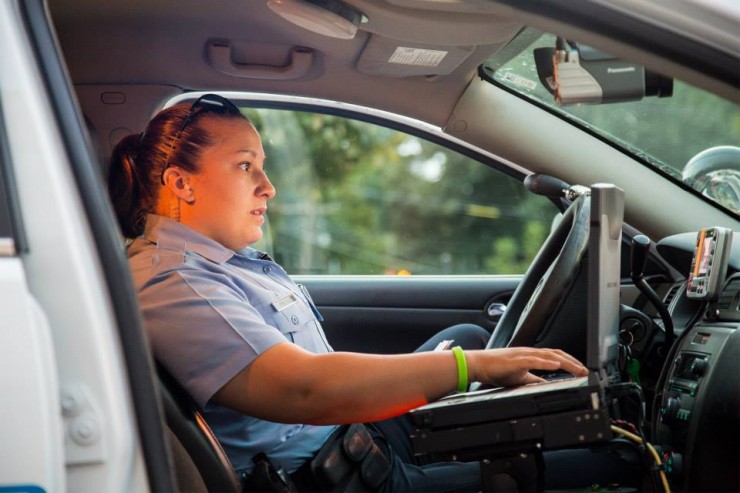 The role of field training officer is one of the most important assignments there is at any agency. FTOs, on behalf of the department, share their knowledge and skills with the incoming generation. They have first crack at developing the culture, attitude and work ethic of a young police officer. The role of field training officer is one of the most important assignments there is at any agency. FTOs, on behalf of the department, share their knowledge and skills with the incoming generation. They have first crack at developing the culture, attitude and work ethic of a young police officer.
It’s a role that must not be taken lightly, and it’s no surprise to say that most FTOs don’t take it lightly. In fact, most FTOs take their responsibilities very seriously. In the year 2000, the National Institute of Ethics completed what was at the time the nation’s largest study of ethical standards inside law enforcement. They found that the FTO was the most frustrated officer in the department.
Frustrated, angry and burned out, the FTO hits the road with their new and easily influenced police officer. This paints a gloomy picture, in so far as it’s accurate today. The good news is that the FTO can also be repaired. Following are three things the FTO and FTO manager can do to help avoid—or fix—FTO burn out.
Prepare them for success: According to the August 2013 edition of Police Chief Magazine, almost 55% of FTOs surveyed described their preparation and training as a newly appointed FTO as “marginal or non-existent.” That’s a big fail for their agencies. We all want the FTO to be highly trained and equipped to handle their new role as trainers, mentors, coaches and role models. The newly appointed FTO enters his or her new specialty with promise and capability. They should be given the resources and training necessary to be successful.
Never assume that the FTO is a natural born leader. None of us are. Enroll your new FTO into a basic FTO School. Find a school that covers topics like adult learning, generation studies, ethics and liability. The long-term success of the FTO can very well depend on the training they receive as rookie trainers.
Document, document, document: The same Police Chief Magazine article cites the number #1 most frustrating challenge to the FTO is “lack of administrative support.” It’s been my experience that lack of support from your chain of command usually sounds something like this, “We just don’t have the documentation to support …” If you’ve heard that before you’ve likely been disappointed and felt let down by your command staff.
My best advice on conquering this challenge is to eliminate that excuse. Beef up your documentation and strengthen your daily observation reports. Be sure that your performance evaluations include details on the trainee’s deficiencies, details on the training tips and techniques you’ve offered the OIT as well as any kind of extended remedial training they’ve received. Don’t forget to include examples of positive reinforcement and coaching. Including both of those things will help reassure your command that the program’s number first goal is the trainee’s success.
Find your real motivation: “When people of action cease to believe in a cause, they then begin to believe only in the action.” An unknown French philosopher was given credit for that quote. It rings very true with me. Having a purpose and mission to accomplish at work makes my job fulfilling. Hard work doesn’t wear us down, lack of purpose does. If you are an FTO or if you manage your agency’s FTO program, pay close attention to what drives you. What motivates you and your training officers? Is it a sense of accomplishment? Maybe appreciation for a job well done?
During WWII, General Motors Company lost a great deal of male employees to go fight in the war. Women began working in the plants and in the offices. GMC also transformed a number of their car-making facilities into war-machine-making facilities. Military vehicles of all shapes and sizes were now assembled inside their plants. GMC noticed that during this period of time their productivity and efficiency increased. But after the war, when male employees returned to work, production numbers fell back down to the levels they were at before the war. GMC hired a man by the name of Peter Drucker to investigate this phenomenon. He found that the reason the female employees worked so hard and produced so well was the purpose behind their mission. A noble cause that motivated them: The women of GMC knew that the vehicles they were producing were the very same vehicles their husbands and sons were driving while fighting in the war.
Law enforcement is a noble cause. Field training is a noble cause. Anger, frustration and burn out are easily diagnosed symptoms. If treated properly and quickly, the FTO can be saved and motivated again.
Conclusion Always work to reignite the passion that brought you into this wonderful profession and keep your commitment to training the future of law enforcement.
Daniel Greene is a Sergeant with the Chandler Police Department in Chandler, AZ. Daniel began his career as an Officer with the police department in 1996. In 1998 he was selected as a Field Training Officer and served his first tour of duty in the Field Training Unit till the year 2000. After two years as a detective, Daniel returned to the Field Training Unit and remained there until 2006. In November of 2006 Dan promoted to Sergeant and remained in Patrol supervising a team of eight officers. In January of 2008 Dan was selected to inherent the Field Training Unit once more, this time as it’s supervisor. Dan has received certification in a number of fields within Law Enforcement. Dan is currently a certified General Instructor, Defensive Tactics Instructor, Taser International Instructor, Ground Survival Instructor, Field Training Officer and AZPOST Leadership Instructor.
|
|
Fitness Tip from

One exercise targeting three important areas of need for officers is
shown in this video.
Hip mobility, core strength, and lower body muscular endurance are
challenged all at once to increase workout functionality. To perform
.
Analysis Paralysis: A Training Paradox
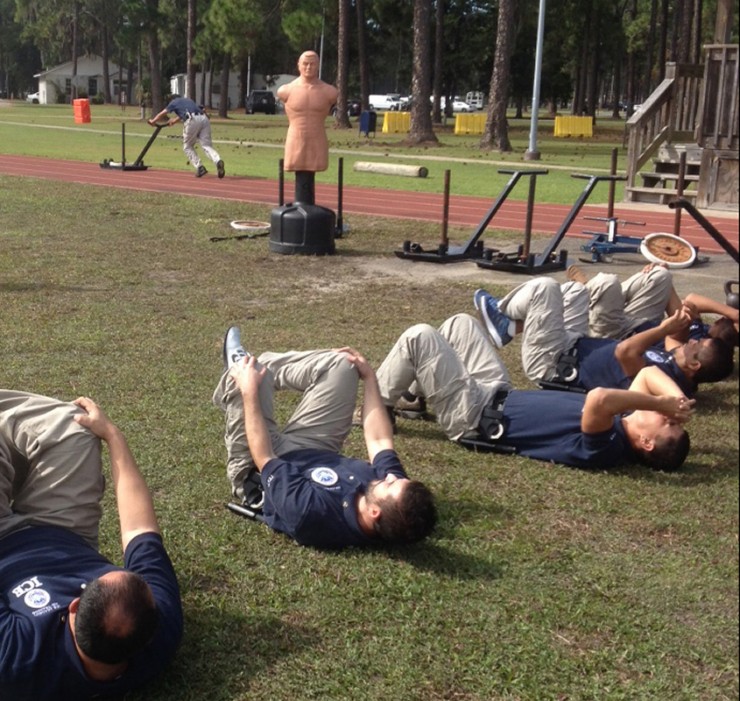 Does otherwise good training instill in officers a fear to act? Does otherwise good training instill in officers a fear to act? By Madeline Horner – Reprinted from Calibre Press. PT gear! Two minutes! Move!” The command echoes in my ears as a herd of police recruits bottleneck in the locker room door. Less than 45 seconds later, they’re standing on their blocks to begin a grueling series of push-ups. Sweat drips on the floor and hands begin to slide. A forearm hits the floor as a recruit loses all strength in his arms. Then someone shouts: “Flutter-kick position! Move!” They must work like animals, being broken down, because one of them decided to write his BLET training objectives in pencil instead of pen. We call this training. From this training, will they become strong? Absolutely. Will they learn to pay attention to detail? Certainly. Will they be instilled with the knowledge that the actions of one will be reflected on all? Eventually. Will they be reminded of the direct correlation between making an error and receiving a consequence? I’d say so. Will they be receiving appropriate stress inoculation for use later in their career? I hope so. Will they attain the confidence to make a decision without seeking prior approval? I’m not so sure. Why do we train this way? We train this way because we are a paramilitary organization and police officers must be instilled with the strength and mental fortitude to fight and kill a person. We train this way because to be a good commander you must be able to follow orders yourself. We train this way because we must be able to present a solid, unified line of law enforcement ability to the civilians we police. But we aren’t soldiers. A soldier encounters dangers as part of a group, and when the leader says to shoot all must shoot. When the leader says to stand down, all must stand down. Police officers encounter dangers alone. There’s no leader telling them when to shoot and when not to shoot. A police officer must be able to make this decision by himself in the moment, and without hesitation. Fear to Act As a field training officer (FTO), I’ve had the same conversation with every trainee I ever received. It’s the same conversation that my FTOs had with me, and likely the same conversation future FTOs will have with their trainees: “This job is not about not making mistakes. You will make mistakes. There’s no such thing as a perfect call. The important thing is about how well you recover after you make a mistake.” I spent a lot of time trying to unhinge that latent fear each recruit carried. No recruit ever really believed me when I told them that I wanted them to make mistakes—aggressive mistakes. I can fix aggressive, but I can’t fix a void. Training is the place to make mistakes. Recruits unfortunately seem to view training as a pass/fail test. These recruits truly believe, as many officers do, that they can’t be seen to fail by making a mistake. I spent months, riding in a car with a person who was afraid to tell me that he needed to use the bathroom. I watched him squirm in the driver’s seat doing a seated version of the potty dance. Then out of sheer masochistic curiosity, I waited to see how long it would take him to tell me he needed to stop. I must say while I was impressed by his fortitude, I was not impressed with the underlying implication. If you can’t make the command decision to use the bathroom, how then can you be trusted to make the command decision to take a life? Recently I had the opportunity to speak to an officer who’d been involved in a shooting while he had been on field training. Like any officer worth his salt, this officer was Monday-morning quarterbacking himself. Asking himself what he would do differently if given the opportunity to do it over again. Now before I tell you what he said, I want you to take yourself back to when you were on field training. Take yourself back to that time when seeing an expired registration sticker made your blood start to heat just a little bit. That moment when you look at your training officer and the words “I want to stop him” slide past your lips even as you are reaching for the light bar switch. The implied question of “Is that okay with you?” hovering in the air. For some of us this trip back may take longer than others … We spoke at length, and I was struck right down to my core by what he said. He felt there was a part of him that had wanted to shoot sooner, but his training officer wasn’t shooting. So he waited. He was looking to his training officer to tell him that it was okay to shoot, that it was okay to save his own life. Like many officers do, they both waited until the suspect had fired at them before engaging in a shoot out. I can’t help but wonder if the delay was in some way due to the engrained need for someone else to tell them when it was okay to start. Conclusion Now don’t get me wrong, I believe in and fully support the training offered by our academies. Still, I wonder if there is there a fix for this police training paradox. I’ve seen, heard, and happen to work for one of the many departments that’s altering its training programs to make up for this training gap. By shortening the amount of time we spend breaking down recruits and increasing the amount of time building them up, these progressive departments are working to improve and increase the quality and delivery of scenario training during the academy. This can also be accomplished by adding regular ride alongs to the academy curriculum that will improve the recruit’s perception of police decision-making before they have to make those decisions on field training. But is there more that we can do? I’m sure many of you thought of ideas while reading this article. I encourage trainers and officers to put their ideas into the world for judgment. Don’t allow yourselves to be satisfied with the status quo. Do for your department what you do for yourself: strive to be better and take action.
|
To Lie or Not to Lie: The Use of Deception During An Interrogation
|
 By
John Reid & Associates By
John Reid & Associates
May - June 2012 (click here for printable version)
If the agents involved in the recent Colombia incident are interrogated, should the investigators tell them they have evidence that they don't really have? It depends on a number of considerations.
Earlier this year a case was reported in which a detective doctored a crime lab report to use as a prop during an interrogation. While the suspect did not confess, the detective's tactics spurred legal questions regarding the use of deception during an interrogation. The legal twist was that even though the report used as an interrogation prop was manufactured by the investigator, it was based on factual verbal information provided by the crime lab. In other words, the manufactured evidence contained truthful information that incriminated the suspect but the report was not a bona fide report from the crime lab. 1
Legal Considerations
The legal test for deceptive practices during an interrogation has remain unchanged for more than 40 years. The use of deception during an interrogation must be considered within the totality of circumstances when deciding the admissibility of a confession.2 Deception that shocks the conscience of the court or community will generally result in a suppressed confession. An example of deception that "shocks the conscience" is lying to the suspect about the possible consequences he faces, e.g., telling a homicide suspect that the legislature just dropped first degree murder to a misdemeanor. Similarly, an investigator who elicits a confession after falsely telling the suspect that he is his court appointed public defender has "shocked the conscience".
A second legal guideline regulating deceptive practices, stemming from a 1989 case, makes a distinction between manufacturing evidence against the suspect (which is not permissible) and false verbal assertions (which generally are permissible). 3 In that case the investigator manufactured a fictitious crime lab report indicating that the suspect's DNA was found during an autopsy of the victim. After reading the "crime lab report" the suspect confessed. The suspect's confession was later suppressed at trial. If the investigator had falsely told the suspect that his DNA was found during the victim's autopsy this would have been permissible - but the investigator went too far by manufacturing the lab report. Other than these exceptions, there are many decisions upholding the use of verbal deception during an interrogation.
There is no per se legal restriction against the use of "props" during an interrogation. However, the prop must truly be a mere visual aid such as a blank DVD where the suspect is falsely told that it is the surveillance video showing the suspect removing property from a building. To determine whether a prop crosses the line of being improper, ask the following question: "Could an analysis of the purported evidence incriminate the suspect?" If the answer is "yes" the prop should not be used. In the DVD example, even if the DVD was labeled "Surveillance Video, May 12, 2012" anyone who played the DVD would realize that there was absolutely nothing on it that would incriminate the suspect.
Procedural Considerations
Most investigators have experienced some success with deceptive practices during an interrogation. For example, the investigator may produce a file containing a number of blank pages. As the investigator thumbs through the pages in the file he states, "This is a report from an eye-witness who saw you outside the building that night; this is a report indicating your fingerprints were found inside the building; this report shows that you made a large cash purchase two days after you went into that apartment building." A guilty person who believes that the investigator, in fact, has all of this incriminating evidence is more likely to tell the truth.
On the other hand, consider the investigator who falsely tells a suspect, "We found your fingerprint inside that house." Unbeknownst to the investigator, the suspect wore gloves during the burglary that he committed. Obviously, under this circumstance the deceptive tactic completely backfires. The investigator will lose credibility, the suspect will become more confident in his ability to lie and the interrogation will deteriorate very quickly.
Suffice it to say, lying to a suspect about having incriminating evidence is a risky interrogation tactic. To reduce this risk the investigator who anticipates the possibility of mentioning fictitious evidence during the interrogation may first test the fictitious evidence during the interview by asking a bait question.
Consider the investigator who is contemplating making a false statement during the interrogation concerning an eye-witness who saw the suspect at the scene of the crime. During the interview the investigator may ask the following bait question, "Is there any reason a witness, who was walking their dog down Washington street that night, would tell us that they saw you leave the apartment complex around 7:00?"
If the suspect offers an emphatic denial to this bait question it would be an indication to the investigator that he should not mention a fictitious eye-witness during the interrogation. On the other hand, if the suspect offered a hesitant or qualified response to this bait question, the investigator should have confidence in mentioning an eye-witness during the interrogation. The following are other procedural considerations relating to deceptive statements during an interrogation: 1. Consider deception as a last resort effort to overcome stubborn, weak denials typically offered by a guilty suspect. 2. Do not lie to a suspect who claims not to remember his actions at the time of the crime. There are reported cases of internalized false confessions where innocent suspects claim that they were convinced by the investigator that they must have committed the crime, even though the suspect had no initial recollection of committing the crime. Obviously, the use of deception by the investigator could increase the likelihood of this occurrence. 3. Do not use false evidence to threaten inevitable consequences. A number of previous web tips have addressed the dangers of convincing an innocent suspect that he or she will suffer negative consequences regardless of whether the suspect acknowledges guilt. When this tactic is reinforced with false claims that the investigator has evidence implicating the suspect in the crime, a false confession is a real possibility. Miscellaneous Considerations
Some private companies have established internal policies that prohibit corporate investigators from making false statements during an interview or interrogation of an employee. The basis for this policy is generally based on corporate ethical considerations as opposed to legal requirements. Especially when a corporate investigation centers around administrative acts of wrong-doing, the use of deceptive practices may fall outside of the realm of acceptable standards of practice and open the employer to possible civil liability.
Police officers who work in small communities often arrest and re-arrest the same suspects, or relatives of that suspect on a regular basis. In a tight-knit community the officer's reputation will often dictate his success in developing informants and eliciting confessions from suspects. If the officer establishes a reputation of being a straight shooter and honest he is likely to be successful. On the other hand, if the officer has a reputation of lying to suspects and not being trustworthy, his ability to solve cases through gathering street information or by interrogating suspects is greatly hindered. Under this circumstance, the investigator will be more successful by establishing a reputation of being truthful.
The same advise applies to the corporate investigator who will quickly establish a reputation of either being credible or someone not to trust. It must be remembered that both innocent and guilty suspects will not cooperate with an investigator they do not trust; the one case that might be solved by making deceptive statements during an interrogation could result in the failure to resolve many future cases.
Finally, investigators who electronically record interrogations should consider their ability to explain their use of deception practices to a jury. The defense, of course, will argue that the recorded deception somehow renders the defendant's confession as untrustworthy. A competent prosecutor should be able to address this issue by educating the jury with respect to the law and emphasizing that the confession is corroborated with information only the guilty person could have provided.
Conclusion
Deceptive practices are prevalent within society and largely considered an acceptable part of doing business or preserving social relationships. When a store asks a customer to register for a free birthday gift they don't want to send the customer a gift - they want to find out how old the customer is so they can market products appropriate to someone that age. We have all been served a meal that was less than appetizing and yet, deceptively, we would finish our portion, compliment the chef and leave a generous tip. These examples involve everyday practices of law abiding citizens. What about when dealing with criminal suspects? Certainly courts and society recognize that investigators often need to resort to deceptive practices in an effort to learn the truth from a criminal suspect. Indeed, the law extends great latitude within the area of making false statements to a criminal suspect.
However, as addressed in this article, just because lying to a suspect is accepted by the courts and will generally not cause an innocent person to confess, there are other considerations that may cause an investigator to avoid making false statements to a suspect. These involve circumstances where the investigator's deceptive conduct may negatively affect the investigator's (or employer's) ability to solve the crimes, as well as affect their reputation.
1 Reported in "Austin Police Use of Doctored DNA Report in Interrogation Raises Legal Questions," Statesman.com, Jan. 30, 2012
2Frazier v. Cupp 394 U.S. 731 (1969)
3 Cayward v. Fl 552 So 2nd 971 (1989)
< < jump to the policetraining.net home
page>age>
Copyright: / 123RF Stock Photo
Copyright: / 123RF Stock Photo
|
|
|
