 Murphy's
Law for Police Rookies
Murphy's
Law for Police Rookies
Murphy's law also applies to recruits, so don't be surprised when
things don't go your way.
by William Harvey
Murphy's law is the adage that anything that can go wrong will go
wrong. Several websites and books are dedicated to Murphy's law and
how these truisms can be applied to various occupations, stations in
life, and situations.
As for the true origins of Murphy, most scholars differ but I tell
you this, Murphy is Irish. If there ever is a definitive race of
people who could exemplify this, it is us indeed. You may remember
reading in this column about my blue-haired Irish mother.
If Murphy had written about being a police rookie, what would these
proverbs state about "rookiehood?" Here are three:
You will have an accident in your first year.
Don't panic about this one. Police work has a learning curve. Nearly
every cop I know had a "bump" during the first year on the street.
Nobody died. Most of the time, it was nothing serious. During my
first week, I backed into a dumpster and put a scratch on the car.
Not too bad, but Murphy was right.
Most of these little inconveniences will give you a chance to learn
how to fill out the department's pesky accident paperwork. You'll be
called "Crash," and you'll get to know the inside of the sergeant's
office. It will be a a wake-up call reminding you to wear your seat
belt, slow the heck down, and use this as a safety learning
experience.
One of your first solo calls will be legendary.
You'll be working one of your first shifts, wanting to prove you can
work a call without a Field Training Officer (FTO), when it happens.
The Gods of Policeland drop a call on you that will take all of the
king's horses and all the king's men. Don't get embarrassed; we all
know this happens.
Remind yourself that it will make a great story after work. I'll
remind you that you should call for backup, when the call is beyond
your capabilities. Why do the Gods of Policeland do this? They've
got an awesome sense of humor when it comes to rookies.
Despite how nice you are, you will get a complaint.
Holy IAD, Batman! What do you mean I'm getting reviewed over that
silly call! Calm down. Most of these calls is either a communication
breakdown or a courtesy complaint. Most of these are unfounded, and
you'll have your first trip to fill out the "why, oh why" paperwork.
Don't panic, and follow the direction of your FTO and/or supervisor.
Just remember that what is no big deal to you can be a major deal to
a citizen. This may be the first parking ticket they've received in
60 years of driving, and now it's your fault that they'll reach the
pearly gates to face their maker with a parking violation. Stay
professional in all interactions. Remind yourself that if you do
your job, you'll get complaints, most of which will be unfounded.
Here are a few other Murphy-isms for rookies:
-
You'll direct traffic in the rain on the day you forget your
raincoat.
-
There will be a snow squall the night you forget your winter
jacket and gloves.
-
You'll be subpoenaed the day you have scheduled for a
mini-vacation.
-
The last call of the day before a long weekend will require a
crime scene access log.
-
The squad will win free pizzas in a radio contest the week you
start a diet.
-
Your official first-watch party will be scheduled for the
weekend you plan a second honeymoon.
-
You'll get to work an overtime detail, after you spouse bought
tickets for a concert
William Harvey
William "Bill" Harvey is the chief of the Ephrata (Pa.) Police
Department. He retired from the Savannah (Ga.) Police Department
where he worked assignments in training, patrol, and CID. Harvey has
more than 25 years of experience working with recruits, rookies, and
FTOs.

 Having
A Third Person in the Interview Room
Having
A Third Person in the Interview Room
By John Reid & Associates
Privacy is considered the single most important psychological
factor contributing to the success of an interview or interrogation.
This is something we each inherently recognize. For example, if a
man wanted to discuss marital problems with a close friend, he would
not meet his friend at a crowded bar to discuss this sensitive
topic. Rather, he would meet his friend in a quiet restaurant or
cafe to discuss his personal problems in private. Quite simply, it
is easier for a person to tell the truth when communicating with one
other individual. Consequently, we recommend that in most cases
interviews should be conducted one-on-one, with only the
investigator and suspect in the room.
There are exceptions to this guideline. Perhaps an investigator and
his/her partner both want to be present during the interview. A male
investigator may be interviewing a female sexual assault victim and,
to protect against a false claim of misconduct, request that a
female observer be present during the interview. In other cases, the
suspect may not speak English requiring that an interpreter be
involved during the interview. Finally, a parent, supervisor or
union representative may want to be present during the interview or
interrogation. Each of these circumstances will be discussed
separately.
Partner, witness
The partner or witness should be seated behind, and to the side of
the suspect. Second, the partner or witness should remain silent.
They may take written notes, but should not interact with the
suspect. The goal is to minimize the violation of privacy having a
third person in the room presents, as illustrated in figure A:
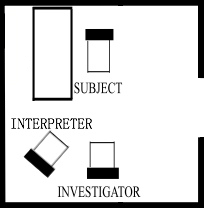
Figure A
Interpreter
An interpreter should typically be positioned to one side of the
investigator, with the investigator sitting directly in front of the
subject, as illustrated in figure B. If the interpreter is
personally acquainted with the subject, or the subject is hostile,
the interpreter may be positioned behind the suspect, similar to the
previous witness in figure A.
Figure B
The interpreter should be instructed to translate the investigator(s
questions and the subject(s response to the questions word for word
in first person. ("I wasn't there." versus "He said he wasn't
there.") Specifically, the interpreter should be cautioned not to
summarize either questions or responses. If the interpreter is not
trustworthy, perhaps because of possible sympathy toward the
subject, the investigator may explain that the entire interview will
be electronically recorded and that the accuracy of the
interpreter's translations will be checked by an objective third
party. While this may not, in fact, be feasible such a statement may
have the effect of more accurate translations.
Finally, the subject should be instructed to address the
investigator when speaking. There will be a natural tendency for the
subject to talk to the interpreter, since the interpreter is the
person who asked the question. However, to properly evaluate the
subject's nonverbal behaviors and to increase the deceptive
subject's fear of detection (lying to the investigator rather than
the interpreter), it is important that the subject direct his or her
responses to the investigator
At the beginning of the interview the subject should be politely
admonished if he responds to the interpreter rather than the
investigator, e.g,. "Armando, talk to me, not him." Once this
pattern has been established, it could be a significant behavior
symptom of deception if the subject, all of a sudden, addressed the
interpreter rather than the investigator. This is similar to the
witness in a courtroom looking to the defense attorney for help
prior to responding to a threatening question asked by the
prosecutor
Parent, union representative
In the previous situations the third person in the interview room is
beneficial to the investigator. However, this is not necessarily the
case when the third person is an advocate for the suspect, such as a
parent, human resource staff or a union representative. In those
circumstance in which there is no legal requirement for the parent
or company representative to be in the room, the investigator should
meet with this individual in private and first try to persuade that
person to not be present during the interview or interrogation. The
following statement has been used effectively to accomplish this
goal:
"I believe you and I have the same goal which is to identify whether
or not (suspect) is involved in (issue). [Parent] If he is involved
you certainly don't want him to think that he can get away with
something like this and do worse things in the future, right?
[Company Rep] If he is involved in this you owe it to the other
employees in this company to discipline the proper person and not
put all employees under a cloud of suspicion and have them subjected
to greater scrutiny, right?
Let's assume, for a minute, that in fact (suspect) did commit this
offense. Put yourself in his shoes. Do you think it would be easier
for him to tell the truth with just me in the room? Of course it
would be. Think back when you were young and did something wrong.
Was it easier for you to tell the truth to just your mom or dad? Or
did you want to be questioned in the presence of many people? Just
your mom or dad, right. This is the same situation.
Let me learn what the truth is and then I will bring you into the
room for you to hear the truth. At that point you may ask (your son)
(employee) any questions you wish to. But let's work together in
this matter to learn the truth by allowing me to first talk to him
in private, alright?
If the parent or company representative insists on being in the
interview room during questioning, the investigator should have that
individual sit in the witness chair illustrated in figure A. Second,
the parent or company representative should be advised that they are
only in the room to observe, and that if they speak and interrupt,
the investigator will have no choice but to terminate the interview
because of this interference.
During the interview or interrogation, if the parent or company
representative does say or ask something the investigator should
immediately advise the parent or company representative with a
statement such as:
"Jim/Mary I just want to remind you that our agreement was
that if you were in the room you would only observe and not
interject yourself into the conversation . Correct? You are not
keeping up your end of the bargain. If you continue to interrupt me
I am terminating this interview because of your interference."
In conclusion, during most interviews and interrogations the
investigator should be alone in the room with the suspect absent any
legal requirement to do otherwise. If a third person is present as
an observer or interpreter, specific procedures should be followed
to minimize the violation of privacy this third person represents.
If the third person is an advocate for the suspect the investigator
should attempt to persuade that individual to remain outside the
room. If that individual insists on being present during the
interview, they should be cautioned to not interrupt the
investigator.
Credit and Permission Statement: This
Investigator Tip was developed by John E. Reid and Associates Inc.
Permission is hereby granted to those who wish to share or copy the
article. For additional 'tips' visit
www.reid.com;
select 'Educational Information' and 'Investigator Tip'. Inquiries
regarding Investigator Tips should be directed to Janet Finnerty
johnreid@htc.net. For more
information regarding Reid seminars and training products, contact
John E. Reid and Associates, Inc. at 800-255-5747 or
www.reid.com
 Surviving
Your Relationships
Surviving
Your Relationships
By Sgt. Betsy
Branter Smith
Cops have a
notoriously high divorce rate, but divorce statistics are
only part of the story. Think about all the engagements,
live-in boyfriend/girlfriend situations, or same-sex
partnerships that don’t work out either. Let’s face it, we
tend to be lousy at intimate relationships.
In the
Street Survival seminar, we
talk about surviving this job not only physically and
tactically, but emotionally, and a large part of our
survival is dependant upon the success of our personal
relationships. I can’t tell you how many officers have come
up to me after a seminar and said “All this time, I thought
it was all my wife’s fault that we don’t get along, but now
I’m beginning to understand that it might just be me.”
The majority
of the research and writings on this topic tend to focus on
what our spouses can do to make our marriages better. If
only our partners would change their attitudes, be more
understanding, learn to communicate better, and deal more
successfully with the day-to-day stressors that “we,” the
cops, face we’d all be happier. I’m suggesting that those of
us with the badge look in the mirror, look into our hearts,
and try to figure out what
we can do to improve our relationships; here are
a few suggestions
-
Watch how you talk to and treat those you love.
Do you give orders or make requests when you get home?
Do you work your tail off to help out a citizen while
you’re on duty but when you get home it’s just too much
trouble to help fold the laundry or take out the
garbage? Sometimes we treat strangers, our co-workers,
or the citizens better than we do our own families. I
had a revelation a few years ago during a heated
argument with my husband, a former police lieutenant. He
said to me “Don’t talk to me like one of your officers!”
And I spontaneously shot back with “I would
never talk to my officers the way I talk to
you!” Holy cow! I really like the guys who work for me,
but I adore my husband, and yet here I was, talking to
him like some incompetent rookie that was about to get
terminated. Take a good, hard look at how you
communicate with your loved ones. Pay attention not only
to your words, but your gestures, your tone of voice,
your general demeanor. Do you talk to them like the
precious people they are, or do you need to do some work
on your communication skills at home?
-
Have a “going home” ritual. It can be hard to
transition from crimefighter to spouse, partner, or
parent. I used to come home immediately after a twelve
hour shift to my family who was waiting to have dinner
with me. My husband would cook a great meal, hand me a
glass of wine as I walked in the door, and ask me about
my day. Sounds perfect, right? In reality, it drove me
nuts. I’d arrive home still in “cop mode,” either wired
or exhausted, and more than a little surly. All I wanted
was to go through the mail, wolf down something to eat,
and enjoy my glass of wine in total silence and
solitude…not exactly the happy homecoming that my family
kept anticipating night after night. I had to develop a
new “going home ritual” before I no longer was welcome
in my own home! Now, a couple of nights a week after
work I go to the gym and on the other nights I at least
take a shower at the police department and change into
my favorite sweats before I drive home. I get a home a
little later, but my family agrees that I’m a whole lot
more pleasant to be around, and I’m much more engaged
from the time I walk in the door.
-
Don’t get too caught up in your own self-importance.
On average, less than two out of every one hundred
police applicants actually get hired, so by the time we
get “on the job” we already feel like we’re pretty darn
special. Add to that the public’s fascination with our
profession, the danger factor, and the power and
authority, and it’s easy for us to lose perspective.
After all, how can anyone’s day compare to yours? So
what if your spouse had to deal with 25 second graders
on a field trip today, or your partner had an argument
with her boss, or your teenage son got turned down for
the freshman dance by his not-so-secret crush? That
stuff is petty compared to the traffic crashes, the
suicides, the child molesters, and domestic violence
calls you went to today! Obviously, the family needs to
get a little perspective! Or maybe
you do? It’s easy for your family members’
trials and triumphs to get overshadowed by the serious
nature of your profession. In fact, they may begin to
trivialize their own issues because they don’t want to
“bother” you with them. Take the time to find out about
their day, truly listen to what they have to say, ask
questions, show empathy,
make them feel valued. They’ll be much more
ready to listen when you’re ready to talk about your
day, which brings me to my next point.
-
Bring your family in to “your” world.
Very often
cops hide what we really do from our families. We
don’twant to worry them or frighten them or make them
cynical or paranoid, plus sometimes
we just don’t feel like talking. But it’s a
mistake to keep your family at arm’s length. Tell your
spouse about your frustration with that battered wife
who just won’t let her husband be arrested; bend your
partner’s ear about why your sergeant was such a jerk
today, but try to find something positive to talk about
too. Tell them how great it felt to find that lost
little girl or finally solve those string of residential
burglaries. And don’t forget your kids. Sharing your day
with them in an age-appropriate manner can result in
some great parent/child bonding. I use my work “stories”
as teachable moments for my kids. In fact, my youngest
daughter and I have developed a routine as we’re getting
ready for bed when I tell her “Tales of Stupid Decisions
by Teenage Girls.” I get to vent, she learns how to stay
out of trouble, and we both understand each other’s
world a little better.
-
When you make a commitment to spend time with your
family, honor it.
Treat it like a court subpoena, a call-in for overtime,
in-service training; or whatever mental game you have to
play with yourself to make family time “mandatory."
Yeah, you might be tired; sure, you’ve got a lot going
on; but if it was the department telling you that you
have to come in and do something, you’d do it.
Consistently make your family a priority.
Cops tend to put off family time until “tomorrow” or “my
days off” or “when I’m on vacation” or even “when I
retire,” and sometimes by then, it’s too late. Given the
precarious nature of our job, time with your loved ones
should
rarely be put off until some other time!
-
Keep in touch.
A “thanks for packing me a lunch” note left on the
kitchen table, a brief text message to say “I miss you”
or a quick phone call to say “We’re really busy out here
tonight but I can’t wait to see you and the kids in the
morning” are short, simple ways to stay in touch with
your family even while you’re out fighting crime. Our
families worry about us and miss us when we’re on duty,
and it only takes a few seconds to let them know that
you’re okay and that you miss them, appreciate them,
love them, and can’t wait to get back home to see them!
-
Don’t be afraid to get help.
Years of poor
communication, job stress, resentment toward the agency
or maybe even each other can leave a relationship badly
damaged. The writings and teachings of both
Dr. Ellen
Kirschman and
Dr. Kevin
Gillmartin are excellent resources for police
officers and their families looking to improve their
relationships. And before you join the ranks of the 75%
of us who gave up on a marriage, give counseling a try.
You spend your time at work helping others, so let a
professional therapist or your minister or your
department’s employee assistance personnel give you a
hand.
Just
like officer survival training has been instrumental in
reducing police officer injuries and deaths,
relationship survival can help our
profession reduce that high divorce rate.
Train for your relationships like you train for your
survival, because both are worth fighting for!
About the author
Sergeant Betsy Smith has nearly 30 years of law enforcement
experience and recently retired as a patrol supervisor in a
Chicago suburb. A graduate of the Northwestern University
Center for Public Safety's School of Staff and Command,
Betsy is a police trainer, author and instructor for the
Calibre Press Street Survival Seminar. Visit Betsy's website
at www.femaleforces.com.
Contact Betsy Smith and Follow Betsy on Twitter

Are you Considering Transitioning out of Law Enforcement? Here’s
some Expert Career Advice for You
“If your day isn’t complete until someone calls you Chief and
salutes you, you’re going to have a difficult time when you enter
the corporate world. It’s going to be a totally different
experience,” said Tim Hardiman, who spent 23 years with the NYPD.
This was just one piece of advice offered up by a panel of law
enforcement and physical security professionals who shared their
personal experience changing careers. These expert panelists, some
of whom sort through hundreds of résumés for every job they post,
gave attendees advice on how to prepare themselves in advance for a
career change. If you’re considering leaving law enforcement and
transitioning to another field, here are some things you should keep
in mind.
more >
< < jump to the policetraining.net home page
Image credit: pan>
andersonrise / 123RF Stock Photo
Image credit:
123peterpolak / 123RF Stock Photo





