|

|
|

March
2015
Important: To ensure future delivery of
the Policetraining.net newsletter to your inbox (not bulk or junk folders)
please add our "From" address
info@policetraining.net to your address book or e-mail whitelist.
|
- Sponsored By -
 |
|
 |

Habits of Unhappy Cops
|

BY MICHAEL WASILEWSKI AND ALTHEA OLSON
An article appeared last month brilliant in its combination
of simplicity and wisdom. We found it shared and re-shared
on social media, and were struck by the intelligence and
clarity the author used in simplifying such a large and
pervasive problem in so many peoples’ lives.
“The 7 Habits of Chronically Unhappy People” by Tamara Star,
a popular speaker and writer, has been featured on a number
of sites and blogs since, getting well-deserved attention
and hopefully opening eyes and spreading insight. If you’ve
not yet read it, you should. To summarize, Star’s 7 Habits
are:
1. Your default belief is that life is hard.
2. You believe most people can't be trusted.
3. You concentrate on what's wrong in this world versus
what's right.
4. You compare yourself to others and harbor jealousy.
5. You strive to control your life.
6. You consider your future with worry and fear.
7. You fill your conversations with gossip and complaints.
These made an impression on us in another important way,
too. Their universality applies to people from all walks of
life, certainly across all professions, but we saw in them a
clear explanation of why so many police officers are cynical
and unhappy. That they reinforce and reiterate so much of
what we've written about, in a simple, easy-to-digest
format, is a plus.
And so, with a gracious tip of the hat to Ms Star, we've
adapted her list to the…
The 7 Habits of Chronically Unhappy Cops
Believing that life is hard
According to Star, “Unhappy people see themselves as victims
of life and stay stuck in the ‘look what happened to me’
attitude versus finding a way through and out the other
side.” The default for some, mainly because it’s easier than
accepting personal responsibility to confront or digging
oneself out of the problems they face, is to simply embrace
a sort of modernist fatalism.
True adherents of the philosophy might at least be admired
for their stoicism, but that’s really not a trait of the
“Life is Hard” crowd, is it? In truth they’re unhappy but
weighed down by ennui or fear; it’s easier than trying,
though.
We all know these officers. Stuck in a rut they hate but
refuse to escape, never disappointed for they never aspire,
and blaming it all on the inevitability of their own
mediocrity. Life is something that happens to them, and if
it’s hard and they’re unhappy, well, what are you gonna do?
Believing most people can't be trusted
Healthy cynicism and a keen sense of the evil mankind is
capable of is critical to a police officer’s success and
survival. It’s when no one is trusted, no one receives the
benefit of any doubt, and the bar to trustworthiness is set
so high virtually no one can be deemed “safe” that cynicism
has gone too far, and the officer’s relational world
suffers.
All but the rarest of us are social creatures, needing human
companionship and, yes, trusting relationships to feel
fulfilled. What happens with far too many cops is this:
Having immersed themselves in a world where people cheat,
rob, mistreat, and sometimes grievously hurt or kill each
other as a matter of course, the officer sees nothing else.
Everyone is a threat, working an angle, or bound to
disappoint. Unable to relax, seeing danger around every
corner, and shrinking from most social contact is a
dangerous, sad, unhappy place to be.
Happy people – and happy cops – are not oblivious but they
are willing to risk. And sure, people disappoint but, if the
hurt is not too great, they can be forgiven.
Concentrating on what's wrong in this world versus what's
right
Unhappy cops see crime rates growing out-of-control in an
increasingly violent world at home, and global threats
beyond our shores jeopardizing our very survival as a nation
and species. They see kids and young adults as more
disrespectful and less well-educated than ever before and,
even if we’re not all murdered in the streets or taken out
by Al Qaida, ISIS, or the next great evil from across the
sea, they will surely run our nation and world into the
ground and leave us soon-to-be geezers munching on the
generic cat food at our fourth-rate retirement homes.
Happy cops enjoy a sense of perspective!
They know crime rates are actually at historic lows, and
especially violent crimes (though the still violent are
truly and remarkably violent!). The world has always faced
the dangers of the mad and ambitious, but when was the last
time you considered nuclear annihilation a real possibility
(sure, it’s still possible but would be a really terrible
business decision; computer viruses are as likely to be the
weapon of choice the next time a couple major powers
tangle). And although they are more than a little sheltered
and far from perfect, kids today are scary smart. Trust them
in the long haul (but definitely keep an eye on ‘em!). And
just look at the wealth of technology and knowledge we have
at our fingertips. Overall, we’re probably going to be just
fine.
Comparing themselves to others and harboring
jealousy
Star points out “Unhappy people believe someone else's good
fortune steals from their own. They believe there's not
enough goodness to go around and constantly compare yours
against theirs. This leads to jealousy and resentment.”
Look around your department at the cops harboring resentment
and jealousy. Who complains about assignments they’ve never
gotten, counts the favors that have gone to others, and
derides the successes of others, attributing them to
“ass-kissing,” “sleeping her way to the top,” or mere luck?
How happy are those officers? Jealousy masks great
disappointment.
Striving to control their lives
In contrast to the fatalism of those in the “Life is Hard”
camp, another subset is the hyper-driven, Type A+++ cop.
Refusing to yield any control, relax, or place trust in
anyone else, these buzzing high-tension wires in human form
place tremendous pressure on themselves to find perfection.
Trouble is, finding perfection is exhausting… and
impossible. Perfectionists are rarely happy and, even if
they capture a fleeting moment, it can’t last and the cycle
begins anew.
Occasionally letting go of control is freeing. Allowing for
imperfection broadens horizons. Being “good enough” in some
things, or even being willing to not be good at all, makes
for a much more interesting world.
Considering the future with worry and fear
All of us experience fear and worry, and appropriate fear is
important for cops who’d like to come out the back end of a
20-30 year career more or less intact. When fear permeates
everything, becoming paralyzing or occupying far too much of
our time and mental energy, it’s become too much.
Cops need to visualize what they fear, and then mentally
rehearse to overcome it. This is healthy. So is knowing what
could happen in any given situation and building confidence
to meet the challenge. Seeing only what could go wrong,
however, and losing sight of the fact that it almost
certainly won’t, is a recipe for unhappiness. Expect the
expected, while being prepared for the unexpected, is a
better approach, and one more likely to make keep you happy.
Filling their conversations with gossip and
complaints
Star wrote, “Unhappy people like to live in the past. What's
happened to them and life's hardships are their conversation
of choice… Happy people live in the now and dream about the
future. You can feel their positive vibe from across the
room. They're excited about something they're working on,
grateful for what they have and dreaming about the
possibilities of life.”
We’ve heard it said “it’s a cop’s prerogative to bitch,” and
it sometimes seems most of us are taking full advantage of
the entitlement. The problem, however, is that it gets old
pretty quick, and venting is really less about “blowing off
steam” and does little more than accentuate and reinforce
negativity.
We all have plenty of genuine gripes, and sometimes voicing
them is an impetus to seeking help and finding solutions. We
need to know which battles to fight and what to let go,
however. Happiness is found in both letting go and focusing
on thoughts and words that are hopeful and forward moving.
Happiness is not only reflected in the habits, actions,
thoughts, beliefs, and words you choose, but positively
influenced by them. Identify the habits of unhappy cops in
yourself today, and see if consciously and deliberately
replacing them doesn’t make a huge difference.
|
|
Fitness Tip from

Having a hard time making it to the gym?
There are a multitude of exercises that use minimal equipment and
can be performed virtually anywhere just like the four exercises
shown in this
video.
Expand your exercise toolbox and learn tips to ensure safety.
Having A Third Person in the Interview Room

By John Reid & Associates
Privacy is considered
the single most important psychological factor
contributing to the success of an interview or
interrogation. This is something we each inherently
recognize. For example, if a man wanted to discuss
marital problems with a close friend, he would not meet
his friend at a crowded bar to discuss this sensitive
topic. Rather, he would meet his friend in a quiet
restaurant or cafe to discuss his personal problems in
private. Quite simply, it is easier for a person to tell
the truth when communicating with one other individual.
Consequently, we recommend that in most cases interviews
should be conducted one-on-one, with only the
investigator and suspect in the room.
There are exceptions to
this guideline. Perhaps an investigator and his/her
partner both want to be present during the interview. A
male investigator may be interviewing a female sexual
assault victim and, to protect against a false claim of
misconduct, request that a female observer be present
during the interview. In other cases, the suspect may
not speak English requiring that an interpreter be
involved during the interview. Finally, a parent,
supervisor or union representative may want to be
present during the interview or interrogation. Each of
these circumstances will be discussed separately.
Partner,
witness
The partner or witness
should be seated behind, and to the side of the suspect.
Second, the partner or witness should remain silent.
They may take written notes, but should not interact
with the suspect. The goal is to minimize the violation
of privacy having a third person in the room presents,
as illustrated in figure A:
Figure A
Interpreter
An interpreter should
typically be positioned to one side of the investigator,
with the investigator sitting directly in front of the
subject, as illustrated in figure B. If the interpreter
is personally acquainted with the subject, or the
subject is hostile, the interpreter may be positioned
behind the suspect, similar to the previous witness in
figure A.
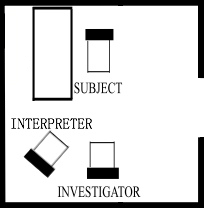
Figure B
The interpreter should
be instructed to translate the investigator(s questions
and the subject(s response to the questions word for
word in first person. ("I wasn't there." versus "He said
he wasn't there.") Specifically, the interpreter should
be cautioned not to summarize either questions or
responses. If the interpreter is not trustworthy,
perhaps because of possible sympathy toward the subject,
the investigator may explain that the entire interview
will be electronically recorded and that the accuracy of
the interpreter's translations will be checked by an
objective third party. While this may not, in fact, be
feasible such a statement may have the effect of more
accurate translations.
Finally, the subject
should be instructed to address the investigator when
speaking. There will be a natural tendency for the
subject to talk to the interpreter, since the
interpreter is the person who asked the question.
However, to properly evaluate the subject's nonverbal
behaviors and to increase the deceptive subject's fear
of detection (lying to the investigator rather than the
interpreter), it is important that the subject direct
his or her responses to the investigator.
At the beginning of the
interview the subject should be politely admonished if
he responds to the interpreter rather than the
investigator, e.g,. "Armando, talk to me, not him." Once
this pattern has been established, it could be a
significant behavior symptom of deception if the
subject, all of a sudden, addressed the interpreter
rather than the investigator. This is similar to the
witness in a courtroom looking to the defense attorney
for help prior to responding to a threatening question
asked by the prosecutor.
Parent, union
representative
In the previous
situations the third person in the interview room is
beneficial to the investigator. However, this is not
necessarily the case when the third person is an
advocate for the suspect, such as a parent, human
resource staff or a union representative. In those
circumstance in which there is no legal requirement for
the parent or company representative to be in the room,
the investigator should meet with this individual in
private and first try to persuade that person to not be
present during the interview or interrogation. The
following statement has been used effectively to
accomplish this goal:
"I believe you and I have the same goal which is to
identify whether or not (suspect) is involved in
(issue). [Parent] If he is involved you certainly don't
want him to think that he can get away with something
like this and do worse things in the future, right?
[Company Rep] If he is involved in this you owe it to
the other employees in this company to discipline the
proper person and not put all employees under a cloud of
suspicion and have them subjected to greater scrutiny,
right?
Let's assume, for a minute, that in fact (suspect) did
commit this offense. Put yourself in his shoes. Do you
think it would be easier for him to tell the truth with
just me in the room? Of course it would be. Think back
when you were young and did something wrong. Was it
easier for you to tell the truth to just your mom or
dad? Or did you want to be questioned in the presence of
many people? Just your mom or dad, right. This is the
same situation.
Let me learn what the truth is and then I will bring you
into the room for you to hear the truth. At that point
you may ask (your son) (employee) any questions you wish
to. But let's work together in this matter to learn the
truth by allowing me to first talk to him in private,
alright?"
If the parent or company
representative insists on being in the interview room
during questioning, the investigator should have that
individual sit in the witness chair illustrated in
figure A. Second, the parent or company representative
should be advised that they are only in the room to
observe, and that if they speak and interrupt, the
investigator will have no choice but to terminate the
interview because of this interference.
During the interview or
interrogation, if the parent or company representative
does say or ask something the investigator should
immediately advise the parent or company representative
with a statement such as:
"Jim/Mary I just want to remind you that our
agreement was that if you were in the room you would
only observe and not interject yourself into the
conversation . Correct? You are not keeping up your end
of the bargain. If you continue to interrupt me I am
terminating this interview because of your
interference."
In conclusion, during most interviews and interrogations
the investigator should be alone in the room with the
suspect absent any legal requirement to do otherwise. If
a third person is present as an observer or interpreter,
specific procedures should be followed to minimize the
violation of privacy this third person represents. If
the third person is an advocate for the suspect the
investigator should attempt to persuade that individual
to remain outside the room. If that individual insists
on being present during the interview, they should be
cautioned to not interrupt the investigator.
Credit and Permission
Statement:
Permission is hereby
granted to those who wish to share or copy this article.
In those instances, the following Credit Statement must
be included "This Investigator Tip was developed by John
E. Reid and Associates Inc. 800-255-5747 / www.reid.com."
Inquiries regarding Investigator Tips should be directed
to Janet Finnerty jfinnerty@reid.com.
|
Surviving a Career in Law Enforcement
|

It takes hard work and common sense
by Paul Cappitelli
As I venture into my 37th year of
working in and around law enforcement, I'm reflecting
upon my career journey. I am honored to have been a part
of this most rewarding profession. Now retired, I
perform consulting work on a part time basis and write
occasional articles for police publications while
enjoying the benefits of the public service pension
system. Sadly, not everyone who started out with me was
able to reach the career finish line for various
reasons. Let’s explore the challenges of career
survival.
Without argument, being a police officer today is a much
different daily job experience than being a police
officer 35 years ago. But as the saying goes, "some
things never change." What remains the same is that
there are hurdles, obstacles and barriers along the road
to retirement today just as there were in the past.
Every police officer starts their journey from the same
point of origin with the same type of academy training,
the same type of equipment and the same ammunition
allocation. But why is it that not all officers are able
to reach the retirement destination with their health
and pension intact? Sadly, the answer is oftentimes
painfully obvious.
A small percentage of officers are injured and not able
to return to their careers. An even smaller percentage
make the ultimate sacrifice by paying with their life at
the hands of ruthless cowardly criminals. For those who
have been injured or have fallen in the line of duty, we
pay our respect and homage for their sacrifice.
But the majority of other officers do not make it to a
successful retirement because of self-inflicted
mistakes. In some cases, those mistakes cost them their
life. Not wearing a seatbelt, driving recklessly and/or
too fast, not wearing body armor and not exercising
caution along the roadway are right at the top of the
list of self-destructive behaviors. Below 100 is clear
in identifying these risks, yet year after year, dozens
of officers nationwide continue to die or suffer
career-ending injuries because they fail to embrace
commonsense officer safety habits.
Ironically, another major reason an officer is derailed
on the journey toward a successful retirement has
nothing to do with the physical hazards of the job, but
beyond the physical hazards lies another silent killer:
unethical conduct. This is sometimes metaphorically
referred to as "the ethical gunshot wound." These are
the officers who say or do unethical or illegal things
during the course of their career and are terminated
and/or prosecuted. They are a disgrace to themselves,
the public, their families and the profession as a
whole. But who are they? What are their names?
Unfortunately, every police officer reading this article
knows who in their department is at risk of succumbing
to an ethical gunshot wound. These people can be good
cops in their ability to identify criminals and throw
people in jail, but they have telltale signs of poor
life choices and a track record of stepping over the
line when they believe they can get away with it. The
core of these misfits are not worthy of public trust,
and yet they continue to live among us.
Officers who hide under the cloak of secrecy by
protecting one another provide the ammunition for the
ethical gunshot. It takes a tremendous amount of courage
to stand up to unethical practices. Being ethical and
obeying the law is a seemingly fundamental principal of
a police officer, yet it is sometimes obscured by one's
misguided belief that it's acceptable to veer off
course.
Assess yourself. Take a few moments to read the Law
Enforcement Code of Ethics. Pause after each line and
ask yourself if you still adhere to these tenets. As a
retired street cop, I can say with great certainty that
living by this code will increase your chances of career
survival exponentially and protect you from the greatest
hazard of policing: yourself.
< < jump to the policetraining.net home
page>age>
Copyright: / 123RF Stock Photo
Copyright: / 123RF Stock Photo
|
|
|
