|
By Joel Lashley
Reprinted from Correctionsone.com
Prisoners with special needs continue to provide challenges
for police, correctional, and healthcare security personnel.
For example, a subject is arrested on the street exhibiting
bizarre behavior and then the prisoner is brought into your
jail for booking or emergency room for medical clearance.
The transporting police officers have him in special
restraints due to his bizarre and violent behavior. The
patient is rocking back and forth in the chair. His wrists
are raw and bleeding as he strains against the cuffs.
Suddenly he stops rocking and glances blankly around the
room, but doesn’t make eye contact with anyone. You step
forward and ask him his name. He doesn’t answer. You lean
towards his ear and ask a little louder, “What kind of drugs
did you take today?”
Immediately, he violently jerks his head away, as if in
pain, and starts pulling on his cuffs so hard that it
appears that he could seriously injure his wrists. He
resumes vigorously rocking back and forth. At this point,
you might be making a reasonable assumption — he's on PCP or
some other powerful street drug. But your assumption may
just as easily be wrong.
The arresting officers explain that he was found on a park
bench, naked from the waist down. He wouldn’t answer them or
even visually acknowledge their presence. When they shined a
flashlight towards his face he shrieked, covered his eyes,
and began rocking on the bench. When they attempted to apply
a blanket escort hold he backhanded one of them. Then they
attempted wrist compression, but it didn’t seem to have any
affect, and he just tried to bite them.
Still, he didn’t exhibit abnormal strength and they were
able to control him. He did struggle against the handcuffs
and began kicking so that the officers eventually had to
restrain his legs with a hobble restraint to prevent him
from injuring the officers or himself. Under the
circumstances, they did an adequate job of controlling the
subject. Similar encounters, under same sort of
circumstances, have not gone so well.
If I had been there, my first thought would have been that
this individual had autism or a similar related disability.
I would have considered this possibility because I have
raised a son with autism spectrum disorder, studied autism,
and controlled many subjects with autism who were in crisis.
We have now reached a point, in the public safety
professions, when autism spectrum disorders have to become
one of our “first thoughts”, whenever we observe certain
aberrant behaviors.
Nationally recognized police and corrections crisis
intervention trainer, Gary Klugiewicz
(www.acmistystems.net), sums the problem up this way, “We
need to be aware of what to look for and when to 'shift
gear' when dealing with individuals who exhibit these signs
and symptoms. We also need to remember that although our
usual picture of autism is of an adolescent who is acting
out in an unusual manner, which adolescents with autism grow
up and become adults with autism. Police, corrections, and
healthcare security officers need to learn autisms “signs
and symptoms” so that they can recognize and manage these
persons safely, effectively, and humanely. ”
What could the officers have observed about the above
situation that may have given them clues about his behavior?
The subject had a lack of verbalization, eye contact, and a
seeming lack of a response to pain. In addition, he was
rocking and appeared to have aversion to light, sound, and
touch. Finally he resisted but didn’t have the typical super
strength of a chemical abuser or other EDP. In fact, he
appeared physically weak.
What if the arresting officers had known that half of all
people with autism are nonverbal? That they rarely make eye
contact? That they often appear to be oblivious to pain?
That they may instinctively strike out if touched, or if
their personal safety zone is invaded? That they may
commonly bite as a means of defense? That they often
self-stimulate (rock, twirl, flap their hands, or even hum)
to manage stress or focus their attention?
What if the arresting officers had known that some persons
on the autism spectrum don’t have a sense of modesty or
nudity, which would help to explain their subject’s partial
state of undress? What if they had been trained that persons
with autism will often be hypotonic (low muscle tone),
possibly making them easier to handle, but also more
vulnerable to injury and positional asphyxia? What if they
also knew that a light touch may seem painful but a firm
hold might have a calming effect?
In this situation, what could they have done differently to
control this subject than if he was on PCP? There are many
differences, but it’s a fair question and the overall answer
is likely “nothing” unless they had special training. The
truth of the matter is that we often times don’t handle
these situations well because we don’t have the proper
communication skills, physical skills, or equipment to
handle them safely.
The big differences are that their needs and culpability are
different; and, the way in which we assess their threat
level is different. The subject with autism doesn’t normally
take illegal drugs, like a typical chemical abuser. He also
is probably less of a physical threat than a drug user or
even an EDP. He may also be easier to manage if responders
are properly trained and equipped.
How many officers can honestly say that they know how to
effectively control someone with a brain injury,
experiencing chemical hallucinations, or having even having
an emotional crisis? If we understand that our instinctive
intervention attempts often make things worse for both the
cognitively impaired and the emotionally disturbed subject,
resulting in diminished safety for everyone, would we still
do business the same old way? Probably not, and if we did,
we are in the wrong line of work because whether you are a
police officer, corrections officer, or treatment
professional, your are in the public safety business. Safety
in a nutshell is the residual benefit for training us to
serve citizens with developmental disorders like autism. It
will ultimately make us all that much better at handling
anyone in crisis for any reason.
Most of what is known about persons with autism
unfortunately lies only in the hands of those of us who love
them. That may someday change as neurologists,
psychologists, and research scientists begin to unravel the
mysteries of what’s happening in the mind of someone with
autism. If you read the literature, their opinions seem to
be changing almost daily.
Treatment facility counselors, police officers, corrections
officers, healthcare security officers, paramedics, and
other first responders need to learn what families and daily
care providers know about autism, before they can be
effective responders. If we fail to respond correctly to
persons with autism, not only will we often become a primary
player in a disturbance, but we will often be the cause of
one.
Dennis Debbaudt, the true pioneer of autism response
education for public safety,
(www.autismriskmanagement.com) has repeatedly pointed out
that persons with autism are coming more frequently into
conflict with police and showing up more often in our
emergency rooms and jails. Research has shown that persons
with autism are seven times more likely to encounter the
police. There are many reasons for this increase in police
contacts - as support resources continue to dry up in the
community, as citizens increasingly phone in complaints
about strange behavior, and as the actual prevalence of
autism continues to rise.
One assumption we can start to proceed under is this:
acting-out behaviors from persons with autism—even violent
or self-abusive behaviors—are usually a form of nonverbal
communication. They are messages saying, “I am in pain!”, “I
am lost!”, “I am afraid!”, “don’t touch me!”, or simply
“stay back!” Persons with the inability to communicate, both
verbally and nonverbally, can’t say “stay back” with a
glance, a gesture, or a word. They often have to say it by
running from our control or by instinctively striking out.
If I am in a contact position, and my partner comes up in a
cover position and gets too close, he might get back-handed.
A neurotypical (cognitively normal) subject might simply
have given him a dirty look over the shoulder. Both are
natural responses and acceptable in the perpetrator’s mind.
The lesson? Stay out of striking distance and add a couple
feet. When someone is in crisis, whether they have autism or
not, they need less sight, less sound, more room, and more
time. This is the opposite of what we often give them.
Although we don’t deserve to get hit if we get too close, as
public safety officers we have to understand a fundamental
principle — violence does not occur in a vacuum. It is
usually preceded by some act on the part of the victim.
Sometimes that act is just showing up! But if we show up
with a plan, we and everyone else stays safer! If we know
what the threat assessment opportunities are, we will be
less likely to get assaulted.
Most people have many tools in their box to communicate that
they are suffering, hungry, cold, bored, and so forth. Most
persons with autism do not. Many only have one tool! That
tool is atypical extra-verbal communication, often
manifesting as physically acting-out. The problem is again
compounded by the inability, or impaired ability, for
persons with autism to recognize and utilize social cues and
common gestures. Expressions and other body language are
often totally meaningless to them.
The problem is, nonverbal communication — tone of voice, eye
contact, facial expression, body language, and hand
gesturing — is how most people mostly communicate. This is
not the case with individuals with autism. Once the
determination is made that this may be a person with autism
slow it down, allow the person to process, and keep everyone
safer. It should be noted that a person with autism may take
up to eleven, yes eleven, seconds to process your words.
Slow it down – don’t over-stimulate the person. Less is more
– more makes things worse.
In Tactical Communications (Verbal Judo®) instructor
training, we learn that, in the "normal" communication
process, only 7-10% of communication is content, i.e.,
facts, data, proof, and evidence. 33-40% of communication is
in tone of voice, i.e., pitch, modulation, and volume. The
other 60% is other nonverbal communication (ONV), i.e, body
language, facial expressions, and gesturing.
People with autism often rely heavily on the words alone,
not the tone of voice or body language as their primary
communication tool. By simply making a threatening glance,
or even an annoyed expression, neurotypical persons can
effectively say "stay back." However, a person with autism
might instinctively say the same thing by swatting at you
with an open hand.
In a subsequent article, we will learn how to apply the
principles of S.A.F.E.R. 8 to 5 Concept from Verbal Judo®
Program, to persons with cognitive impairments, including
Autism Spectrum Disorders. We will also learn how to
verbally and nonverbally communicate using the Autism
Directive Cycle©, which we developed at Children’s Hospital
of Wisconsin, to help healthcare providers and first
responders serve persons with autism and other cognitive
disorders.
I’d like to thank Dr. George Thompson from the Verbal Judo
Institute (www.VerbalJudo.com) for reviewing the materials
and providing his guidance. After that, we can explore
recommendations and precautions for the physically control,
restraint, and transport subjects with autism and
developmental disorders.
For more information about this topic, Joel Lashley can be
contacted directly at joellashley@chw.org.
About the author
Joel Lashley has worked as a public safety professional for
25 years, including 17 years of service in the health care
setting. Joel leads the training program for hospital,
clinical, and social outreach staff in Violence Awareness,
Prevention, and Management at Children’s Hospital of
Wisconsin in Milwaukee, the only level 1 pediatric trauma
center in the region, serving critically injured and ill
patients throughout the Mid-West
He has trained hundreds of nursing, clinical, social work,
psychiatric, and public safety professionals in the
management and prevention of violence. He is a certified
instructor for Interventions for Patients with Challenging
Behaviors and Principles of Subject Control (POSC®) –
Security Personnel, and Non-violent Crisis Intervention®,
from the Crisis Prevention Institute. He is a member of the
International Association for Healthcare Security and Safety
and the International Association of Non-violent Crisis
Intervention Certified Instructors.
Joel has developed a program for managing the care of
children, adolescents, and adults with autism and other
cognitive disabilites. The fact that his son has autism has
made him concerned about how this segment of our population
is managed in the medical, security, and law enforcement
arenas. Future articles deal with this and other issues
facing our medical and mental health facilities as we search
for ways to best treat their patients.
.
|







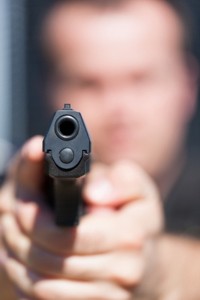 Would
that it could, that one shot from an officer’s sidearm could
effectively stop a deadly suspect in his tracks. Oh, it can
and has happened but the “Myth of the One Shot Stop” has
been disproven many years ago.
Would
that it could, that one shot from an officer’s sidearm could
effectively stop a deadly suspect in his tracks. Oh, it can
and has happened but the “Myth of the One Shot Stop” has
been disproven many years ago.