 By John E. Reid & Associates
Each year in the United States hundreds of thousands of polygraph
examinations are administered. The primary value of the polygraph
technique is to eliminate innocent suspects early during an
investigation. This greatly assists an investigation in that
investigators can focus their efforts on other suspects. When a
suspect is identified as deceptive, frequently the suspect will
confess during an interrogation that follows the polygraph
examination. While this may sound like a positive finding, it is not
because it encourages incompetent examiners to use the polygraph
instrument as a psychological prop to elicit confessions.
Properly administered, the polygraph technique is a non-accusatory
diagnostic procedure that allows an examiner to collect
physiological data to infer whether or not a subject is telling the
truth to relevant questions (see August web tip). Accusatory
interrogation has no place in a properly conduced polygraph
examination (Reid and Inbau, Truth and Deception the Polygraph
"Lie-detector" Technique, Williams and Wilkins, 1977).
Unfortunately, the private environment and intimate relationship an
examiner forms with a subject during a polygraph examination creates
an ideal breeding ground for a confession. This factor is
significant enough that some state supreme courts have ruled that
taking a polygraph examination is so inherently coercive that any
confession made during the course of a polygraph examination should
be suppressed. It should be understood that a confession obtained
during an interrogation following a polygraph examination is
accepted in all states.
Since the polygraph is not a lie-detector, its usefulness during an
investigation is entirely dependent on the competency of the
examiner. A competent examiner will be accurate in determining truth
or deception approximately 90% of the time (based strictly on chart
analysis). This figure will increase if the examiner incorporates
other means of detecting deception such as behavior symptom
analysis. The competent examiner will be unable to render a definite
opinion of truth or deception in about 10% of subjects examined. An
examiner who boasts of an accuracy rate above 95% and an
inconclusive rate less than 5% should be avoided.
Training in the polygraph technique can range from two to six months
of instruction. The best training programs include not only the
basic class-room instruction, but an internship period as well.
During this internship the student's charts and procedures are
carefully scrutinized to develop clinical skills. Following this
training and obtaining a license, if required, competent examiners
will join a professional organization such as the American Polygraph
Association or the Association of Police Polygraphists.
An important part of an examiner's training is to identify those
subjects who are at risk for producing erroneous results. The ideal
subject is one of average, or above average intelligence, who is not
mentally impaired and is in reasonably good medical health. It is
also important that the subject's emotional state is relatively
stable during the examination. A leading cause for false positive
results (reporting a truthful subject as deceptive) is anger within
the subject. This anger may be caused by prior interrogation or an
accusatory pre-test interview. Inadequate development or selection
of control questions is another cause for false positive results.
False negative results (reporting a deceptive subject as innocent)
may be the result of improper question formulation in which relevant
questions are phrased in such a way that they do not present a
significant threat to the guilty person. Subjects with a lower
intelligence may also increase the risk of a false negative result.
In some cases, a guilty subject may engage in countermeasures that
the examiner fails to recognize during chart analysis. Identifying
countermeasures is a critical part of a competent examiner's
training. In our office almost 25% of guilty suspects are identified
primarily because of their use of countermeasures. Innocent subjects
allow their body to respond normally during a polygraph examination.
It is the guilty subject who will consciously try to manipulate the
polygraph recordings. In this regard, agencies should be very
cautious when using an examiner who relies exclusively on computer
analyzed charts. None of the software developed for this purpose is
capable of identifying specific subject countermeasures.
Another aspect of a competent examiner's training is to identify
unsuitable subjects. Generally speaking, children under the age of
14 are not suitable for the polygraph technique. Subjects with
significant mental disorders, such as diminished mental capacity or
symptoms of detachment from reality are often not suitable for the
technique. The subject's mental state is also an important
consideration. Fatigue, intoxication, anguish and trauma may each
render a subject unsuitable for the polygraph technique.
Without a doubt, however, the greatest risk for erroneous polygraph
opinions is outside pressure. Agencies place tremendous pressure on
polygraph examiners to obtain findings consistent with predetermined
expectations. There is pressure to form an opinion in every case
and, when a subject produces deceptive polygraph results, to obtain
a confession from that subject. For these reasons the position of a
polygraph examiner should be somewhat autonomous from other agency
functions. The personality of the examiner should be such that he or
she is an analytic thinker and possess a great deal of
self-confidence with little interest in pleasing others or advancing
in rank through politics.
With this background, the following are recommendations for the
proper use of the polygraph technique during an investigation:
Only use a well-trained, competent examiner;
-
Use polygraph examinations early during an investigation when
there are multiple suspects with opportunity, access and motive;
-
For legal reasons, do not use the polygraph as a ruse to get a
guilty suspect into a controlled environment merely to conduct
an interrogation;
-
Avoid engaging in accusatory interrogation if the suspect may be
willing to take a polygraph examination;
-
Accept the examiner's opinion that a particular subject is
unsuitable;
-
Do not place pressure on an examiner for a definitive opinion
-10% are inconclusive;
-
If practical, have a second examiner "blindly review" polygraph
charts to verify the original examiner's opinion;
-
Do not rely on an examiner to solve your cases with a
confession. The technique should serve as a diagnostic
investigative aid to establish a person's truthfulness.
Credit and Permission Statement: This Investigator Tip was developed
by John E. Reid and Associates Inc. Permission is hereby granted to
those who wish to share or copy the article. For additional 'tips'
visit
www.reid.com;
select 'Educational Information' and 'Investigator Tip'. Inquiries
regarding Investigator Tips should be directed to Janet Finnerty
johnreid@htc.net.
For more information regarding Reid seminars and training products,
contact John E. Reid and Associates, Inc. at 800-255-5747 or
www.reid.com.


The critical need for "Immediate Action Rapid Deployment" in school
invasions
|
The nightmare scenario
Two armed men carrying handguns and knapsacks reportedly
have entered a local elementary school. You are the closest
responding patrol asset.
What will YOU do?
Upon your arrival, what happens next greatly depends upon
the policy of the law enforcement agency that signs your
paycheck. What you would do if your child was in this school
may be vastly different than what your department expects
you to do. Here’s a few of the most common patrol first
responder actions:
1.
Not hearing any gunfire, establish an outer perimeter to
prevent escape and call for backup.
2.
Hearing gunfire, wait for the predetermined amount of
officers to arrive, make a plan, and enter the structure in
accordance with your agencies’ active shooter response
procedures.
3.
Whatever you want, as your agency has no formal policy,
training or equipment.
Historical background
Statistically, shootings have killed far more children at
school than fires. Hundreds of millions of dollars are spent
protecting school children from the threat of fire, while
minimum training and resources are devoted towards
protecting them from gun violence. For those who do not
believe that school massacres are a realistic threat, there
have been over forty documented school shooting rampages,
the great majority of them occurring in the United States,
beginning back in 1966.
The phenomenon of the suicidal killer has steadily increased
in both frequency and victims. In addition to homegrown
deranged predators, the U.S.-based radical Islamic terrorist
cell now must be considered a credible threat to the safety
and well being of our school-age children. It is well known
that Al Qaeda leaders and followers consider American
schools prime targets of opportunity. They know that a
traditional delayed tactical entry following a period of
protracted negotiation allows ample opportunity to stage the
planned massive final carnage after the arrival of the
worldwide media.
Containment & negotiation tactics at school: A deadly policy
Recent history has proven that the traditional police first
responder tactic that requires the establishment of an outer
perimeter while waiting for backup usually assures that the
planned death of innocents will occur when the intruder is
homicidal and suicidal. It is a common law enforcement
belief that most armed school invaders probably wish to live
and escape, and that aggressive actions initiated by first
responders could “set them off”, and make the situation
worse. Nothing could be further from the truth.
The decision to utilize containment and negotiation as
automatic “default” tactics when the intruders’ motivations
are not known is extremely risky, especially when innocent
children are the potential victims. In the case of a
homicidal and suicidal individual, waiting for them to go
active and begin killing must not be the signal to begin
aggressive pursuit and containment. By then, it is too late.
Every armed and hostile individual entering a public area
must be considered to be homicidal and suicidal, unless
credible information is known to the contrary. This
knowledge cannot be quickly ascertained from a distance. The
more time an aggressive police approach takes to happen, the
longer the armed intruder has to control the environment and
work their plan, the bolder the predator will become and the
more unlikely a bloodless outcome is to occur.
From the moment an armed, homicidal and suicidal predator
enters the building, the end plan is known only to them. In
the case of a school intruder, they usually do not plan to
leave the building alive. Nor do they plan on dying alone.
It becomes the duty of the first responder to interrupt this
murderous plan to minimize carnage at the earliest possible
moment.
In the case of a terrorist school takeover, any delay of the
first responder to actively engage the intruders will
guarantee that ultimately, many innocents will die due to
the delayed aggressive response. The sound of gunfire will
not be heard upon arrival of the patrol officer, it will be
eerily quiet as the terrorists gather children into a
central location and set up bobby traps to slow down future
rescuers. We know this, and so do the terrorists.
Law enforcement policymakers who do not allow first
responders discretion and encourage them to approach armed
school invaders are not delivering the quality of public
safety their citizens deserve. In a dynamic school invader
situation, first responding patrol officers are likely the
only people on scene early enough to save innocent lives.
But only when they are authorized, trained and equipped to
do so.
Patrol-level “Immediate Action Rapid Deployment” (IARD): An
effective aggressive tactic
The sooner first responding officers can establish close
physical proximity to a homicidal and suicidal individual,
the quicker the incident comes to a conclusion. In the
majority of cases, these psychopaths kill themselves as soon
as police gain close proximity, abruptly ending the carnage.
Swift, aggressive contact is the key to interrupting a
deadly plan of mass murder. An active shooter being pursued
by police during a running gun battle is better than
allowing the predator unlimited mobility and time to
accomplish their planned murderous activities.
Recently, an off-duty officer in a large Salt Lake City
shopping mall, armed with only a handgun successfully chased
and cornered a well armed active shooter into a side alcove,
interrupting the rampage and restricting his mobility.
Responding on-duty officers were swiftly able to back-up the
off-duty officer and kill the shooter. Prior to the running
gun battle with the pursuing off-duty officer, nine
innocents had been shot and five died. Not one additional
citizen was shot after the shooter focused his attention
towards this aggressive and heroic officer!
A note on modern equipment now available for patrol-level
IARD
During the nightmare scenario of an armed school intruder,
every second counts. Police administrators must consider
empowering, training and equipping patrol officers to
conduct “Patrol IARD” if the modern delivery of public
safety and the saving of innocent lives is the goal.
The advent of the lightweight Baker Batshield®
portable ballistic shield has made this patrol operation
possible with a minimum of training. An amazing balance of
first responder speed, accuracy, and ballistic protection
has been achieved. First responding patrol officers now have
the ability to utilize progressive Immediate Action Rapid
Deployment (IARD) tactics by approaching armed individuals
prior to, or during active shooter emergencies. Public
safety is delivered in accordance with public expectations.
Visit
www.bakerbatshield.com
for complete information, including live-action video
demonstration.
|
Rick Armellino is the Director and Chief Executive
Officer of
Baker Ballistics,
LLC., the manufacturer of the Baker Batshield®
personal ballistic shield. He has over thirty years
experience in the body armor industry, including
Director of Research and Development and President
of American Body Armor and Equipment, Inc. Rick's
body armor designs have saved over forty American
LEO's from death or serious injury during attacks by
gunfire. Recently, Rick has partnered with noted
ballistic shield trainer, Lt. Al Baker (NYPD, ret.),
to advance the concept of Immediate Action Rapid
Deployment (IARD) tactics for use by first
responders in the approach to armed and hostile
individuals in public places.
|
|
By ©2010 Brian S.
Batterton, Attorney, Legal & Liability Risk Management Institute
(LLRMI.COM)
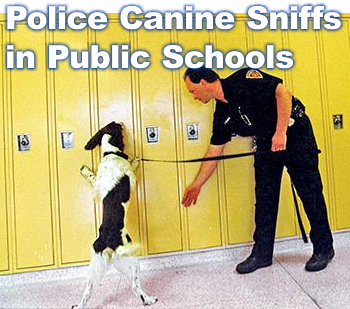
As
public school officials attempt to combat the problem of illegal
drugs at school, the use of police drug sniffing canines is becoming
more prevalent. It is well established that canine sniffs of
lockers and parked cars do not constitute a "search" under the
Fourth Amendment.[i]
However, in some situations, the facts leading up to the use of a
canine may implicate the
Fourth Amendment
by constituting a seizure of a person or property prior to the use
of the canine.
On
March 5, 2010, the Court of Appeals of Texas (Austin) recently
decided
In the Matter of D.H.[ii],
which dealt with such an issue. The facts of
D.H.
are as follows:
In October 2006, officers from the Austin Police
Department arrived at Reagan High School to conduct a canine search
of the school. D.H., who was sixteen at the time, was a student at
the school. Assistant Principal Mike Perez led the officers through
the school, allowing the dog to sniff several classrooms on each
floor of each building. For every inspection, Perez entered the
classroom and informed the teacher of the sweep. The students were
then instructed to leave their property in the classroom and wait in
the hall, and the police entered and allowed the dog to sniff the
items left in the room. The students were not allowed to refuse the
instructions or to take their items with them. When the officers
searched D.H.'s classroom, the dog reacted to her backpack. The
officers called D.H. into the classroom, read D.H. her rights, and
searched her bag, where they found a small bag of mariJuana. [iii]
D.H. filed a motion to suppress with the trial
court alleging that her bag was seized without reasonable suspicion
when she was required to leave it in the class while the canine
conducted a sniff of all bags in the room. The trial court
denied the motion to suppress.
D.H.
appealed and argued (1) her backpack was seized for
Fourth Amendment
purposes when she was required to leave it in the class and (2) the
seizure was not supported by reasonable suspicion since neither the
officers nor school official had a reason to believe that she was
engaged in a school rule or law violation. [iv]
The Court of Appeals of Texas (Austin) first
examined some general rules regarding searches and seizures in
schools. The rules are as follows:
- Although probable cause and a warrant are
generally required before law enforcement may conduct a search,
a search unsupported by probable cause may be reasonable 'when
"special needs, beyond the normal need for law enforcement, make
the warrant and probable-cause requirement impracticable. [v]
[internal quotations omitted]
- Although students in public schools do not
shed their constitutional rights . . . at the schoolhouse gate,
their constitutional rights are not automatically coextensive
with the rights of adults in other settings, and must be
considered in view of the school environment. [vi] [internal
quotations omitted]
- The public-school context requires a relaxed
standard of reasonableness because insisting on "the warrant
requirement would unduly interfere with the maintenance of the
swift and informal disciplinary procedures [that are] needed,'
and 'strict adherence to the requirement that searches be based
on probable cause' would undercut 'the substantial need of
teachers and administrators for freedom to maintain order in the
schools. [vii] [internal quotations omitted]
- In determining
whether a search or seizure of a student or her property
conducted was reasonable, we first consider the
nature of the implicated privacy
interest, then consider
the
character of the intrusion,
and finally consider the
nature and immediacy of the
government's concerns and the efficacy of the [school's action]
in meeting them.
[viii] [emphasis added]
- [T]he Supreme Court has expressly refused to
impose a requirement of "individualized reasonable suspicion of
wrongdoing" on schools' attempts to prevent student drug use.
[ix]
The
court of appeals then declined to decide whether or not D.H.'s bag
was seized within the meaning of the
Fourth Amendment;
rather, the court stated that they would assume the seizure occurred
(since a seizure occurs if there is
meaningful interference
with a person's possessory interest in property) and decide the case
based upon whether such a seizure of D.H's bag was reasonable in the
public school setting.
Thus,
the issue before the court was
whether the seizure of D.H.'s bag by
requiring her to leave it in her class while a conducted conduct a
sniff of all bags in the class was reasonable under the Fourth
Amendment as applied in the school setting.
The court then applied the facts of D.H.'s case
to the rules above. The court stated that to determine whether
the seizure of the bag was reasonable, they would use the three part
test from the rule above (see fourth bullet point) and examine (1)
the nature of the implicated privacy interest, (2) the character of
the intrusion, and (3) the nature of the schools concerns and the
efficacy of the seizure in addressing those concerns (drugs). [x]
Thus, the court first examined the privacy
interest that was frustrated by the seizure of D.H.'s backpack.
In light of the fact that students have a somewhat lessened
expectation of privacy at school and are sometimes subjected to
greater control than adults in a public environment, the court
stated
considering that D.H.'s backpack was not opened, nor were its
contents examined, until after the dog alerted on it, and bearing in
mind the control and supervision that school authorities must
properly exercise in their roles as guardians and tutors of their
students,
we hold that restricting D.H.'s
ability to take her backpack with her implicated a relatively minor
privacy interest.
[xi][emphasis added]
Second, the court of appeals considered the
nature or type of infringement of D.H.'s privacy rights. The
court noted that the students were removed from the class and only
the police officers and the assistant principal were in the class at
the time of the canine sniff. As such, there was no likelihood
that D.H.'s backpack was likely to be stolen and there were no other
students around that may embarrass D.H. The court then stated
Given the method employed
in conducting the canine inspection and the minimally intrusive
nature of the inspection, we hold that the invasion of D.H.'s
privacy was not significant.
[xii] [emphasis added]
Last, the court of appeals considered the nature
and immediacy of the government's (schools) concerns and the
efficacy of the seizure of D.H.'s bag in meeting those concerns.
The court noted that, in previous cases, the United States Supreme
Court has stated that there is an important or perhaps compelling
government interest in preventing drug use by schoolchildren. [xiii]
The assistant principal testified that he knew there was a drug
problem at the school because school officials have found marijuana
being sold at school as well as children returning from lunch under
the influence of drugs. The assistant principal also said that
drugs at school are a serious safety issue due to belligerent
behavior as well as dangerous physical reactions. He also said
that the school officials were always on the lookout for drug use.
Additionally, students and parents sign off on the student handbook
which contains the school policy prohibiting drugs at school.
The court then stated
Considering the low level
of intrusion on D.H.'s limited privacy rights and the evidence about
the drug problem at Reagan High, we hold that the seizure
effectively addressed the problem of student drug use and served the
important governmental interest in protecting the students' safety
and health.
[xiv] [emphasis added]
In light of analysis of the three part test to
determine if the seizure of the bag was reasonable, and in light of
other court precedent from other jurisdictions [xv], the court held
that the brief seizure of D.H.'s bag by requiring her to leave it in
her class as a canine conducted a sniff, was reasonable under the
Fourth Amendment in a public school setting.
________________
NOTE:
Court
holdings can vary significantly between jurisdictions. As
such, it is advisable to seek the advice of a local prosecutor or
legal advisor regarding questions on specific cases. This
article is not intended to constitute legal advice on a specific
case.
SEE RELATED ARTICLES:
Georgia Court Upholds Canine Sniff During
Traffic Stop
U.S. Supreme Court Upholds Canine Sniffs of
Vehicles
Locker Searches and use of K9's
More School-Related Articles
CITATIONS:
[i] Horton
v. Goose Creek Indep. Sch. Dist.,
690 F.2d 470 (5th Cir. 1982); see also
United States v. Place,
462 U.S. 696 (1983);
Illinois v. Caballes,
543 U.S. 405 (2005)
[ii] 306 S.W. 3d 955, 2010 Tex. App. LEXIS
1610
[iii] Id. at 957
[iv] Id.
[v] Id.
at 957-958
[vi] Id.
(quoting
Morse v. Frederick,
551 U.S. 393, 396-97, 127 S. Ct. 2618, 168 L. Ed. 2d 290 (2007)
(quoting
Tinker v. Des Moines Indep. Community Sch.
Dist.,
393 U.S. 503, 506, 89 S. Ct. 733, 21 L. Ed. 2d 731 (1969);
Bethel Sch. Dist. No. 403 v. Fraser,
478 U.S. 675, 682, 106 S. Ct. 3159, 92 L. Ed. 2d 549 (1986);
Hazelwood Sch. Dist. v. Kuhlmeier,
484 U.S. 260, 266, 108 S. Ct. 562, 98 L. Ed. 2d 592 (1988)).
[vii] Id.
(quoting Acton, 515 U.S. at 653 (quoting T.L.O., 469 U.S. at
340-41); see Earls, 536 U.S. at 828-29; see also Safford Unified
Sch. Dist. # 1 v. Redding, 129 S.Ct. 2633, 2639, 174 L. Ed. 2d 354
(2009)
[viii]
Id.
(citing Earls, 536 U.S. at 830, 832, 834)
[ix]
Id.
(citing Earls, 536 U.S. at 837)
[x] Id. at
959
[xi] Id.
[xii] Id.
[xiii] Id.
(citing
Acton,
515 U.S. at 661)
[xiv]
Id.
at 960
[xv]
Id.
at 960 fn3 (See also
Louisiana v. Barrett,
683 So.2d 331, 338 (La. Ct. App. 1996) (school required students to
empty pockets onto desk and leave classroom to allow drug dog to
sniff belongings; "Taking into account the decreased expectation of
privacy defendant had as a student, the relative unobtrusiveness of
the search, and the severity of the need met by the search, we
conclude the type of search conducted in this case (wherein
defendant was asked to empty his pockets and leave the room) is
reasonable and hence constitutional.");
Smith v. Norfolk City Sch. Bd.,
46 Va. Cir. 238, 244-45, 261 (Va. Cir. Ct. 1998) (students were
required to leave belongings in classroom to be sniffed by drug dog;
"Balancing Condon's lessened privacy interests and the minimal
intrusion upon them against the strong governmental concerns with
drugs and guns, this Court concludes that Condon's rights were not
violated by the brief seizure of his belongings.").
WWW.PATC.COM/NEWS
Contact Information
phone:800.365.0119 (local: 317.821.5085)
email:
information@patc.com
web:
www.patc.com
|
www.llrmi.com
Fax: 317.821.5096
< <
jump to the policetraining.net home page



