| Calendar | Add A Class | College Degrees | Online Classes | DVDs & CDs | On-site Classes | Advertising | Contact Us |


Sign up for FREE training articles & class updates Your Email:


cleardot.gif (807 bytes)


cleardot.gif (807 bytes)

December 2015

Important: To ensure future delivery of the Policetraining.net newsletter to your inbox (not bulk or junk folders) please add our "From" address info@policetraining.net to your address book or e-mail whitelist.

in this issue . . .


- Sponsored By -

line-small.gif (227 bytes)


The New Replacement For The Expandable Police Baton?

By Thomas J. Archambault

When I started as a police officer in the 1970’s the police baton was the really the only major tool on the duty belt. Fortunately, training progressed through the years with certification and standardized lesson plans and other tools were added. It is amazing how things have progressed in a relatively short amount of time. More routinely used today are: OC Defense Spray, Electronic Control devices (Tasers), less lethal shotgun, Pepperball, FN203’s, JPX Jet Pepper Gun. These less lethal tools will continue to advance and be implemented for all law enforcement and correctional use of force conditions. This reduced use of force equipment has been demonstrated to saves lives and has resulted in a significant reduction in costly litigation.


Living in a world of Smartphone video, social media and anti-law enforcement propaganda, training in “low profile use of force” has become more critical today than at any other time in law enforcement history.
During my national training, I have asked hundreds of officers 3 simple questions regarding baton use:

Q: How much is it actually used in the field?
A: Most state they have not used the baton in years and rarely ever even take it out of their holster
Q: How much discomfort does it cause?
A: Very uncomfortable. There is too much other required gear to be carried and it is a poor design when getting in and out of a vehicle.
Q: Would they support the notion of having it replaced in the duty belt?
A: The majority said YES.

An impact weapon can be a valuable device and has its place in close use of force confrontations. The problem that arises with an Expandable Police Baton is a partially because of its high visibility. When deployed it tends to escalate confrontations.
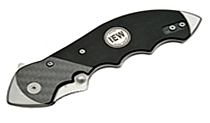
The new IEW® ® (Impact Edged Weapon©) addresses these situations in a low profile carry and low visibility deployment. It provides extremely effective incapacitating striking capabilities in a concealable impact weapon. The IEW® was released at the 2015 Shot Show in Las Vegas. It was received extremely well law enforcement and knife enthusiasts.

Much has been learned in 32 years of use of force training in the control and restraint of violent subjects. All less lethal devices are designed to assist in the physical control of the subject. Restraint is accomplished after (or during) the employment of the tool assisting in the control of the subject for eventual restraint with handcuffs or other appliance.
OC Spray, Taser, less lethal munitions all disrupts the biological function of the body in different ways and eventually the psychological intent of the subject. All of these weapon systems can pose serious health risks that have resulted in the deaths of numerous subjects regardless of age, physical condition and intoxicant involvement.

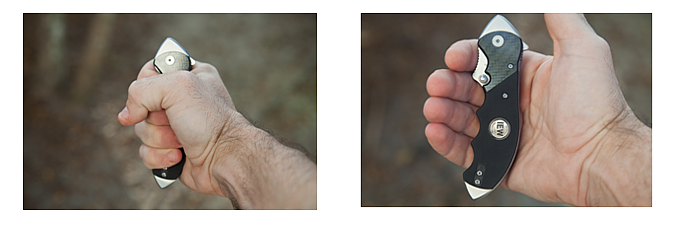
So what is the health or injury risk with an impact weapon? Nothing more than a blunt trauma injury. The primary strike zone with the IEW® is the thigh of the leg delivered in a hammer-fist type strike. It will take a subject down quickly leaving nothing more than a bruise and soreness in the strike area. A retired NYPD training officer I spoke with told me that had Eric Garner (NY non-choke hold event) been struck with the IEW® the whole incident may have had a different end result.


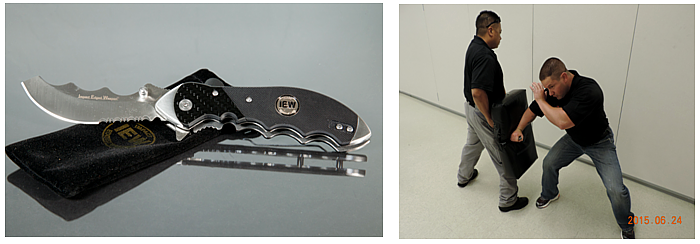
The IEW® delivers it powerful fluid shock wave energy transfer with the strike points on the ends. The blade has finger grooves that align with the handle providing solid and comfortable ergonomic control when striking or breaking windows.


The IEW® handle is constructed of carbon fiber and G-10 plastic. The blade is 440C with a straight and serrated edge for cutting of seats belts. The strike points and inner liner are constructed with stainless steel. The IEW® additionally has an ambidextrous belt clip, thumb studs, finger roll and is auto-assist. Each IEW® is individually serial numbered for ownership safeguard.

TJA Use of Force Training, Inc. is providing an IEW® Instructor Certification Kit© for Expandable Police Baton and Impact Weapon Instructors. (TJA has provided these kits for more 15 years for OC Instructor & recertification in several areas for law enforcement and corrections nationwide) The “kit” is U.S. Priority mailed to the Instructor. Contained in the kit is: USB thumb drive with an IEW® PowerPoint program; all basic course materials; instructor registered written exam and a self-stamped addressed envelope for mailing of the materials back to the TJA office. Once received within 7 working days, the instructor certificate is mailed to the instructor. IEW®’s are provided for departments at a discount price of $75.00 (MSRP $125.)

The IEW® is a great low profile, concealable impact weapon and a useful tactical knife.
For additional information: visit YouTube® “IEW KNIFE” or contact TJA Use of Force Training, Inc., 1301 SW 4th Court, Cape Coral, FL 33991; Main# 239-281-5181; tja1@tactical-training.com or www.tactical-training.com .

The Author: Thomas J. Archambault is a 32-year nationally recognized use of force trainer and expert. He specializes in non-lethal use of force and less lethal technologies with a specialty field of control and restraint techniques & tactics. He has trained and certified 1000’s of instructors throughout the United States at municipal, county, state and federal levels of law enforcement, corrections and the U.S. Military.

 line-small.gif (227 bytes)

Fitness Tip from 

Create a rock-solid foundation while enhancing mobility, stability, and strength with this full-body exercise utilizing a sandbag featured in this
video.  

    line-small.gif (227 bytes)


Slugs vs. The Rest


This climate is beating the motivation out of cops, and the public is bearing the consequences

 By Jim Glennon

I believe there are generally two types of police officers. These are:

1   The Slugs: These generally do as little as possible, just enough to keep the bosses off of their collective behinds. They work harder at not working than doing the actual job.

2   The Journeymen: They work because they want to make a difference becoming cops for all the right reasons. These officers are the foundation of a police department.

 If I were to ask you, “Of these two groups, which find themselves in trouble most?” What would be your answer?

For those of you not in law enforcement, who work in the private sector and have goals, agendas, and deliverables related to the bottom line, you’d most likely say that the obvious answer is #1—The Slugs.

And you wouldn’t be more wrong.

Held to Different Standards Those Slugs, get in trouble the least—by far!

“What? No! That just doesn’t make sense.”

You’re right, it doesn’t make any sense. At least not if you live in the world that sees a correlation between specific behavior, completion of tasks, innovative thinking and financial success.

In the private sector the ultimate goal is the bottom line. Achieve or go out of business.

But government and law enforcement is a completely different animal. What is the goal of those working in government? Keep your job.

I know that sounds cynical, but it has become the nature of the bureaucratic beast. Check with any police agency in the country and see if you can find published, predetermined, specific and measurable goals to which employees will be held to account. Don’t waste your time, they don’t exist.

What you will find are well-intentioned and sincere “Mission Statements” designed to communicate philosophy. What they won’t specify are measurable goals, such as a reduction of crime rates, a decrease in the numbers of homicides and/or the saving of lives.

Why? Because in government there is no real bottom line, no way to actually go out of business. Almost no way to get fired, unless of course you screw something up. And, to screw something up you need to be doing.

Slugs vs. Journeymen Back to The Slugs and The Journeymen.

The people in Baltimore are screaming that the police aren’t doing their jobs. I saw one citizen on the tube saying something along these lines: “They get paid. They need to get back here and do their jobs. I don’t care what their excuses are. We pay their salaries, just order them to get back here and do what they get paid to do!”

And there is the conundrum. What do they get paid to do, exactly?

Define it specifically. Oh, you can demand they answer 9-1-1 calls, write legible and thorough reports, and patrol specific areas.

But beyond that? You can’t. Seriously, you can’t define the specifics when it comes to the day-to-day activity and behavior of an individual police officer.

Hell, most states won’t even allow the imposition of minimum standards (quotas). And even if quotas are allowed, how do you manage and supervise that? You want them to write one ticket a day? Great! The Slugs will write one ticket. But never two.

The simple fact is this: Police officers who do the bare minimum NEVER get fired. You won’t find cops getting pink slips for a process of lousy work over a period of years. No, when police officers get fired they get fired because of an event: They get fired for doing!

The reality: Police officers have a job that isn’t task specific and is almost totally autonomous. If they want to drive around all day answering radio calls and do nothing more, they can. They won’t be fired for not being proactive because proactivity cannot be managed.

The People Want—What? The people in Baltimore, New York and Chicago are experiencing a rise in crime and they are all looking to the police for help. Suddenly the complaint is that the police aren’t proactive enough.

Not proactive enough? Really?

For the last year everyone from the Mayor of New York to the national media and the ACLU has been screaming that the police are too proactive, too aggressive, too involved. Too many arrests were made for minor crimes: single sales of cigarettes, loitering, jaywalking, personal use of marijuana, etc.

Stop-and-frisk arrests became associated with racism and an example of rampant bias and prejudice. When force was used, the media portrayed it as the fault of the police and not those who were brazenly committing crimes and resisting arrest.

The media, politicians, pundits and intellectual class demanded that officers be held accountable.

So who got in trouble? The Slugs? Nope! It was the proactive cops, The Journeymen. And they’ve gotten the message: If I do less I get paid the same, can’t get hurt, and won’t get in trouble.

What most don’t understand is that the stop-and-frisk cops are the best police officers on the street. They use their experience and honed instincts to stop crime before it happens. They are invaluable to the citizens who truly need them patrolling their streets.

Great cops detect the body language cues of drug dealers, armed robbers, pick-pockets and others who make their living victimizing the innocent. And when they do, they approach, question and if they have articulable facts and reasonable suspicion, they frisk.

And not only is it the absolute best way to thwart and deter criminal behavior, it’s 100 % legal.

And for the last year or so, great cops have been called racists, brutes, thugs and criminals.

Now What? How do you manage police officers who have decided to do only the bare minimum? How do you demand proactive behavior? How do you manage and discipline for a lack of it?

Guess what? You can’t.

You want them using their experience. You need to encourage proactivity. But that means risk. It means having to justify actions after they’ve been taken. Why did you stop that particular person? What exactly drew your attention? And since reasonable suspicion is less than probable cause and tough to articulate, this leaves tons of room for the injection of bias complaints from everybody.

Motivation, true motivation, is intrinsic in nature, especially for law enforcement officers. That motivation is being beaten out of the proactive cops. They are getting the message.

Lt. Jim Glennon, a third generation LEO, retired from the Lombard, Ill. PD after 29 years of service. Rising to the rank of lieutenant, he commanded both patrol and the Investigations Unit. In 1998, he was selected as the first Commander of Investigations for the newly formed DuPage County Major Crimes (Homicide) Task Force. He is the owner of The Calibre Press Street Survival Seminar. He is the author of Arresting Communication: Essential Interaction Skills for Law Enforcement.

line-small.gif (227 bytes)

Sexting and Sextortion – It’s Not the Crime You Think, It’s Worse

By Daphne Levenson – Next Generation Training Nov. 10, 2015

Sexting and Sextortion are similar to rape and underage prostitution cases, in that, often the wrong person gets blamed.  Most programs and trainings center around “Just say No” and we know how well that (didn’t) work for drugs.  Thankfully many states are passing laws that give the police and prosecutors with more options than labeling everyone who received an unsolicited photo a sex offender for life.

Peer pressure comes in all shapes, sizes and sexes.  Little Suzie and friends can be pretty nasty.   Your normally level headed daughter gets invited to a slumber party and all the girls are taking selfies in their underwear.  They start sharing on-line.  All the other girls are pressuring your daughter, she feels safe in the friend’s bedroom, it seems a little naughty but fun, what could it hurt?  Especially when they tell her that if she doesn’t do it she is too immature to hang-out with them anymore! Did I mention girls are nasty?

As a mother of teen boys, I’ve heard other boy’s mom’s say “Well it’s that slutty girl’s fault.  If she hadn’t taken and sent the picture, my little Johnny would have never of forwarded it.” In my class on this topic, and at the ballpark, I am pretty blunt. Have you checked Johnny’s phone to see what preceded the picture? Is your darling baby-boy pressuring her, begging her, pledging eternal love, making promises (to her and 6 other girls)?  When Johnny gets a picture does he ask for more, different positions?  Does he threaten to send it out to the school or her parents if sweet talking doesn’t work?  If so your precious Johnny is a predator in the making, in fact, he may have an on-line coach and community.   

Technology and predators have advanced so that the predators don’t even have to talk kids into sending photos, although many still do enjoy the thrill of that chase.  Naked or near naked photos of mostly, underage girls, are traded like baseball cards.  In one case, near Houston, a 14 years old girl sent several hustler-style pictures to her 19 year old “on-line” boyfriend.  However, it wasn’t until those pictures ended up with hundreds of others girl’s pictures uploaded to a very popular, main-stream, photo-sharing application in the cloud, that the FBI and media got involved.  Did the girl willingly send the pictures to the 19 year old?  Yes, however, I doubt her intent was such global distribution.  

Predators LOVE training new people. That is a lesson straight out of child molester’s handbook.  Find other people that like the same thing your do and it proves you’re not a sicko.  So how do you get t+he password to join the naughty picture club?  Provide pictures of a girl we don’t have.  They will even tell you the different positions to ask for and give you a script to go by.  Extra kudo’s if you can fill a niche they don’t have (Ex. Asian, Hispanic, barley developed…), you get the idea.  

The internet doesn’t come with filters.  Our childhoods were tame by comparison.   We may have played doctor or looked at our elders Playboy magazine but we did not have 24/7 unlimited exposure to EVERY FETISH in the world on tap at the click of the search button.  Is it any wonder our kids desensitized to nudity at such a young age.  Maybe this is the temptation that does lead some girls to send out nude pictures as unrequested “flirts.”  Obviously, this type of behavior indicates self-esteem or other issues.   

By the way - how is the security on your kids phone and laptop? Are you positive that app they downloaded last night doesn’t have a backdoor for perv’s to steal all their pictures (with geo-location information) or take pictures of your wife, daughter, sister through their web camera without them know while they are changing clothes. Check out the Ms. Teen America video:  http://tinyurl.com/NGTsexting.  Predators are disgustingly patient. They will get a picture of a girl  and sit on it for months or years, stalk her on social media until they see she has applied to college, has a new job or is getting married then extort her for more pictures, even video’s, with the threat to ruin her life – this crime is called Sextortion. (Check out the FBI video’s on it at the link above)     

As with many crimes, by the time the police are called in, we only see the symptoms to the larger issue.  We need training to understand the big picture preferably held with other stakeholders such as schools, DA’s, etc.  We cannot work in isolation from parents, pre-teens and teens to catch the real bad guys, not just the fish caught in the net.  Avoiding the conversation and education will delight the predators who are of course always willing to lend a listening ear when those mean authority figures just do not understand. 

Bio - Daphne Levenson delivered grant funded DOJ training for 18 years.  She was also the Director of the Alabama Association of Chief of Police for 7 years.  She and her husband, a retired Police Lieutenant own Next Generation Training www.NextGenTraining.org and continue to travel nationwide to deliver training classes to law enforcement and related stakeholders on topics they are passionate about.