
By John E. Reid & Associates
A concept we teach in our
basic course is, "If you're going to interview, interview. If you're
going to interrogate, interrogate." There are two important parts of
this lesson. The first is that there are significant procedural
differences between interviewing and interrogation. The second is
that if these procedures are intermingled, the investigator will
often be ineffective in accomplishing the goals of either one.
An Interview
An interview is a non-accusatory question and answer session with a
suspect, victim or witness. The goal of an interview is to gather
information and make an assessment of the subject's credibility.
Some of this information will be investigative in nature. Examples
of investigative questions include, "When did you arrive home last
night?"; "Do you have access to a handgun?"; "Do you know who Gloria
Smith is?" Other interview questions are specifically designed to
elicit behavioral responses from a subject such as, "Do you think
this lady really was raped?" or, "Tell me why you wouldn't force a
woman to have sex with you?"
It is important that the investigator maintain a non-accusatory tone
and demeanor during an interview. This is so even when he knows that
the subject has lied to an investigative question or exhibits clear
indications of deception to a question designed to evoke behavioral
responses. Under this circumstance if the investigator becomes
accusatory or challenging the subject will become guarded and
reluctant to offer information. A subject will offer much more
meaningful information if he does not feel threatened or
intimidated. In short an investigator should allow, and in some
cases, even invite subjects to lie during an interview. As long as
the subject continues to answer the investigator's question
information is being learned.
During an interview the investigator should talk about 20% of the
time and the person being interviewed 80%. To accomplish this
balance, the investigator should keep his questions succinct and,
whenever possible, elicit a narrative response from the subject. Too
often, investigators reveal so much information through their
questions that following an interview the subject has learned much
more about the investigation than what the investigator has learned
about the suspect's possible involvement in the crime.
An Interrogation
The purpose for an interrogation is to elicit the truth from a
person whom the investigator believes has lied during an interview.
It represents, therefore, an effort to persuade the subject to tell
the truth. In some instances, an innocent person will be
interrogated. Under this circumstance interrogation tactics used
must not be so persuasive as to elicit a false confession. A
particular tactic to avoid is to threaten the subject with
inevitable consequences followed by a promise of leniency if the
subject confesses.
The interrogation should not consist of accusatory questions for
this will only lead to further denials from the subject. Rather, it
should consist of a monologue during which the investigator makes
statements designed to persuade the subject to tell the truth. The
monologue often addresses the circumstances which led up to the
subject's commission of the crime. In addition, logic and rationale
arguments (based on evidence) may be used to persuade the subject to
tell the truth.
During an interrogation, the investigator's demeanor should be
understanding toward the subject's criminal behavior. It is
psychologically much easier for a subject to tell the truth to
someone who appears to understand why he committed the crime. At no
time should the investigator remind the subject of the seriousness
of his offense or possible punishment for it. Such reminders merely
reinforce the subject's effort to avoid consequences through
continued denials.
If the investigator's persuasive statements have an impact on the
subject, the guilty subject often exhibits signs which indicate that
he is considering telling the truth. At this point the investigator
asks a question which offers the subject two choices concerning some
aspect of the crime. For example, "Did you plan this out for months
and months in advance or did it pretty much happen on the spur of
the moment?" If the subject now acknowledges that the crime happened
on the spur of the moment, this represents his initial admission of
guilt.
Once the subject makes an initial admission of guilt, active
persuasion stops and the investigator returns to the interviewing
mode where a full confession is elicited by asking non-accusatory
questions. If the subject is truly guilty of the offense he will be
able to provide the investigator with details of the crime that only
the guilty person would know.
On the other hand, if the investigator makes no clear distinction
between interviewing and interrogation, less information will be
learned when questions are asked during the interaction that
resembles "interviewing" and the persuasive impact of the
"interrogation" stage will be minimized. Of most concern, however,
is that the guilty subject may never truly be persuaded to reach a
stage where he is willing to openly talk about his crime (the first
admission of guilt). Under this circumstance, often active
persuasion is used to extract details of the confession piece by
piece. The voluntariness of that confession, and even its
trustworthiness, may later be challenged in court.
Credit and Permission Statement: This Investigator Tip was developed
by John E. Reid and Associates Inc. Permission is hereby granted to
those who wish to share or copy the article. For additional 'tips'
visit
www.reid.com;
select 'Educational Information' and 'Investigator Tip'. Inquiries
regarding Investigator Tips should be directed to Janet Finnerty
johnreid@htc.net.
For more information regarding Reid seminars and training products,
contact John E. Reid and Associates, Inc. at 800-255-5747 or
www.reid.com.


Recognizing the problem is only half the battle, but it‘s
the most important half.
We have a problem
in law enforcement. It‘s a problem that gets us hurt and killed, and
it gets us sued. It also gets us disciplined and fired, and it gets
us blasted in the media and the court of public opinion‖ on a
regular basis.It‘s a problem we all know about and that we have
always known about. We have in various ways and for many years
talked about it, lectured on it, researched it and written about it
in articles and books (and now online). We have spent untold hours
in emergency rooms and in intensive care wards because of it. We
have suffered post traumatic stress disorder because of it, and we
have medically retired because of it. We have buried cops because of
it. We have argued about it, won (and lost) elections because of it,
and gotten fired over it. We have filed grievances because of it,
and we have staged walkouts and work slowdowns because of it. We
have made movies about it, and we have seen entire television series
based upon it. Volumes have been written about it, in both fiction
and non-fiction genres, and we have turned a former LAPD Sergeant
into one of the country‘s best known authors because he wrote about
it. We are routinely called stupid, murderous racists because of it.
We are often afraid to speak of it to the media, or to the families
of those that are affected by it. We have started associations to
address it, created accreditation agencies to try to manage it, and
have passed laws to force ourselves to deal with it.
We have researched,
developed, written, published and circulated rules and regulations,
policies and procedures, general and special orders, and training
memoranda, in an attempt to manage it internally. In this effort, we
have consumed enough paper and ink to choke a herd of horses. As a
result we have, as often as not, confused and befuddled those that
we are trying to direct with this deluge of directives. We have been
sued over it, and we have created heroes (and villains) because of
it. We have fought courtroom battles over it, and we have paid out
untold millions of dollars because of it. It is not just our
problem; those that work in jails and prisons have the problem, too.
It may not be as well known, or as clearly defined in those
settings, but it gets us hurt and sued all the same. Along the way
we have created an entire industry of equipment manufacturers that
conceptualize, invent, and produce products to help us either manage
it or avoid it. We have provided new careers for thousands of
trainers and hundreds of expert witnesses, not to mention defense
attorneys, plaintiff‘s attorneys, reconstruction experts, private
investigators, and all the attendant staff persons required to
support them. What is this problem? The one we have always known we
have?
Law enforcement is
risky. It is a risky business. It is very easy to get hurt, get in
trouble, or get sued. This risk is there even when you do things
right, and when you do the right thing. The risk is there every time
you interact with someone, even when you‘re trying to help them. It
is there if you try to avoid or ignore them. It is there if you say
something to them, or if you say nothing at all. The risk is there
every time you get a call, and respond in your vehicle. It is there
if you drive like a crazy person, or if you maintain perfect,
professional control. It is there if you arrive on the scene too
quickly, or not quickly enough. The risk is there when you make a
statement regarding an incident. It is there if you tell
investigators everything you know, or if you insist on a lawyer
before talking. The risk is there when you document your report. It
is there whether you believe that less is more‖, and that you should
not write too much down or they‖ will use it against you or if you
believe in a thorough and accurate report, including every detail of
the incident. In fact, the risky part of law enforcement is
everything we do or don‘t do.
But that‘s not the
real problem that we have in law enforcement. Sometimes we just lose
hope. We despair. You see despair in the Chief or Sheriff that got
fired from his or her last job, because someone didn‘t like their
attempts at managing the risk. So now they‘re just marking time
until retirement. You see despair in the supervisor that feels like
there is no support from above and no respect from below. You see
despair in the trainer that can‘t get the money or training time to
do what they know needs to be done to help keep officers safe. And
you see despair in the words and actions of officers that have tried
very hard for a long time to do things right, and to do the right
thing, only to end up a victim of the people and the system they are
trying to protect. Sometimes they feel that there is no hope. But
that‘s still not the real problem. We know about all of these things
we‘ve seen them all, over and over again. None of these words bring
surprise or enlightenment. The real problem is when we decide that
we can never win. That everyone is out to get us. That we‘re damned
if we do, and damned if we don‘t. That the department will screw us
if it can. That citizens are all adam henrys‖. That there‘s no point
in trying, because nothing will change anyway. The reason that this
attitude is the real problem is that it leads to all of the other
bad things listed here. A belief so negatively grounded undermines
any positive effort before it begins.
Of course, not all officers, supervisors, trainers and
administrators feel this way. Many most do their best on a daily
basis to make things better for those they are responsible for and
to. When faced with the deep seated negativism that we so often see,
many consider it a challenge to do better, and they strive to do so.
I once worked in an agency that, no matter how good your attitude
was when you walked in the door at the start of your shift, by the
time you got through the preliminaries and actually hit the road,
you were lucky if you weren‘t the same snarling beast that others
were. That made shifts there long and hard.
But I also worked
at a place where everyone came to work rarin‘ to go, where they
couldn‘t wait to get out there and help people, and solve problems.
Working there was a joy.
Policing is all
about managing risk. We came into law enforcement with risk
management skills in place. We developed them as we grew up. We have
each managed the risk in our own lives, in many thousands of ways,
since we were old enough to under-stand what ―getting in trouble‖
meant. In our police careers we continue to manage risk on a daily
basis. But, some-where along the way, we often start to lose focus
on the entire risk management puzzle. We start to think more about
certain types of risk, and we forget about others. Or we try to
manage risk in ways that will, in and of themselves, get us into
more trouble (creative report writing, anyone?).
Here‘s the thing:
Risk management is not a mystery, and it‘s not about staying out of
trouble, and not getting sued. It‘s not about staying safe, or
staying alive. It‘s about all of those things, and there is no
separating them.
All of life is
perspective. Risk management is really about managing all of the
risks that we face, both in our personal lives and in our
professional endeavors, because there‘s often no separating them,
either.
We are all risk
managers, looking out for each other.
Stay safe, and wear
your vest!
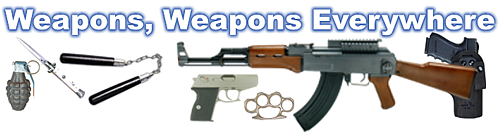
Danger is posed by the way someone uses a weapon, not what
the weapon is
Exactly how many weapons do you carry? How prepared are you to use
them? How prepared are you to keep someone else from using them, and
maybe use them on you?
Most officers carry at
least one firearm, most of the time. Some officers carry a back-up
firearm, at least while they‘re on duty. And each of us knows at
least one officer that carries more than two guns. There‘s an old
joke in there somewhere that involves a fellow officer carrying so
much hardware that he rusts in place if he gets caught in the rain.
Of course, aside from your sidearm, many of you have some sort of
long gun in the vehicle you drive on duty, whether it‘s a shotgun of
patrol rifle. So it‘s safe to say that most officers have at least
one and maybe two firearms at their disposal. Is that all? Many
officers work for departments that have provided them with one or
more non-lethal alternatives. This category can cover many different
things, such as aerosol spray, batons, electronic control devices,
and less-lethal‖ munitions. We should also consider the various
restraint systems that we use, i.e. handcuffs and the like, as
weapons, since that is what they are.
Is that all? That‘s a lot of technology at an officer‘s disposal. Of
course that means you have to train with it all, and then hit the
street carrying it all.
By the way, how‘s your back? Many officers would stop here, having
made a pretty long list of technological force and control
alternatives. And if you stop here, you‘ve left out a few things.
Like your knife, and your car, and anything else in the immediate
area. In fact, the world is full of weapons of opportunity, or what
department policies sometimes refer to as last resort weapons. The
idea here is that various things can be used as weapons, even though
that‘s not what the technology is intended for. A good example might
be your flashlight, or your portable radio. Of course, the reason
these things are considered weapons of last resort is that using
them as weapons can have detrimental consequences. Because of that,
you‘re expected to limit their use as weapons to those times where
things are really desperate, and your life –or the life of another
is at risk. So, if a suspect is trying to disarm you, you might
strike him or her with the radio or flashlight that‘s already in
your hand, rather than taking the time to grab your baton off your
belt.
The detrimental effects of using these last resort weapons really
take three forms, two of which you‘ve probably already thought of.
First, using something like a radio or a flashlight is likely to
cause more serious injury to the person that you are defending
against, due to the weight or the physical configuration of the
weapon you choose. Think sharp edges here, and you‘ve got the
picture. Secondly, hitting someone with your radio means that you‘ve
just employed an impact weapon that cost hundreds, or even
thousands, of dollars. That‘s not an issue when a life is at stake,
but it might be if you can‘t articulate why such a choice was
necessary. Finally, and one issue that you might not have given as
much thought to, there is the very real possibility that your
adversary will choose one of these weapons of opportunity, and use
it on you. In fact, when a bad guy comes to the fight, just about
any
thing in the area
including your firearms –are weapons of opportunity to him or
her. In this sense, technology is absolutely a two-edged sword.
When law enforcement professionals consider this issue, it‘s typical
that the talk turns to weapon retention training and practices.
Traditionally that has meant firearm retention. Now, however, with
officers carrying so many more items that could be turned against
them, we need to broaden our approach to weapon retention. We need
to think about how we will avoid being injured or killed by a
suspect that grabs our baton, or our flashlight, or even our ink
pen. A creative suspect especially one that has been schooled in the
art of criminal mischief while incarcerated can use just about
anything to harm you. Officers sometimes take the position that if a
suspect grabs their OC or their baton, or anything else that might
be available, they will just use deadly force. In many cases, that
is probably the best option, and the safest thing to do. But
officers need to consider the capabilities of the weapon that the
suspect has armed himself with. For example, if he or she grabs your
baton, you might need to use deadly force. However, if you can keep
distance between you and the suspect, you might not need to, at
least not immediately That is not to say that officers shouldn‘t be
ready to escalate to high levels of force should such a situation
develop. The old adage of, Never take a stick to a knife fight, in
all of its permutations absolutely applies here. If an officer
perceives that his or her life, or the life of another, is at risk,
then appropriate force should be used to keep those lives safe.
Officers do need to realize, however, that should deadly force be
used in response to a threat from what law enforcement typically
refers to as a non-lethal weapon, there will be a vigorous
investigation. Officers need to be clear in their documentation of
the incident. Great detail regarding the suspect‘s actions and
responses or lack thereof to the commands of officers, should be
included in reports of the incident. The public and that includes
prosecuting attorneys, internal affairs investigators, politicians,
and the like will be very sensitive to the fact that the officer was
faced with a non-lethal weapon‖. When reporting the incident,
officers must take care to describe the danger that the suspect
posed, and the need for higher levels of force by officers.
By the way, there‘s one weapon available to officers that we haven‘t
discussed probably because we don‘t think of it as a piece of
technology. However, it is probably the most significant weapon an
officer has, both in dealing with an incident, and in documenting an
incident‘s aftermath. That weapon is the officer‘s brain. Officers
that have trained their brain to deal with critical situations,
through what if‖ exercises and other means of developing and
augmenting their knowledge, have an awesome weapon. Experienced
officers know that there is no substitute for training with this
most powerful of weapons. In the final analysis, officers‘
knowledge, skills and abilities, are what sets them apart from other
individuals.
Technology can help us,
but the power of the mind is what truly keeps us safe.
Stay safe, and wear your vest!

Traumas of Law Enforcement Training
Sgt. Tom Hamann of the Lake Oswego (OR) Police Department is the
peer support coordinator for his agency so he thought the
“Traumas of Law Enforcement” training in March 2010 would be
beneficial to attend. He
had no idea that he would use what he learned just two months later.
Since 1996, Concerns of Police Survivors (C.O.P.S.) has provided
this highly-acclaimed training to help agencies deal with officer
death, injury, disability, police suicide, and the after effects of
losing a co-worker.
Although law enforcement loses between 140-160 officers each year,
some agencies have no protocol for how to make an appropriate death
notification, how to deal with the surviving family, or how to carry
out the sensitive, compassionate support that surviving families
need to deal with the loss of a loved one to sudden, often violent
death.
Sgt. Hamann’s Chief suffered a fatal heart attack at his home on the
evening of May 20, 2010, just hours after responding to a call.
Chief Duncan was just six days away from his retirement. Sgt. Hamann
had learned during the training that his Chief’s death may be
classified line of duty because he had responded to a call within 24
hours of his death; critical information he had learned, but never
hoped to use. Sgt. Hamann had the resources and information on how
to best handle a line-of-duty death from the training and he set to
work ensuring his Chief’s wake and funeral were well planned. He was
also able to ensure the Chief’s surviving family would continue to
have good follow-up support from the agency and its personnel.
“I would encourage others to attend the training because it is
important to learn what the procedure is before you have a
line-of-duty death. It is good to have the information on hand
before it happens; because when the event occurs, it is overwhelming
for everyone. If you have the resource book with all the information
that we received at the training, then you have something to help
you make the best decisions,” stated Sgt. Hamann.
The “Traumas of Law
Enforcement” training is a free, 3 day, 21-hour training that
allows officers an opportunity to develop general orders addressing
traumatic issues affecting officers and sensitize them to emotional
support needs of the fallen officers’ families. Officers learn
appropriate death notification, funeral protocol, the need for
emotional debriefings following critical incidents, law enforcement
suicide, officer disability, issues faced by traumatized officers,
the effects of officer deaths on the co-workers, appropriate methods
for dealing with survivors after the funeral, and the importance of
support for officers that continue on the job. The “Traumas
of Law Enforcement” is recommended for Chiefs, Superintendents,
Sheriffs, Chaplains, Dispatchers, Benefits Assistance Officers,
Planning and Research Officers, Employee Assistance providers,
Liaison Officers, Special Operations Divisions Officers, Victim
Assistance personnel, any law enforcement officer, law enforcement
family member, or law enforcement survivor.
C.O.P.S. presents the “Traumas
of Law Enforcement” training at various key cities across the
country each year and every year approximately 700 local, county,
state, and Federal law enforcement officers/officials attend these
training. These trainings are funded through a grant from the Bureau
of Justice Assistance, Office of Justice Programs, United States
Department of Justice.
The estimated $90,000 cost for these trainings provides tremendous
financial relief for C.O.P.S., a national, non-profit organization
and makes the training affordable to agencies that need to provide
travel, meals, and lodging costs for officers assigned to this
training.
“Everyone at C.O.P.S. has been really helpful and supportive of our
agency through the loss of our Chief. We certainly appreciate that
and it had made dealing with this easier… as easy as it can be,”
concluded Sgt. Hamann.
Below are the dates and cities where the Traumas of Law Enforcement
for 2011 will be held:
January 10-12, 2011
Abilene, Texas
Registration Deadline: December 17,
2010
January 24-26, 2011
Dublin, California
Registration Deadline: January 7, 2011
January 31-February 2, 2011
Manchester, New Hampshire
Registration Deadline: January 7, 2011
February 7-9, 2011
Jacksonville, Florida
Registration Deadline: January 7,
2011
February 28-March 2, 2011
Memphis (Bartlett), Tennessee
Registration Deadline: January 28,
2011
March 14-16, 2011
Fairfax, Virginia
Registration Deadline: February 28,
2011
March 28-30, 2011
Madison, Wisconsin
Registration Deadline: February 28, 2011
Visit www.nationalcops.org
if you need specific information on the training location or would
like to register online.
C.O.P.S. can also be reached at 573-346-4911.
< <
jump to the policetraining.net home page






