
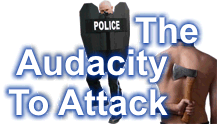
By Rick Armellino
Baker Batshield
Reprinted from
Policeone.com
Military historians have used the term audacity to describe a
bold life-threatening action that is beyond the norm, with an apparent higher
level of risk, almost always associated with a devastating attack that follows
swift movement and surprise.
Obligation versus
policy
All law enforcement agencies are
cognizant of their obligation to serve and protect their citizens’ safety.
How different agencies perform this duty varies
widely.
Generally, the larger the agency, the more risk adverse
their policies, and the greater chance for delay and inaction during
fast-breaking mass murder events.
Providing unequivocally clear and distinct policy that grants
full discretion to any law enforcement officer to launch an attack
against imminent or active killers is considered very audacious, and for good
reason.
Allowing first responders the individual authority
to make entry and attack a deadly threat is completely dependent upon the
fortitude and caliber of leadership within their respective agency, and the
leadership's ability to manage, train and equip an autonomous patrol force
tasked with swift and aggressive action.
Risk-adverse law enforcement agencies
usually place controls on any activities that could appear audacious to the
public at large.
It's unfair to place officers in the moral quandary
of having to decide to use aggressive tactics or deadly force in order to save
lives, and then run the risk of having their employer condemn their actions when
the results turn out to be less than perfect.
Judgment calls
Don Alwes is a well-recognized law enforcement instructor that
has been instrumental in the evolution and implementation of the latest version
the National Tactical Officer's Association’s (NTOA) active shooter response
protocol, which now includes solo officer.
Alwes teaches tactics and imparts his students with the
aggressive mindset required to enable the first available responder to
confidently attack armed and hostile threats to the public.
Explains Alwes, "Everything we as police officers do everyday
is a judgment call. Our job is to help save lives. If it is deemed
in the best judgment of the individual officer to immediately enter a dangerous
situation alone, without waiting for backup, then there should be no
departmental policy preventing it. Choosing to risk one's life to help
another is a moral decision between you and your conscience. The decision to
act should not be regulated or discouraged by police administrators."
Hostage job - by the
book
On October 2nd,
2006, ten young females were taken hostage following an armed invasion of their
one-room schoolhouse in the rural farming community of Nickel Mines,
Pennsylvania.
The first state troopers to arrive
cautiously approached the small building and were warned by the invader that if
they did not immediately leave the premises, he was going to shoot all the
children.
Audacious behavior?
You bet.
Policy and training dictated a traditional police response,
and as such, a perimeter was instantly established, and the SWAT team notified.
More help arrives,
more on the way
The appearance of calmness that the officers sensed from
waiting outside the school could hardly compare with the terror occurring just
inside the simple wood-framed building.
Unbeknown to the growing group of
officers outside, the invader was diligently arranging the scene of the pending
massacre.
He busied himself man-handling the little girls,
threatening their lives, restraining their limbs with wire ties, and positioning
the girls side by side along the back wall, just beneath the blackboard.
The continuous sounds of sirens and radio chatter, including a
trooper's amplified voice emanating from a vehicle’s PA system undoubtedly
provided some level of comfort -- these little girls knew they were not alone,
and that help had arrived.
After approximately thirty minutes of preparation, the final
scene for the pending massacre was set, and the girls realized this monster was
ready to kill.
Shaking and profusely sweating, and speaking incoherently to
everyone, or maybe just to himself, he began pointing his trembling firearm
directly at the girls. It was very obvious to those trapped inside that
their terrible ordeal was soon to end.
Out of time
Two of the young hostages were sisters, named Marian and
Barbie Fisher, ages thirteen and eleven. Marian and Barbie seized the
moment and negotiated more time to live. Marian engaged the monster in
conversation, asking him about God, family, and why?
The forced conversation did not go well, and the sisters
valiantly attempted to buy more time for the group with the most desperate of
delay tactics -- “Shoot me first”, bravely offered Marian. Her little
sister played into this impromptu delaying plan to buy a few more
precious moments of life and softly answered, “No, no. Not her.
Shoot me first.”
One of the younger girls began screaming and the older girls
valiantly tried to quiet the noisy one. The girls sensed, correctly, that
their time in this world had run out.
The child’s desperate screaming was heard by the active
shooter response team positioned just outside a wooden storage shed, near the
rear wall of the schoolhouse.
Ten officers were standing ready, lined
up alongside the shed, and crouched behind a large ballistic shield.
Upon hearing the screaming, the brave officers
requested permission to immediately make entry -- the answer came back,
permission denied.
The sound of rapid gunfire was heard shortly afterwards.
Random observations
following the massacre
One trooper later shared his personal observances at an
information sharing seminar attended by law enforcement, and recalled his
feelings just prior to the massacre. He stated that after waiting for a
period of time following no contact with the invader, in his opinion, the
situation seemed to have calmed down, and a peaceful resolution appeared likely.
Another trooper was quoted by the local media recalling that
when the gunfire began, his reaction was total shock and disbelief, “He’s
shooting into the air. Ain’t no way he’s shooting those kids”.
One Amish man, a local farmer who arrived following the
invasion and prior to the murders, shared his simple observation -- "they came,
but they didn't do anything."
Most people have difficultly assimilating the magnitude of
such an evil plan – including those who write the policies, calculate the odds,
and budget for the costs to prepare for the unspeakable, or not.
Immediate
Action Rapid Deployment (IARD) for citizen rescue
The definition of IARD is:
An emergency
response that provides swift deployment of law enforcement resources to
developing or on-going, life-threatening situations where delayed deployment of
emergency personnel could otherwise result in death or great bodily harm to
innocent persons. The innocents are likely to be incapable of
self-protection or escape to a safer environment owing to duress, time and/or
other logistical restriction.
IARD is the appropriate law enforcement
first response activity specifically designed for law enforcement rescue of
citizens in grave danger, when a proactive entry and pursuit is tasked to the
very first responder(s), and not a second, or later wave of response.
Not surprisingly, broad differences of
opinion and various interpretations exist relating to what is, and what's not
considered an appropriate response to “developing
or on-going life-threatening situations.”
Many agencies consider the “rapid
deployment” of patrol officers to the proximity of an event to gather
information and establish an outer perimeter as fulfilling their “swift
deployment of law enforcement resources” obligation in order to prevent “death
or great bodily harm to innocent persons”.
Although “rapid deployment” to the proximity of the
invasion is a popular and common emergency response, it is not IARD
IARD tactics dictate that an almost
immediate pursuit begins upon arrival and the pursuit pauses into a temporary
perimeter only when appropriate resistance is encountered.
Once resistance disappears, so does the perimeter.
Pursuing officers constantly probe and apply enough pressure
so the invader’s attention is always focused on the pursuers, and not onto the
endangered citizens.
Agency requirements -- Immediate Action Rapid Deployment
(IARD)
- Automatically authorized and used whenever citizens'
safety is in question
- Clear policy that supports independently initiated IARD
activity
- Indemnification of IARD actions (when legally possible)
- Initial and recurrent realistic scenario based IARD
training and equipment
- Appropriate vehicle housed equipment including shields
and CQB weaponry
- Communication expectations as time and situation allows
Close quarter battle
(CQB) – A military concept
CQB is a military term that closely describes the type of
dangerous and dynamic environment police officers may operate while conducting
IARD in the pursuit and neutralization of armed invaders
Although politically incorrect, military
terms are appropriate to describe tactics used by police to rescue citizens from
violent and deranged members of society.
Homicidal and suicidal predators having the audacity
to capture, attack and kill innocent citizens are conducting mayhem comparable
to an “act of war”, and must be considered a “weapon of mass destruction”
IARD trained and equipped officers use military style CQB
combat survival tactics that require the use of speed, aggression, surprise and
most of all, a healthy dose of audacity.
Probing, diversion tactics, and any impromptu maneuver or
activities that allow the officer to gain a safer entry and make steady progress
towards the threat are examples of actions that may be considered useful within
this multi-faceted rescue concept.
Officer confidence and increased
capability grows from a solid foundation of training and support.
The familiarity and comfort derived from use of
individual initiative, dynamic tactics and newly acquired skill-sets are vitally
important for the survival of the officer, and the innocents in need of their
life-saving services
Mindset training
Long time trainer Sal Mascoli, working in Las Vegas, has almost six years experience as
a US Marine Corps FAST Company instructor, and has accumulated nearly fourteen
years training within law enforcement.
He knows the challenges of training LEO's to be
forceful and aggressive, especially younger officers having what Mascoli
considers, “limited life experience”.
Mascoli shares observations and teaching
style, “Today’s kids are overly concerned about legal issues, worrying about
offending people or breaking policy.
Many of them have never been in a fight.
We train them that during a life-threatening attack
on themselves, or innocent victims, they need to instantly react; right, wrong
or indifferent.
Something needs to be done to become a catalyst of
affecting a change in the suspect’s aggressive behavior.”
“I
have developed a training technique I consider ‘mindset drills’, and introduce
‘mayhem moments’ into the class.
An instructor conducts a surprise preplanned attack
onto a member of the class, and the first attack is always met with inaction.
By the end of the training block, these same new
officers are jumping over desks, diving at the aggressor, and properly handling
the realistic situation.
It’s not exactly active shooter training, but it’s a
good beginning establishing the proper mindset.”
Learn from military
history
Much can be learned from the past
experiences of our military, including the need for quality leadership.
Without true leadership and support to the officer
tasked with the mission, IARD is likely destined to fail
Police trainers don't need to look very far for useful
information to encourage the leadership, training philosophy and skills that
impart the audacity required to conduct IARD -- one of the most successful
military leaders in history is an American Army General named George S. Patton,
Jr.
Patton’s letters, speeches, press conferences and personal
diary afford a unique view into the philosophies of a leader that exhibited the
superior abilities to train, motivate, and nurture personnel that repeatedly won
battles against a well-trained and equipped enemy.
Patton and his men formed a strong bond
based upon mutual respect, admiration and ability to win.
He frequently expressed awe and gratitude towards
the courageous actions and accomplishments of his troops, and was revered by his
men who knew he supported them implicitly and did everything in his power to
assist their brave efforts.
Patton’s legacy includes a compilation of
his writings and speeches; The Patton
Papers 1940 – 1945, complied by Martin Blumenson, is available in the
Library of Congress.
The following are excerpts from Patton’s writings –
bold text, clarifications and comments in parenthesis are added by the author of
this article:
General George S.
Patton, Jr. (GSP) on Policy
- "The chief value of Armored forces
is to
develop initiative and imagination. If we
tear such down (initiative & imagination) with "Standard Operating
Procedure", we vitiate (invalidate, corrupt) our purpose."
GSP on
Mindset
- "Things are shaping up pretty well
now but I wish we had more of the killer instinct in our men. They are too
damned complacent --
willing to die but not anxious to kill.
I tell them that it is fine to be willing to die for their country but a
damned sight better to make the German die for his. No one has ever told
them that .... The British have suffered and are mad, but our men are not
..."
- "We are attacking the Siegfried
Line. I know that there are many generals with my reputation who would not
have dared to do it because ... They
are more afraid of losing a battle than anxious to win one
.... I do not believe that any of these lines are
impregnable ... If we get through, we will materially shorten the war --
there is no if about
getting through; I am sure we will!" (he did)
- "On the way, I was appalled to find
an American infantry battalion miles behind the front digging 'tomb-like
slit trenches'. I told them to stop it, as
it was stupid
to be afraid of a beaten enemy ...."
(cowards who kill unarmed innocents plan to die and are not warriors, but a
beaten enemy)
- "Leadership ... is the thing that
wins battles. I have it -- but I'll be damned if I can define it. Probably
it consists in knowing what you want to do and then doing it and getting mad
if any one steps in the way.
Self confidence
and leadership are twin brothers ..
GSP on Training
(1941, prior to combat)
- "Owing to the fact that all of us
have been, so to speak, going to school for almost a year, we have to a
degree acquired the student complex, that is,
we have a
tendency to await instructions rather than proceed at our own initiative.
People must try to use their imagination and when orders fail to come, must
act on their own best judgment.
A safe rule to
follow is that in case of doubt, push on a little further and then keep on
pushing ....."
GSP on Tactics
- "It is my earnest effort to keep it
from becoming static because that is a poor way of fighting.
The best way to
defend it is to attack, and the best way to attack is to attack.
At Chancellorsville,
Lee was asked why he attacked when he was outnumbered three to one. Lee
said he was too weak to defend ...." (Confederate General Robert E. Lee won
this civil war battle)
- "The
only way you can win a war is to attack and keep attacking some more
...."
- "Remember this: no set piece of
tactics is of any merit in itself, unless it is executed by
heroic and disciplined troops who have self-confidence
and who
have leaders who take care of them."
At the close of the European theater of operations during the
Second World War, French General Giraud visited General Patton, and offered his
opinion that the remarkable and historic success of Patton's 3rd Army was,
"chiefly due to luck" -- Patton replied, "No, to audacity".
The case for a strong
patrol offense
It is fair to say that in the
overwhelming cross-sections across
America's law enforcement agencies, SWAT is no
longer considered the primary responder to armed invasions in public places.
And for good reason, outside of a handful of
full-time on patrol tactical teams, gathering a SWAT team takes too much
valuable time, and an armed invader must never be allowed to control the clock.
The increasing occurrences of swift,
unprovoked attacks against innocents during homicidal and suicidal mass
murdering events are changing the way law enforcement administrators view the
duties and expectations of their current patrol assets.
A well-trained, confident and self-motivated offense
is needed to counter today's homicidal and suicidal predator.
The unmitigated audacity to attack and kill innocents must be
met with an equal or greater level of audaciousness by the first responders
having the best chance of offering rescue, the brave front line troops called
patrol officers.

By John E Reid & Associates
When average people are asked about nonverbal communication, most will mention
eye contact. The eyes are considered "the windows of the soul" and The Eagles
warned that, "you can't hide your lying eyes." When Judge Judy detects possible
deception, she admonishes the witness to look her in the eyes. Effective
communicators learn not only how to read the meaning of another person's eye
contact, but also to use their own eye contact to influence other people. This
field of study is referred to as
gaze and mutual gaze.
Interestingly, of all possible nonverbal behaviors studied, eye contact is
generally least influenced through psychophysiological processes, but rather is
a learned response depending on societal rules. Furthermore, not all societies
teach the same rules. The following discussion applies generally to western
culture.
Breaks of Gaze
Consider that you are attending a seminar and the instructor asks for a
volunteer to come to the front of the class to demonstrate a principle. If you
do not want to be called upon, your eyes will immediately go down to the table
top. This unconscious drop of gaze sends the message of shame, guilt or
embarrassment. In other situations, for example when a clergyman expresses his
condolences at the passing of a loved one, a drop of gaze signals sympathy and
compassion. Neurolinguistically, a downward break of gaze indicates that
emotional centers of the brain are being accessed.
Obviously, when an investigator is interviewing a suspect, victim or witness,
unconscious downward breaks of gaze may send the unwanted message, "I am
uncomfortable asking you these questions." To instill confidence and
credibility, it is important that a speaker maintain eye contact when addressing
another person. However, during an interrogation when the investigator is
displaying sympathy and compassion toward the suspect's unfortunate situation, a
downward break of gaze may greatly enhance the investigator's sincerity.
Similarly, during an interrogation, the suspect whose eyes drop downward often
means that the suspect is experiencing remorse and guilt. This can be a key
behavior that the suspect is on the verge of confessing.
A different meaning is attached when the eyes break gaze to the side or upward.
Under this circumstance, the subject may be recalling factual information,
forming an opinion, editing unnecessary information from a response or
fabricating an answer. Such breaks of gaze should be expected from a truthful
suspect who is asked a hypothetical question, or one that requires long term
memory. As an example, consider two suspects who were asked the following
question concerning an alibi where they both claimed that two weeks ago they
were home alone on the night of the crime. "Did you receive any telephone calls
that evening?" The first suspect, without breaking gaze responds, "No one called
at all." The second suspect, after breaking gaze and delaying slightly,
responds, "No one called at all." Even though their verbal responses were the
same, the second suspect's response is more credible because the question
requires accessing memory and, thus, a break of gaze would be appropriate.
Mutual Gaze
When two people are conversing about a topic of mutual interest the normal level
of eye-to-eye contact is between 30 - 60% of the time. This is referred to as
mutual gaze. When interacting with a speaker, the listener's eyes generally
focus on the speaker's mouth. A conscientious communicator will recognize when
the other person raises his gaze slightly to make direct eye-to-eye contact.
When the gaze is held it is a signal that the other person wants to say
something. Consider a committee meeting where you strongly disagree with a
proposal a speaker is making. In an effort to be recognized and voice your
disapproval, you will attempt to make direct eye contact with the speaker.
Nonverbally, you are asking permission to be called upon to speak.
During an interrogation a suspect who has been quietly listening to the
investigator's theme may try to establish mutual gaze to seek permission to
speak. Invariably, if this permission is granted, the suspect will offer a
denial. Whether the denial is truthful or deceptive will require further
assessment, but the societal rule remains: Prior to interrupting a speaker,
often an attempt will be made to establish mutual gaze with that speaker.
Mutual gaze by an investigator can be used during an interview to encourage a
subject to continue to talk. Assume that you have asked a subject the question,
"Tell me about your relationship with (the victim)?" and the suspect offers a
shallow response. By establishing mutual gaze with the suspect following his
response sends the nonverbal message, "I want you to tell me more." Under this
circumstance simply by looking at the suspect's eyes, and perhaps nodding your
head, most suspects will continue to talk.
Nature of Eye Contact
Eye contact can be generally described as cold, hard, penetrating, warm or soft.
Quantifying these descriptions can be difficult, but they refer to pupillary
dilation and related muscles affecting the opening of the eye lids and
contraction of the eye brows. A cold, hard stare may signify defiance, anger or
authority. As an example, with the proper stare a parent can send the nonverbal
message to a child, "Don't do that!" A suspect who displays this type of eye
contact may be legitimately angry, which is more often associated with
truthfulness. If the stare is forced and inconsistent with other nonverbal
behaviors, it may reflect defiance which is more often associated with
deception.
During an interview, an investigator should avoid a cold hard stare since it
signifies an emotional detachment from the suspect, which is undesirable.
Rather, warm and soft eye contact should be used. This type of eye contact
encourages open communication since it is associated with openness, trust and
liking. Innocent suspects, who are not overly nervous, often display warm and
soft eye contact during an interview. Conversely, a deceptive suspect's eyes are
often described as shifty, unfocused or averting.
Factors Influencing Eye Contact
In addition to culture, a subject's eye contact may be influenced by their
personality, general nervous tension, their emotional state and various medical
conditions. It is important, therefore, that an investigator establish a
baseline of normal eye contact for each subject before attaching significance to
this behavior. Of equal importance, an investigator should be aware of his or
her own eye contact when communicating with others. Some people simply have
atypical eye contact. They may engage in a penetrating, cold hard stare when
conversing about even insignificant topics. Others, may exhibit generally poor
eye contact when talking to a trusted friend about a topic of mutual interest.
Such deviations from societal norms may cause difficulties for an investigator
whose success is so closely associated with effective communication
|

*
An increase in “ums” and “ahs”.”
*
The body turning away from you.
*
A widening of the eyes.
*
A hand reaching to cover parts of the
face, especially the mouth, even
momentarily.
*
An increase in foot or leg movement.
*
A change in voice pitch.
*
A change in eye contact. The person
may begin to look away or to stare at
you.
*
A change in speaking speed.
Key:
When you spot one of those red
flags, ask for more information. If you
spot the same lying signs, your suspicions
are probably accurate.
Here is a list of suspicious body language
and voice cues that let you know the
person you are talking to might not be
telling you the full or accurate story. By
itself, any one of them could be a natural
mannerism, or even a sign of stress. But if
you notice two or more of these signs at a
time when you already suspect less than
full honesty, your skepticism may be
justified.
— adapted from “Become a Human Lie
Detector,” Marty Nemko,
www.monster.com
|

If there is one thing that I could get my civilian friends to realize this
holiday season is not how blessed they are during the holidays but how REALLY
blessed they are during the holidays.
In law enforcement, the holiday season is one of the busiest, most dangerous
times for officers all across the country on patrol. The reason for this is
simple, people with big problems see those problems as even bigger during the
time of the year when you are just suppose to be happy because everyone else is,
but it doesn't always work out that way.
Officer's respond to distraught, extremely depressed individuals who may be
drunk, physically abusive to themselves or others, want to take their own lives
or the lives of others, or commit violent acts in an attempt to recover from
financial or emotional hardships. We as first responders have to deal with these
often disturbed individuals that have now gone completely over the edge because
it is Thanksgiving Day or Christmas Eve and they are alone, broke, or out of
their drug of choice and can't find anymore.
Instead of carving the turkey at home, these officers may be wrestling a dad to
the ground that was supposed to carve a turkey but decided to cut his wrist with
the knife instead. They may be
responding to an accident only to have to notify loved ones of a tragic,
fatality and loss of a family member.
Many of these officers may get to "swing" by their own houses and enjoy their
lunch break with the family before getting back to business, if they are lucky
enough. Not to mention all the dispatchers, firemen and emergency medical
personnel that must work 24/7 as well and may not get to celebrate until the
next day, when others are beginning to take down the tree and ornaments.
When I walk into a trailer on a disturbance call this Christmas, and there is a
2 year old with a diaper on that hasn't been changed in a day, roaches crawling
up the walls, beer cans everywhere and mamma and boyfriend just beat the hell
out of each other, I will be very thankful for what I have. I will, despite my
own hardships, realize that I am still blessed compared to so many people,
living in this country and other countries across the globe.
So when your find yourself sitting around the fire drinking eggnog this
Christmas, remember all those patrol officers out there protecting and serving
behind the scenes, 24 hours a day, 7 days a week, so that the rest of the world
will still think that there is peace on earth....
Happy Thanksgiving, Merry Christmas, and Happy Holidays to you and yours.
Andrew Hawkes
http://highwaydruginterdiction.com/
< <
jump to the policetraining.net home page





