Preparation—true
preparation—is the only way to be a cop
By
Tony Blauer
About
two decades ago I realized that the only way I’d ever be
able to defend myself is if I understood four things:
1
What did I fear?
2
How do I conquer those fears?
3
How do ‘real’ attacks occur?
4
And, how do I defend against those real attacks?
The “truth” I discovered was never in bigger muscles or
accumulating techniques.
The truth—yours and mine—was in understanding behavior,
psychology, biomechanics and violence.
Sounds so simple, right? So tell me, why has this obvious
process eluded most defensive tactics instructors as well as
virtually every self-defense and martial art system?
DT trainers must realize that it’s only during their
class that an officer is supposed to learn how to protect
himself and control a hostile subject. If that
process fails, someone may die. If half the techniques
taught don’t really work, then half the training time is
wasted. And, sadly, most of what is taught doesn’t address
the realities of serious, aggressive resistance, which is
the only time an officer is in real danger. Many street
tragedies could be avoided. Presumptuous training strategies
and tactics are partly to blame.
Suffice it to say, there are problems with the training
process. However, there’s a far bigger problem than the DT
curriculum. The real problem is you, the officer.
Preparation Is Everything
Yes,
the officer is responsible for many of these tragedies. Why?
Because at the end of the day, it’s you and you alone
responsible to make the call, to choose the level of force,
to trust your instincts and your intuition. It’s your
responsibility alone. During confrontations, responsibility
must be read response/ability: one’s ability to
respond.
As a professional police officer, you knowingly and
deliberately place yourself in harms way to “serve and
protect.” You must ask yourself some moral, ethical and
legal questions regarding your preparation and
response/ability. Do you feel confident to contain and
control violence? What areas do you feel weak in—and why
aren’t you developing those areas? Indifference isn’t a
valid defense. Nor is ignorance.
Remember: The system, the research, the analysis and legal
aid are only at your disposal AFTER the event. Until then
you are in control (or supposed to be). Being an effective
police officer goes beyond the oath and attitude. On
judgment day you are either a warrior or a worrier. Preparation
will decide.
Does your training support sudden violent attack? An
integral part of every officer’s training should include
counter/ambush drills.
And what is preparation? It’s the truth filter you view your
responsibilities through. And if that ability to
respond is inadequate, deficient, delinquent, or
insufficient—you fail. If you lose a confrontation, you may
lose a court case, but perhaps you’ll lose your life.
Preparation is about conscience and accountability. If you
can’t motivate yourself to practice drawing and dry-firing
or cuffing tactics or to work on verbal skills or do 10
finger tip pushups every morning and go for a run (you get
the picture), then you aren’t responsible. Police work is
dangerous. Period.
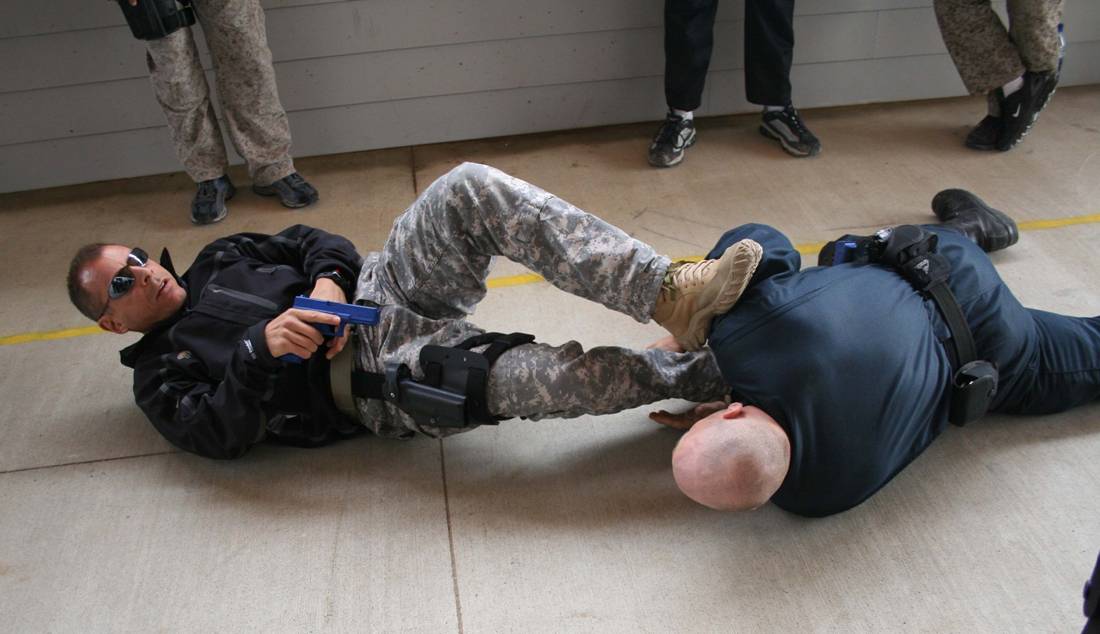
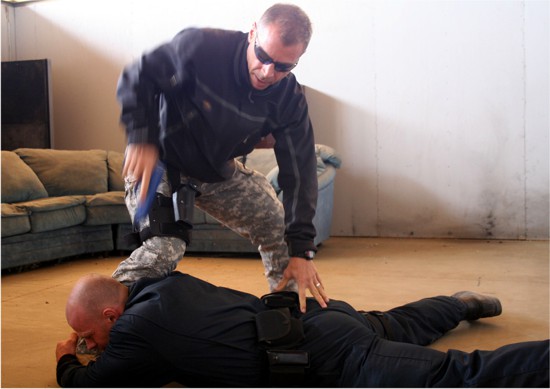
“Presumed Compliance” is the paradox every officer faces
when they approach any suspect. Does your training prepare
you for the sudden ambush? In photo 1, above left, I
simulate approaching a proned suspect who suddenly attacks
forcing a ground fight. Then in photo 2, above, I’m showing
a simple gross-motor response resulting from being forced to
the ground that keeps me safe and the combative suspect at
bay.
Coach Bear Bryant said, “The will to win compares little
with the will to prepare to win.” In my 17 years of
professional teaching I have observed lots of ‘will to win,’
but rarely do I see the requisite preparation to match the
attitude.
How many in-service officers do you know who continue to
train for survival—close-quarter skills, weapon retention,
hands-on knife controls, contact simulations, verbal
de-escalation strategies, etc.? If you think the academy DT
program is all you ever need, plus the occasional seminar,
forget it. It’s not enough. In fact, it’s never enough. It
takes a microsecond of doubt or hesitation to change your
life forever in combat.
How can you ensure your survival? You can’t. But you sure
can enhance it. And it starts with a major paradigm shift, a
real attitude adjustment. It starts when you can recognize
‘presumed compliance’.
Presumed Compliance, Defined
Presumed
Compliance
is a key component to the “Behavioral Defensive Tactics” TM
program. It’s the pervasive mind-set that predisposes an
officer to fail, or, at a minimum, succeed under duress and
with friction.
During every confrontation, there’s a sequential
relationship between predator and prey that transcends
technique. Training must address this behavioral truth.
There are three distinct arsenals required for real
survival training: the powerful synergistic qualities of the
1) emotional, 2) psychological and 3) biomechanical
arsenals. To understand the totality of the concept one must
first appreciate its three-dimensional integrity. Simply
put: How you think (psychological) determines how you feel
(emotional). This in turn will illicit a complex
biomechanical response. Naturally, how you think, feel and
behave will affect your choices (strategy) and your
performance (tactical skill). The truth is that your
thoughts and behavior will either enhance or encumber your
tactical options. The mind navigates the body.
Society has helped to create the presumed compliance
frame of mind. Stereotyped images of authority figures
possessing knowledge and power are pounded into our minds
from birth. So why would it be different when you finally
earn the right to wear the badge? All of the manuals and SOP
doctrines imply your successful control of every situation.
You have the theoretical force-option continuum. You have
backup and other tools at your disposal. But nowhere does
the training address fear management strategies or
behavioral tactics to influence systematic de-escalation or
even a street-smart approach to defensive tactics
(everything works when it’s choreographed).
Ask yourself this:
Did you survive your last physical confrontation because you
were better trained than your opponent? Or did you control
it because your opponent lacked training? Reflect on that.
There’s a huge difference.
Conclusion
Survival
training is not complicated. The “truth” is rather simple,
but will require a paradigm shift, which may be difficult
for a community that notoriously waits for a tragedy to
change SOPs and tactics. Real fighting—street survival—has
little to do with a technique, martial arts or finesse.
Street survival training is about attitude, preparation and
integrity during training. Learn to discern fact from
fantasy. Commit to the truth and pursue excellence.
You must live with what you do and don’t do. The truth is in
the training. Do you need skills that work against a
compliant cooperative subject or an aggressive resister? At
the end of the day, it is your response/ability that
determines the choices you make.
Tony Blauer
Tony Blauer is one of the world’s leaders in the
research and development of training and equipment for
military and law enforcement communities. He’s best known
for the development of the S.P.E.A.R. System, a personal
defense and defensive tactics program entirely designed
around human physiology and the High Gear scenario-training
suit. His site is www.BlauerTactical.com, and he can be
reached at
tony@blauertactical.com.





 January
- February 2012
January
- February 2012