Written by Dr. Dorothy McCoy and Former
DEA Agent Michael Vigil
Sun Tzu’s Art of War:
If
you know the enemy and know yourself, you need not fear for
the result
of
a hundred battles. If you know yourself but not the enemy,
for every victory gained
you will also suffer a defeat. If you know neither the enemy
nor yourself, you will succumb in every battle.
Endorsement:
I have years of experience working in an
undercover capacity with the ATF and I find that these
techniques are the essential "tools of the trade" to survive
and help save lives for those who give up the ultimate
sacrifice for their country.
Respectfully Submitted,
Davy Aguilera (ATF and former ATF
Country Attaché in Mexico)
The
Authors
The authors are
from two different worlds. Dr. McCoy is the researcher,
psychotherapist and published author.
Mr.
Vigil is the rough and tough former DEA agent and internally
renowned drug trafficking expert. He has extensive
international experience and worked aboard for almost
eighteen years against some of the most dangerous and
ruthless drug traffickers in the world. He is also
considered an expert in undercover operations. Dr. McCoy has
spent the last 15 years studying human behavior. Her
specific area is the identification of deviant behavior and
how to respond to that behavior. The primary purpose of
research, whether it is in the field or in the lab, is
prediction. In law enforcement prediction can save your
life.
Some of this
material is from the pages of numerous research studies.
Some comes from Mr. Vigil’s time in the trenches.
The Holy Grail of Deception
Detection
Are you seeking
the Holy Grail of deception detection? Regrettably, I have
bad news for you. There is no silver bullet accurate and
consistent deception detector or we would have found it by
now. Our society, as it exists today, could no longer
function if we were to identify the legendary perfect lie
detector, body language clue. Professional and personal
relationships would quickly tumble into disarray and
disharmony; societies would crumble at our feet. Hence, we
obviously need our polite, little prevarications.
As you will find, when you read former
Agent Vigil’s
From the Trenches
scenarios, accurately understanding and interpreting body
language is essential for many reasons. Determining
truthfulness is only one goal.
Research
Let’s look at
some recent research studies. According to researcher David
Matsumato and his colleagues (2011), “Some people say that
gaze aversion is the sure sign of lying, others that fidgety
feet or hands are the key indicators. Still others believe
that analysis of voice stress or body posture provides
benchmarks. Research has tested all of these indicators and
found them only weakly associated with deception.” This was
reported in the FBI Bulletin in June of last year. These
researchers suggest that having a baseline from which we can
understand a particular subject aids in detecting a
deviation from the baseline.
Nonverbal
behavior may increase during lying. Untalented prevaricators
are going to try to convince you of the veracity of their
words. They may nod, try to appear sincere or use other
nonverbal tools that they do not employ when they are being
truthful. Again, you must have established a baseline of
behaviors to detect these aberrant body language clues. Of
particular interest are micro-expressions that are gone in
the blink of an eye, oftentimes before we notice them in
social situations. I fact, you may perceive it zoom past
then question yourself, “Did I just see what I thought I
saw?” You may have seen something useful or it may be simply
a knee jerk emotional reaction that has nothing to do with
veracity. It is still information you can add to your theory
of truthfulness. Detecting deception is about adding many
variables (i.e., body language, verbal expression, tone of
voice, non-voluntary body reactions, background information)
to develop a useful theory.
There is nothing as deceptive
as an obvious fact. -- Sherlock Holmes
Statements and body language are
normally congruent. If someone says, “I am scared silly” his
or her body expression should correspond with the verbal
statement. If there is an incompatibility you may wish to
probe a little deeper. Though, lying does not establish
guilt. It establishes only duplicity.
University of Virginia authors,
Bella M. DePaulo, Ph.D., and Wendy Morris found a few lie
indicators in their 2004 research study (Adelson, p. 1).
These indicators are—increased pupil size, study listeners
state liars are more nervous than the venerable “truthfuls,”
and the dishonest are more likely to press their lips
together. The authors will describe the full results of
their study in their publication, Deception Detection in
Forensic Contexts.
Now, let’s talk about talented
liars, such as psychopaths. They are a different challenge
altogether. They are the gifted deceivers. However, even
psychopaths have tell-tale vulnerabilities. At the end of
the quiz you will find more information on these intriguing
chameleons.
New Technology
If you happen to
carry around a functional, magnetic resonance imaging
machine around with you, you may be able to actually test
for “truth” in the near future. These tests may be reliable
because they test brain activity. Dr. Paul Root Wolpe
(2004), at the University of Pennsylvania, states, “A number
of universities and private companies are trying to develop
lie-detection technologies, using fMRI, EEG, near infrared
light, and other strategies to directly access brain
function” (p. 1).
Because of reliability concerns
in using the polygraph, the fMRI may be part of a more
dependable future for lie detection.
The Holistic Approach
We suggest using
the holistic approach in detecting deceptions. Read the
research literature on deception detection and interrogation
and verbal clues, pay close attention to micro and
macro-expressions, look to establish a truth baseline, find
a good mentor, and practice, practice, and practice.
Would you like to
test your skills? Are you a master at reading body language?
We shall see.
Take the quiz
1.
You have asked a suspect a question and he looks up and to
the left. This might mean:
a.
He is focusing on his feelings.
b.
He is looking inside himself constructing an image.
c.
He is distraught.
d.
He is trying to find the light at the end of the tunnel.
2.
This body language tool will help you to appear warm,
friendly, open and confident:
a.
Arms unfolded
b.
Feet about ten inches apart
c.
Nodding your head
d.
Smile
3.
If a suspect is making little eye contact. It might mean:
a.
He is lying
b.
He doesn’t want anyone to read emotion in his eyes
c.
He is shy
d.
He does not like you
4.
If a suspect is wringing her hands as you talk. It might
mean:
a.
She is nervous.
b.
Her hands are dirty.
c.
She is late for an appointment.
d.
She is lying.
5.
You are talking to a suspect and you lean toward him and nod
occasionally. It might mean:
a.
You are near sighted
b.
You are self-centered
c.
You are paying close attention.
d.
You are having trouble hearing responses.
6.
If a suspect has her arms folded and legs crossed. It might
mean:
a.
She is cold.
b.
She is lying.
c.
She wants to understand the person with whom she is speaking
d.
She is defensive.
7.
An officer is standing tall with chest out and head held
high. It might mean:
a.
Improper training
b.
Aggression
c.
Strong self-confidence
d.
A poorly fitted vest
8.
A suspect’s pupils increase in size during the interview. It
might mean:
a.
He is getting aggressive.
b.
He thinks the other person is sexy.
c.
He is trying to read emotion.
d.
He is lying.
9.
You are talking to a suspect and she is filtering her
answers through her hands. It might mean:
a.
She is trying to hide bad breath.
b.
She is lying.
c.
She is self-conscious.
d.
She is feeling intimidated.
10.
We have such a powerful brain circuitry for the facial
expression that,
a.
We see faces where there are none (i.e., moon).
b.
We often misread expressions.
c.
We get tired of reading expressions.
d.
We smile and glare just to confuse suspects.
11.
You stop a man driving a new SUV in Nevada and his carotid
artery is pumping wildly. It might mean:
a.
He is wanted by the FBI.
b.
He has been exercising.
c.
He is embarrassed.
d.
He is stressed because he anticipates a speeding ticket.
(See explanation after quiz—no peeking!)
12.
You have asked a suspect a question and he looks up and to
the right. It might mean:
a.
He is lying.
b.
He does not understand your question and he is stalling.
c.
He is trying to remember his attorney’s phone number.
d.
He is recalling a real image from within.
13.
You ask a suspect if he killed his rich Aunt Sophie. He
replies, “No, I did not kill Aunt Sophie!” It might mean:
a.
He is very precise in his use of the English language.
b.
He is grief stricken about his poor Auntie.
c.
He is lying.
d.
It means absolutely nothing.
Most
appropriate responses (according to some research studies).
You must understand that research studies and experts often
disagree. If they should ever agree on one universal answer
I will let you know. Promise!
1.
B
2.
D
3.
A
4.
A
5.
C
6.
D
7.
C
8.
D
9.
B
10.
A
11.
A
12.
C and D
13.
C
More information for questions 12 and 13
12. In both c and d the suspect is looking inside for
information stored there.
13. If a suspect uses a contraction, such as “I didn’t do
it,” in answer to your questions, “Did you kill your aunt?”
he is more likely to be telling the truth than if he were to
says, “No, I did not.” Contractions seem to be more
trustworthy. I promise that’s the truth.
Explanation for Question 11
Warren Steed
Jeffs, leader of a polygamous sect and one of the FBI’s Ten
Most Wanted Fugitives, was arrested during a routine traffic
stop in Las Vegas when an observant State Trooper noticed
the fugitive’s carotid artery was throbbing wildly—he took a
closer look. Good job, Trooper.
Scoring your test
Give yourself one point for every correct
answer. You can give yourself more points, but it will make
scoring confusing.
Scores 1 – 4
I am afraid that
you might find surviving on the mean streets more
challenging than other officers. You are more likely to miss
a body language signal that precedes an aggressive act.
Also, you are more likely to misjudge a suspect’s intention
and truthfulness. You may want to learn more about body
language by visiting the Non-Verbal Communication Website
and others on the Net. There is much to learn and it is
quite interesting.
To be safe, stay close to
someone who scored 10 or more on the test.
Scores 5 – 8
You are doing
relatively well and can probably communicate and understand
body language communication with little effort. You may want
to visit the reference site listed (and many others) above
to increase your store of knowledge. What does it mean when
someone looks up and to the right while taking your picture
with his/her cell phone? See, I told you there was more to
learn. Besides being 50% safe is not quite enough.
Scores 9 – 13
You should be
working for the Secret Service. They normally score highest
of various professionals on tests of deception detection.
You are usually knowledgeable
about body language. This knowledge will give you a distinct
advantage in understanding your fellow creatures. Let me
warn you, some of the nice officers from the first scoring
group are going to be looking for you. Thank you.
Conclusion
Would you like to
know how to consistently identify dishonesty? According to
body language expert Robert Phipps, “Darting eyes, palms not
visible, shifting from one foot to another, hand covering
mouth or finger tugging at ear are clues.” Regrettably, as
you know, these indicators are not always accurate. You
should keep researching and learning about body language and
lie detection. The more you know the safer you are, and in
law enforcement this is the prime directive—stay safe.
"It is always
awkward doing business with an alias."-- Sherlock Holmes
Former DEA Agent
Michael Vigil: From the Trenches
During the many
years of working undercover operations with the Drug
Enforcement Administration, it was critical for Agent
Vigil’s survival to be able to quickly read the intentions
and actions of very violent drug traffickers. During his
tenure with the DEA, they did not receive training on how to
read body language, but he quickly trained himself in
non-verbal communications. His life and those of his
colleagues depended on this ability. He learned to read
facial expressions, eye movement, breathing, perspiration,
positioning of the body, leg movement, and positioning of
the head. Moreover, Agent Vigil did not rely on just one
body signal, but multiple signals that provided him with a
better idea of what the traffickers were thinking and of
their intentions.
Former Agent
Vigil has included information on what he might have done in
various scenarios listed below. Every interviewee, officer
and situation is unique. You will have to decide what you
should do based on your knowledge of yourself and after
considering all relevant variables--quickly.
1.
You are negotiating with a violent drug trafficker and he
keeps looking right and leaning to the right. This might
mean he is lying.
Vigil, “I would
continue to engage in conversation and then return to the
issue(s) that was critical to getting the trafficker to tell
the truth.”
“I would do this repeatedly,
until he realized that I knew he was lying.”
2.
While speaking with a criminal and he has continued eye
contact during the entire conversation. This might mean that
he is telling the truth, however many criminals can
manipulative this signal.
Vigil, “I would
continue to speak with the individual at length and speak
with confidence and authoritatively, returning to key issues
to determine the veracity of the what the criminal was
saying.”
3.
You are negotiating price with a drug dealer and he rolls
his eyes and head, it could mean: He is becoming frustrated.
Vigil, “I would
calm him by speaking softly, but firmly, and at times change
the subject to get him to relax.”
4.
You have been introduced to known drug trafficker by an
informant and he does not blink his eyes very much and has a
look of concentration, it could signal: He may become
hostile and dangerous.
Vigil, “I would attempt to diffuse it by diverting the
conversation to something other than drugs to make the
individual feel more at ease. Or say, something like, “if
you feel uncomfortable doing business with me, I can go
elsewhere.” I was usually able to diffuse the situation.”
5.
An undercover meeting takes place with suspect and he smiles
without opening his mouth, it could mean that he is not
happy and doesn’t fully trust you.
Vigil, “I would talk about something interesting to him and
not press the issue of drugs. I would let him return to the
drug negotiations on his own.
6.
Subsequent to an arrest, you are interrogating the defendant
and he begins to bit his lower lip, it may mean that he is
nervous and is under stress.
Vigil, “During
interrogations of defendants, I actually heightened the
stress levels because suspects will usually want to talk in
order to relieve the stress.”
7.
You are debriefing an informant regarding drug related
activity and he blinks his eyes and has constant hand
movement, it could mean: He is excited and stressed.
Vigil, “I would
calm the informant by being sympathetic to him and at times
changing the subject to other more pleasant topics.”
“By acting calm and not acting
aggressively, the informant usually also became less
agitated.”
8.
As an undercover agent, you are about to consummate a drug
purchase from a drug dealer and he nods his head rapidly and
his facial muscles become tense, it could mean: He is
extremely nervous and anticipates a negative action against
him.
Vigil, “It was critical to alleviate the agitation, because
situations such as this could quickly become explosive.”
By acting calm and limiting my body movements, which
conveyed no aggression on my part, they would normally relax
and any hostility would diminish.”
9.
An undercover meeting occurs with a violent criminal and he
lifts his head and has a snarl on his face, it could mean:
He is arrogant and could become volatile very quickly.
Vigil, “I would
become deadly calm and never display any sign of being
intimidated or nervousness.”
“In a calm and firm voice, I
would look him in the eye and with slow, but purposeful body
movement let him know that I was not afraid of him.”
10.
You meet with a drug trafficker in a hotel room and he
expects to see money for the purchase of drugs and he eyes
move quickly throughout the room and one of legs shakes
constantly, it could mean: He could be planning a “rip-off.”
Vigil, “I would
maintain my composure and stand very close to him and let
him know that if he was planning a robbery, he would be
making a serious mistake.”
“Any sign of nervousness, will
be interpreted as a sign of weakness, which could cause a
deadly situation.”
11.
Subsequent to making an initial purchase of drugs from a
violator, you meet with him and question the quality of his
product and he begins to point his finger at you and his
face becomes red, it could mean: He is becoming aggressive
and dangerous.
Vigil, “I would give him a way to save face, by indicating
that one of his workers could have diluted the drugs a
little too much.”
12.
During a vehicle stop, you order a suspect out of his
vehicle and he begins to fidget and moves slowly from side
to side, it could mean: He may have a weapon and is
contemplating using it.
Vigil, “I would remain calm and provide very precise
commands in a firm manner.”
My voice would not show nervousness, but would let
them know that I was in charge of the situation.”
13.
You meet a trafficker in an isolated area and as you
approach him, he places both hands on his hips, it could
mean: He is ready for anything and it signals that he is
ready to respond to any activity.
Vigil, “I would
allay his suspicions and get him to relax, but beginning the
conversation about something totally unrelated to the
business at hand and that was enjoyable, i.e., sports, cars,
etc.”
14.
An undercover introduction is made to a suspect and when you
shake hands, he twists his wrist so his hand is on top of
yours, it could mean: He immediately wants to impose his
dominance.
Vigil, “I would always give the appearance of being relaxed
and speak in a calm manner to let him know that I was not to
be intimidated.”
15.
A trafficker meets you in a parking lot in a mall and during
the negotiations, he stands with his legs spread wide and
his arms at his sides, it could mean: He is ready to be
aggressive and also defend himself.
Vigil, “I would speak in a controlled manner and appear
to be completely relaxed and therefore not pose a
threat, this would normally allay the individual’s
aggression.”
Vigil’s former colleague in the DEA, William Walker,
Senior Executive Service, wrote the following about
Agent Vigil’s exceptional skills:
“You developed
enhanced observations skills, the capacity to quickly
absorb, assimilate, evaluate and connect seemingly
trivial or unrelated bits of data or events. You
were able to mentally capture and appreciate the
seemingly insignificant factors bearing on a situation.
Use developed active listening skills, heightened
instincts, keen intuition, acute situational awareness
abilities as well as, intensified perception, immediate
understanding and appreciation of your environment and
rapid behavior analysis of those around you. “
That Indefinable Sixth Sense
Much goes into
accurately reading human behavior. Humans are
extraordinarily complex animals.
One must have the skills, abilities, experience,
instinct and perhaps an nebulous sixth sense that we
cannot identify.
Obviously, former Agent Vigil has that
unidentifiable sixth sense. Most of us, through study
and practice, can effectively heighten our perception
and analysis skills and adequately translate the
innumerable variables that constitute human behavior.
I
can't make bricks without clay.—Sherlock Holmes
Special Considerations
Some individuals,
due to differences in the way they respond to their
environment will not fit neatly into the usual body language
model.
1.
Psychopaths—there
are a number of research studies that suggest the
psychopath’s brain is slightly different from
non-psychopath’s brains.
This difference has created a number of potential
issues and it may affect the way they respond. There have
been few (if any) research studies focused solely on
psychopathic body language; nonetheless, there are some
general assumptions we can make. Psychopaths are emotionally
barren. They can appear stoic, casual and unconcerned, even
in stressful situations. Since they lack emotional depth
they must become convincing mimics. They watch us and
imitate our facial expressions and body movements. ”Created”
emotional responses will appear, if you are watching
carefully, slightly off. For example, if you were watching a
foreign movie with dubbed in English, the words would not
synchronize perfectly with the actor’s lip movements. Though
psychopaths may be talented actors they are not in Tom
Hanks’ league and a watchful officer will perceive enough to
suspect something is not quite right. In law enforcement, we
call that a clue.
2.
Psychopaths have vulnerabilities. They are grandiose and
absurdly self-confident. During interrogation if you try the
usual play on emotions or their sense of guilt you will
probably go away frustrated and defeated. They probably
won’t feel guilty. After all, whatever they did was in their
best interest, and their emotions are extraordinarily
shallow. If you concentrate on the facts, have good
background information and refuse to follow them on lengthy
diversions you may triumph. Also,
psychopaths have some idiosyncrasies in their
conversational style. They can contradict themselves within
a very short time span and not seem to notice. You should
notice and focus questions in that area. Though it is a
cliché, I will say it anyway, the best predictor of future
behavior is past behavior. That is particularly true with
psychopaths—they do not learn from their mistakes and they
do not plan for the future. If you happen to encounter a
highly intelligent, successful psychopath, God help you.
3.
South Paws—left handed individuals will be a mirror image of
the right handed individuals. Reverse everything you learn
about eye movement and direction. Right handed individuals
may look up and to the right if they are retrieving a
memory—left handed individuals would be more likely to look
up and to the left. Each person and his or her response
patterns are unique. Body language indicators are simply
that—indicators.
Projecting Strong Body Language
“It is
recommended that individuals maintain the general projection
of confidence via dominant body language even in situations
where they feel safe. Potential perpetrators may perceive
changes in body language signaling vulnerability and act on
this perception.” Wheeler, S., Book, A., & Costello, K.
(2009). Psychopathic traits and perceptions of victim
vulnerability. Criminals Justice and Behavior, 36(6),
635—648
Predators are
very adept at reading body language, even without training.
If they perceive weakness, anxiety, fear or confusion it
will activate on their highly sensitive emotion Geiger
counter. Your body language should signal strong,
determined, and in charge. Make eye contact, stand tall and
straight, walk with purposeful strides and control your
facial expressions. If you have to bluff to win the game,
the predators are likely to be better than you are---keep
that in mind. If you hear the counter begin to make a
cracking noise, get out of the situation.
Violent, Mentally Disordered Persons
Dr. Bruce Harry is a forensic
psychiatrist and an Associate Professor of Psychiatry at the
University of Missouri. He is also Clinical Director of
Fulton State Hospital, which contains Missouri’s only
Maximum and Intermediate Security Units for those whose
violent behavior is associated with their mental disorders.
Dr. Harry addressed the issue of deception detection with
this population. “I can only speak for myself, but
clinically I am inclined to rely upon uncharacteristic
avoidance of eye contact, uncharacteristic stammering,
uncharacteristic coughing and/or clearing of one’s throat,
uncharacteristic indicia of increased anxiety (e.g.,
fidgeting, needing to go to the bathroom, etc.),
uncharacteristically evasive speech and uncharacteristic use
of parapraxes. In
order to use these indicators effectively, however, one must
know the subject’s baseline. And, I only use these to
raise my index of suspicion for deception.”
(McCoy added italics)
Dr. Harry made the same point we have
been discussing. If it is possible to have a baseline, your
chances of accurately assessing veracity are greatly
improved. Dr. Harry has over 30 years of professional
experience.
He has examined thousands of
violent, mentally disordered persons in both criminal and
civil contexts and has treated hundreds of patients who have
mental disorders that manifest as violent behavior.
Remember, not all individuals who have mental disorders that
manifest as violent behaviors are in hospitals. Many such
individuals are on the streets. Thus Dr. Harry’s
contribution is quite valuable.
To let the
brain work without sufficient material is like racing an
engine. It racks itself to pieces.
--Sherlock Holmes
A Few More Tools
Here are a few
obvious facial signals: 1) nostril flair (arousal, anger).
2) grin (happiness, affiliation, contentment); grimace
(fear); lip compression (anger, high emotion, frustration);
canine snarl (disgust); lip pout (sadness, submissions,
uncertainly, seduction). Sneer (contempt, intimidation). 3)
Frown (anger, sadness, concentration); brow raised
(intensity, curious, slight surprise). 4) Big pupils
(arousal, fight or flight, drugs), small pupils
(rest-and-digest); direct gaze (affiliate, threaten,
deception); gaze down (submission, deception, distraction).
Adapted from Givens, 1998--2002, Center for nonverbal
studies.
Remember, you are
not the only person who studies body language. Misleading
body language can be used to do just that—mislead. Look at
the totality of the individual’s presentation when in doubt.
Incongruity may be an attempt to conceal or mislead. As a
Dallas cop told me, the truth is consistent. When the spoken
word is at cross purposes with body language, normally it is
safer to believe the body language; it is more likely to be
unconscious.
Eye Movement and Neurolinguistic
Programming: A Handy Chart
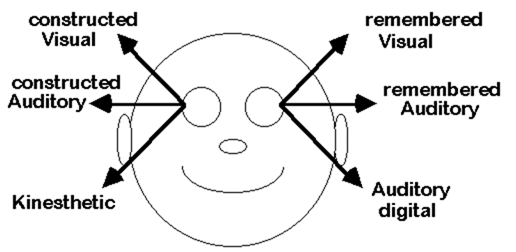
This shows eye
movements observed in many individuals in various cultures.
Eye movement up and to the right is remembered visual (it
happened and I am remembering it). Eye movement up and to
the left is constructed visual (I am creating a visual
image—it is not a memory). Eye movement to the right
remembered auditory (I heard it and I am remembering it).
Eye movement to the left is constructed auditory (I did not
hear it, I am creating it). Eye movement down and to the
right is feeling. Eye movement down and to the left is
internal dialogue.
(Dilts,
1976, 1977; Grinder, DeLozier and Bandler, 1977; Bandler and
Grinder, 1979; Dilts, Grinder, Bandler and DeLozier, 1980)
The Authors
Former Agent Michael S. Vigil
Michael S. Vigil
served with the Drug Enforcement Administration for
thirty-one years and retired at the Senior Executive Service
level. He worked on major investigations, in an undercover
capacity, in the United States, Mexico, Central and South
America, and other countries. He was the Special Agent in
Charge of the Caribbean and San Diego Divisions and also
served as the DEA’s Chief of International Operations. He
was the recipient of over twenty awards, to include the
Administrators’ Distinguished Service Award. He also
received the most prestigious award in law enforcement,
NAPO’s Top Cop Award. He is the subject of numerous books
and is considered an international expert on counter drug
operations.
Dr. McCoy has
been a Licensed Professional Counselor for 15 years. She
has been a published author since 2003. Dr. McCoy is a
former South Carolina State Constable. She researched,
developed and implemented the Master Instructor Program
for the South Carolina Criminal Justice Academy in 2006
– 2007 (one of three in the nation). Dr. McCoy is a
member of the Society for Police and Criminal
Psychology, the American Counseling Association, the
International Consortium for Leadership in Public
Safety, Women in Law Enforcement Leadership and a
Diplomate, with the American Academy of Experts in
Traumatic Stress. She is also a National Certified
Counselor. She is currently writing a book on law
enforcement leadership and ethics in conjunction with
law enforcement leaders from across the nation. She has
been a subject matter expert on radio, in newspapers, on
the Internet, in books and national magazines. Dr. McCoy
is a law enforcement consultant at McCoy Training
Advisors.
If you have
questions about this document contact Dr. McCoy at
drmccoy86@aol.com
The features are
given to man as the means by which he shall express his
emotions, and yours are faithful servants.—Sherlock Holmes
Well then,
about that chasm. I had no serious difficulty in getting
out of it, for the very simple reason that I never was
in it. – Sherlock Holmes