|

|
|

January
2013
Important:
To ensure future delivery of
the Policetraining.net newsletter to your inbox (not bulk or junk folders)
please add our "From" address
info@policetraining.net to your address book or e-mail whitelist.
|
-
Sponsored By -
 |

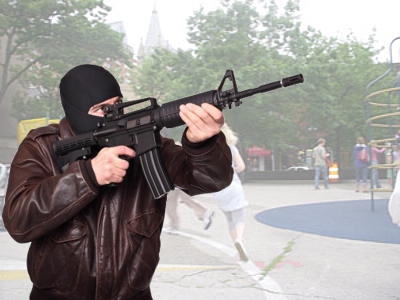 Active
Shooters in Schools: The
Enemy is Denial Active
Shooters in Schools: The
Enemy is Denial
Preventing juvenile mass murder in American schools is the job
of police officers, school teachers, and concerned parents
with Doug Wyllie, PoliceOne Editor in Chief
“How many kids have been killed by school fire in all of North
America in the past 50 years? Kids killed... school fire... North
America... 50 years... How many? Zero. That’s right. Not one single
kid has been killed by school fire anywhere in North America in the
past half a century. Now, how many kids have been killed by school
violence?”
|
So began an extraordinary daylong seminar presented by
Lt. Col. Dave Grossman, a Pulitzer Prize nominated author, West Point psychology
professor, and without a doubt the world’s foremost expert
on human aggression and violence. The event, hosted by the
California Peace
Officers Association,
was held in the auditorium of a very large community church
about 30 miles from San Francisco, and was attended by more
than 250 police officers from around the region.
Grossman’s talk spanned myriad topics of vital importance to law
enforcement, such as the use of autogenic breathing,
surviving gunshot wounds, dealing with survivor guilt
following a gun battle, and others. In coming months, I will
present a series of articles addressing many of these
subjects, but violence among and against children was how
the day began, and so it is in this area I will begin my
coverage...
“In 1998,” Grossman said, “school violence claimed what at the
time was an all time record number of kids’ lives. In that
year there were 35 dead and a quarter of a million serious
injuries due to violence in the school. How many killed by
fire that year? Zero. But we hear people say, ‘That’s
the year Columbine happened, that’s an anomaly.’
Well, in 2004 we had a new all time record — 48 dead in the
schools from violence. How many killed by fire that year?
Zero. Let’s assign some grades. Put your teacher hat on and
give out some grades. What kind of grade do you give the
firefighter for keeping kids safe? An ‘A,’ right?
Reluctantly, reluctantly, the cops give the firefighters an
‘A,’ right? Danged firefighters, they sleep ‘till they’re
hungry and eat ‘till they’re tired. What grade do
we get for keeping the kids safe from
violence? Come on, what’s our grade? Needs improvement,
right?”
Johnny Firefighter, A+ Student
“Why can’t we be like little Johnny Firefighter?” Grossman
asked as he prowled the stage. “He’s our A+ student!”
He paused, briefly, and answered with a voice that blew through
the hall like thunder, “Denial, denial, denial!”
Grossman commanded, “Look up at the ceiling! See all those
sprinklers up there? They’re hard to spot — they’re painted
black — but they’re there. While you’re looking, look at the
material the ceiling is made of. You know that that stuff
was selected because it’s fire-retardant. Hooah? Now look
over there above the door — you see that fire exit sign?
That’s not just any fire exit sign — that’s a
‘battery-backup-when-the-world-ends-it-will-still-be-lit’
fire exit sign. Hooah?”
Walking from the stage toward a nearby fire exit and exterior
wall, Grossman slammed the palm of his hand against the wall
and exclaimed, “Look at these wall boards! They were chosen
because they’re what?! Fireproof or fire retardant, hooah?
There is not one stinking thing in this room that will
burn!”
Pointing around the room as he spoke, Grossman continued, “But
you’ve still got those fire sprinklers, those fire exit
signs, fire hydrants outside, and fire trucks nearby! Are
these fire guys crazy? Are these fire guys paranoid? NO!
This fire guy is our A+ student! Because this fire guy has
redundant, overlapping layers of protection, not a single
kid has been killed by school fire in the last 50 years!
“But you try to prepare for violence — the thing much more likely
to kill our kids in schools, the thing
hundreds of times
more likely to kill our kids in schools — and people think
you’re paranoid. They think you’re crazy. ...They’re in
denial.”
Teaching the Teachers
The challenge for law enforcement agencies and officers,
then, is to overcome not only the attacks taking place in
schools, but to first overcome the denial in the minds of
mayors, city councils, school administrators, and parents.
Grossman said that agencies and officers, although facing an
uphill slog against the denial of the general public, must
diligently work toward increasing understanding among the
sheep that the wolves are coming for their children. Police
officers must train and drill with teachers, not only so
responding officers are intimately familiar with the
facilities, but so that teachers know what they can do in
the event of an attack.
“Come with me to the library at Columbine High School,” Grossman
said. “The teacher in the library at Columbine High School
spent her professional lifetime preparing for a fire, and we
can all agree if there had been a fire in that library, that
teacher would have instinctively, reflexively known what to
do. But the thing most likely to kill her kids — the thing
hundreds of times more likely to kill her kids, the teacher
didn’t have a clue what to do. She should have put those
kids in the librarian’s office but she didn’t know that. So
she did the worst thing possible — she tried to secure her
kids in an un-securable location. She told the kids to hide
in the library — a library that has plate glass windows for
walls. It’s an aquarium, it’s a fish bowl. She told the kids
to hide in a fishbowl. What did those killers see? They saw
targets. They saw fish in a fish bowl.”
Grossman said that if the school administrators at Columbine had
spent a fraction of the money they’d spent preparing for
fire — if the teachers there had spent a fraction of the
time they spent preparing for fire — doing lockdown drills
and talking with local law enforcers about the violent
dangers they face, the outcome that day may have been
different.
Rhetorically he asked the assembled cops, “If somebody had spent
five minutes telling that teacher what
to do, do you think lives would have been saved at
Columbine?”
Arming Campus Cops is Elementary
Nearly two years ago, I wrote an article called
Arming campus cops is elementary. Not surprisingly, Grossman agrees with that hypothesis.
“Never call an unarmed man ‘security’,” Grossman said.
“Call him ‘run-like-hell-when-the-man-with-the-gun-shows-up’ but
never call an unarmed man security. Imagine if someone said,
‘I
want a trained fire professional on site. I want a fire hat,
I want a fire uniform, I want a fire badge. But! No fire
extinguishers in this building. No fire hoses. The hat, the
badge, the uniform — that will keep us safe — but we have no
need for fire extinguishers.’ Well, that would
be insane. It is equally insane, delusional, legally liable,
to say, ‘I
want a trained security professional on site. I want a
security hat, I want a security uniform, and I want a
security badge, but I don’t want a gun.’ It’s
not the hat, the uniform, or the badge. It’s the tools in
the hands of a trained professional that keeps us safe.
“Our problem is not money,” said Grossman. “It is denial.”
Grossman said (and most cops agree) that many of the most
important things we can do to protect our kids would cost us
nothing or next-to-nothing.
Grossman’s Five D’s
In the next installment of this series, I will explore what
follows in much greater detail, but for now, let’s
contemplate the following outline and summary of Dave
Grossman’s “Five D’s.”
1. Denial —
Denial is the enemy and it has no survival value, said Grossman.
2. Deter — Put police officers in schools, because with just one officer
assigned to a school, the probability of a mass murder in
that school drops to almost zero
3. Detect — We’re talking about plain old fashioned police work here. The
ultimate achievement for law enforcement is the crime that
didn’t happen, so giving teachers and administrators regular
access to cops is paramount.
4. Delay —
Various simple mechanisms can be used by teachers and cops to put
time and distance between the killers and the kids.
a.
Ensure that the school/classroom have just a single point of
entry. Simply locking the back door helps create a hard
target.
b.
Conduct your active shooter drills within (and in
partnership with) the schools in your city so teachers know
how to respond, and know what it looks like when you do your
response.
5. Destroy —
Police officers and agencies should consider the following:
a.
Carry off duty. No one would tell a firefighter who has a
fire extinguisher in his trunk that he’s crazy or paranoid.
b.
Equip every cop in America with a patrol rifle. One chief of
police, upon getting rifles for all his officers once said,
“If an active killer strikes in my town, the response time
will be measured in feet per second.”
c.
Put smoke grenades in the trunk of every cop car in America.
Any infantryman who needs to attack across open terrain or
perform a rescue under fire deploys a smoke grenade. A fire
extinguisher will do a decent job in some cases, but a smoke
grenade is designed to perform the function.
d.
Have a “go-to-war bag” filled with lots of loaded magazines
and supplies for tactical combat casualty care.
e.
Use helicopters. Somewhere in your county you probably have
one or more of the following: medivac, media, private,
national guard, coast guard rotors.
f.
Employ the crew-served, continuous-feed, weapon you already
have available to you (a firehouse) by integrating the fire
service into your active shooter training. It is virtually
impossible for a killer to put well-placed shots on target
while also being blasted with water at 300 pounds per square
inch.
g.
Armed citizens can help. Think
United 93. Whatever your personal take
on gun control, it is all but certain that a killer set on
killing is more likely to attack a target where the citizens
are unarmed, rather than one where they are likely to
encounter an armed citizen response.
Coming Soon: External Threats
Today we must not only prepare for juvenile mass murder,
something that had never happened in human history until
only recently, but we also must prepare for the external
threat. Islamist fanatics have slaughtered children in their
own religion — they have killed wantonly, mercilessly, and
without regard for repercussion or regret of any kind. What
do you think they’d think of killing our kids?
“Eight years ago they came and killed 3,000 of our citizens. Do
we know what they’re going to do next? No! But one thing
they’ve done in every country they’ve messed with is killing
kids in schools.”
The latest al Qaeda charter states that “children are noble
targets” and Osama bin Laden himself has said that “Russia
is a preview for what we will do to America.”
What happened in Russia that we need to be concerned with in this
context? In the town of Beslan on September 1, 2004 — the
very day on which children across that country merrily make
their return to school after the long summer break — radical
Islamist terrorists from Chechnya took more than 1,000
teachers, mothers, and children hostage. When the three-day
siege was over, more than 300 hostages had been killed, more
than half of whom were children.
“If I could tackle every American and make them read one book to
help them understand the terrorist’s plan, it would be
Terror at Beslan by John Giduck. Beslan was just a dress rehearsal for what
they’re planning to do to the United States.”
A future feature will focus solely on the issue of the terror
threats against American schools, but for the time being
consider this: There are almost a half a million school
busses in America — it would require every enlisted person
and every officer in the entire Army, Navy, Air Force, and
Marine Corps combined to put just one armed guard on every
school bus in the country.
As a country and as a culture, the level of protection Americans
afford our kids against violence is nothing near what we do
to protect them from fire. Grossman is correct: Denial is
the enemy. We must prepare for violence like the firefighter
prepares for fire. And we must do that today.
Hooah, Colonel!
|
|
About the author
Doug Wyllie is Editor in Chief of
PoliceOne, responsible for setting the editorial direction
of the website and managing the planned editorial features
by our roster of expert writers. In addition to his
editorial and managerial responsibilities, Doug has authored
more than 600 feature articles and tactical tips on a wide
range of topics and trends that affect the law enforcement
community. Doug is a member of International Law Enforcement
Educators and Trainers Association (ILEETA), and an
Associate Member of the California Peace Officers'
Association. He is also a member of the Public Safety
Writers Association, and is a two-time (2011 and 2012)
Western Publishing Association "Maggie Award" Finalist in
the category of Best Regularly Featured Digital Edition
Column. Even in his "spare" time, he is active in his
support for the law enforcement community, contributing his
time and talents toward police-related charitable events as
well as participating in force-on-force training,
search-and-rescue training, and other scenario-based
training designed to prepare cops for the fight they face
every day on the street.
|
Prophet in Your Own Land? Not Likely.
 Brian Willis
It has long been accepted that it is hard to be a prophet in
your own land. The 'experts' always seem to come from
outside the agency and often show up preaching the same
message. Organizations often tend to overlook the expertise
that exists within their own ranks. This is not unique to
one agency or organization. It is rampant throughout North
America.
As I travel around North America speaking on the topics of
Harnessing the Winning Mind and Warrior Spirit, The Pursuit
of Personal Excellence and Excellence in Training I hear
similar stories from officers and trainers regarding this
issue. I have spoken to great trainers who are recognized as
experts in their field, yet not allowed to teach for their
own agencies. I have spoken to officers who have been
recognized at a national level for their heroic deeds and
great police work who are treated like crap by their own
departments. The stories are too many to list and I will not
reveal the names although some of you know who they are.
The question I always get asked is why? There are many
possible answers, none of which make it any easier to
accept. After hearing so many stories from so many great
trainers and officers about their being 'black listed' by
their agencies I have come to view it as a sign that we are
doing something right.
I caution people to about the use of the phrase 'my agency'.
My experience is that the majority of the people in the
agency appreciate the work you do and support you. There are
always a few however, who feel threatened. I believe it is
partly a leadership issue. The leaders Jim Collins would
refer to as Level 5 Leaders celebrate the success of people
within their organizations, the greatest martial arts
masters celebrate the day their students are better than
they are, and great trainers celebrate the day their
students become better trainers than they are. Why? Because
they are confident in themselves and their abilities and
they know their role is to develop their people and put the
spotlight on their people not to outshine them. There are
others however, who lack that confidence and want the
spotlight for themselves. They want everyone to say "Look at
how great that leader is." rather than "Look at all the
great people in that organization." Great organizations are
lead by great leaders who celebrate all the great people
they have in their organizations. If you have not read Good
to Great by Jim Collins then take the time to read it. You
will gain some great insights about the traits and
characteristics of Level 5 Leaders.
If you are one of the many who have been blacklisted by your
agency or are being treated badly by them, first make sure
it is not warranted. If the treatment is legitimately due to
your success my advice is you can choose to let it bring you
down, or choose to allow it to lift you up.
When you ask yourself What's Important Now? the answer will
be clear. Keep seeking excellence, keep sharing your
message, see your mistreatment as a sign you are on the
right track and choose to allow it to lift you up.
Take care.
Brian Willis
If you are interested in booking Brian Willis for a
Harnessing the Winning Mind and Warrior Spirit or Pursuit of
Personal Excellence Seminar or an Excellence in Training
Course contact him at winningmind@mac.com. You can visit his
website at
www.winningmindtraining.com for a list of presentations
and courses Brian can offer your organization, staff
training function or conference.
Make sure you check out
www.warriorspiritbooks.com .
 A
training company requires organization & a sense of
community A
training company requires organization & a sense of
community
By R.K. Miller
Everyone We Reach
For this last installment, I want to share some thoughts on
the actual mechanics of putting together a class. Again,
I’ll look to Lifeline Training—run by Lisa Gitchell and Jim
Glennon—for their experience and expertise to balance my own
(www.LifelineTraining.com).
One of Gitchell’s comments really struck me: “Every one we
reach becomes part of the Lifeline family.” It’s a healthy
approach to running your training business. The way you
support and interact with the your students is, of course,
an important aspect of this.
But there’s another viewpoint I’d encourage you to consider.
The people who facilitate a department’s training classes
are typically civilian employees working in the training
unit or the finance section. As part of their job, they
often have to ask for information so they can process
training requests and payment. A W-9 request is common.
Another common request is that your training company acquire
approved vendor status with that municipality. How you treat
these people, and their requests, speaks to your integrity
and professionalism. Treating them in a positive and helpful
manner—“part of the family”—is the right thing to do.
Let the Word Go Forth
Presenting a specific class begins with getting the word
out. The use of an email database is one way. However,
Gitchell cautions against hammering agencies with a ton of
these. People get enough email as it is these days. If you
have a level of activity that justifies it, an “email blast”
that bundles updates on courses is better than sending out
multiple emails announcing each class.
You can also work with the firearms training facility or
police agency hosting the class to generate interest and
attendance. Ask the host to put out a teletype to nearby
departments announcing the class. Also, post course
announcements on your website and law enforcement websites.
Important: But before you do any of
this, make absolutely sure that the details of the class
announcements are accurate. While I was working for one
training presenter, a slight mix up resulted in my home
address appearing on the course information distributed to
some of the students. Much to the early morning delight of
my wife, the first day two students showed up at our front
door looking for the training and wondering why it was at
our residence. If I’d been home, I might have asked: “Does
this look like a firearms training facility to you?”
But it wasn’t the students’ fault—it was the responsibility
of whoever put out the incorrect address to have made sure
it was right. (It was possibly the same quality-control
inspector who rejected a batch of M&Ms because of all the Ws
on them.)
Once a class is available for reservations, it’s a good idea
to track who and how many have signed up. I typically ask
for the student’s name, cell phone and email address, as
well as the same for the person making the reservation.
Sometime prior to the start, send out an email reminding the
individuals that they’re confirmed for the course. Included
in this should also be any course-specific information, like
required equipment and directions to the training location.
If it’s not obvious, it can be helpful to include a map
designating where to park and where the classroom is. The
easier it is for students to find the class, the less
frustration there will be for them, as well as the
instructors. When needed, it also helps to post directional
signs that first morning guiding students to the class.
Get Organized
You must be organized to teach. One method that’s kept me
organized is to have specific storage options for each
subject.
This typically has three components. First, there’s a
computer file for each course. Within it are sub folders for
separate presentations and a generic folder for documents,
such as the manual and PowerPoint, course forms and related
materials.
The second storage component is an actual—not
digital—expandable folder that travels with me to the first
day of class. This contains sufficient hard copies of
various documents necessary for managing the class,
including blank name tents, rosters, lesson plans, hold
harmless agreements, written tests and evaluations. (These
forms and the manual are also on a CD dedicated to the
course in the same expandable folder.)
The third component consists of at least one large plastic
storage box that contains the logistics for the course. For
example, our diversionary device instructor course box
contains inert devices and other training aids. When
preparing to leave for the class, I pull out that box and
load it in my car along with the expandable file. Usually,
I’ll throw in a fold-up luggage cart too. This works well
for getting bulky items into the classroom.
But Wait, There’s More
It’s a given that some of us suffer from CRS—Can’t Remember,
um—Stuff! Once, after driving for hours to a training venue,
I realized I’d left an important item behind. The scrambling
I had to do to fill this instructional void prompted me to
develop a course-specific checklist, which has since become
standard protocol.
There are some things you just can’t train without. Leaving
the students’ manuals or the course PowerPoint presentation
at home would be a definite problem. The checklist ensures
you don’t. Other must-haves include an emergency medical
trauma kit and electronics, like laptops, thumb-drives,
portable speakers, extension cords, etc. Identify what you
need for a perfect presentation and then build your list
from there.
If you’re just starting out, you probably don’t have a
dedicated training site with the company’s name on the deed.
So you’ll need to build good relationships with locations or
police agencies that serve as hosts. My suggestion is to
have another checklist of facility and on-site equipment
requirements, so you can go over them with the department in
advance of the training.
Usually the agency assigns one person as the point of
contact. This individual is extremely important to the
success of the class. Help to guide them as appropriate in
the various aspects of hosting the training. You’ll
encounter some who have been in this role before and are
confident about what needs to be done. But there will also
be those in this role with little or no prior experience.
Of course, you’ll need a quality classroom, preferably with
audio visual equipment already installed, and enough room to
accommodate the maximum number of students anticipated.
Creature comforts, such as heating and air conditioning that
work, as well as clean bathrooms, are obvious needs. I think
you get the idea.
I consider myself fortunate to have developed some good
friendships with hosts who are willing to go the extra mile.
Again, such partnerships contribute to successful training.
In addition, they can lead to future invitations to teach
more classes.
Instructor Reconnaissance
If you haven’t been there before, you want to make sure of
the training site’s physical layout. When possible, visit to
confirm that the facilities are adequate. If that isn’t
possible, the host may be able to send you photos or a video
of the classroom and other facilities.
Horror story: Teaching for the NRA Law
Enforcement Division, another instructor and I arrived the
day before the start of a five-day class at an Army Reserve
base. The point-of-contact host had assured our NRA
coordinator that the facilities were adequate. Beyond that,
we had NFI—no further information.
The host led us to the designated classroom. There, our
initial concern turned into full-on shock—the “classroom”
was the living room of a house that had been converted to
military use. Even with liberal amounts of Vaseline, we
couldn’t have squeezed our 20-plus students into that small
area. Some quick thinking saved us, and we moved to a nearby
county sheriff’s facility.
But our problems were amplified when we drove to the range
facilities. The classroom issues became extremely trivial in
our minds as we realized that we were literally in the
middle of a rattlesnake round up. Honest to God, they were
slithering around in the road as well as the firing line
when we arrived! Although this serpent surprise was
apparently something that our host accepted as the norm, we
should have known about it in advance—it sure mattered to
us! (For the record, I don’t like snakes.) He half jokingly
mentioned that it was rattlesnake hunting season, but soon
it seemed like they were hunting us.
Pro tip: If you’re using shooting range or other training facilities, get
sufficient information about the location
prior to the class. As a backup, I’ve even used
Google Earth to get an idea of where we’ll be training.
It’s a Set Up
Whenever possible, the classroom should be prepared well
before the students walk in. This includes arranging chairs
and tables as you want them.
On the tables, position manuals, name tents, business cards,
etc. in an orderly uniform fashion. Their first impression
should be a positive one based on how organized the class
appears. In addition, a systems check of the audio-visual
equipment, including a test run with any PowerPoint
presentations to confirm that animations and imbedded videos
work properly, is a must before the students arrive.
CEO
You are—or will be—the company’s CEO (chief executive
officer). However, there’s another translation: chief
everything officer! As you may have already found out, it’s
not an easy job running a training business. You must be
able to multitask well.
You must also have good people work with you to help lighten
the load on your brain and shoulders. I’ve had some very
rewarding experiences—which I attribute to these folks as
much as anything—and some real “bonehead” times in my
training career.
Let’s close by recognizing that law enforcement needs good
training and police agencies don’t necessarily have all the
answers to this problem. If you want to tackle this
challenge, I encourage you and hope this helps. Final
advice: In whatever form that works for you, be organized
and proficient in providing quality instruction. Good luck!
Train safe. God bless America.
< <
jump to the policetraining.net home page
Image credit: tiero / 123RF Stock Photo
Image credit: icetray / 123RF Stock Photo
Contact:
Betsy Brantner Smith
630-399-1645
BetsyBrantner@aol.com
Law Enforcement Icon Dave
Smith Announces Nationwide Training Tour
TUCSON, AZ – Internationally known law enforcement experts and
instructors Dave and Betsy Smith of Dave Smith & Associates are
pleased to announce their 2013 training schedule, exclusively
featuring their “Winning Mind” seminar series for law enforcement
and military personnel.
Dave Smith, known for the “JD Buck Savage” video training series,
his work as the director of education for the Law Enforcement
Television Network [LETN], and as the general manager and senior
instructor for Calibre Press and the “Street Survival” seminar, has
been teaching his signature class, “The Winning Mind”,
internationally since 1987.
With the Praetorian Group’s sale of Calibre Press, Smith will no
longer be teaching the “Street Survival” seminar and will be
focusing on expanding the “Winning Mind” series. “We’re training
people to win and winning goes beyond gunfights and confrontations,”
says Smith. “We want you to win the entire event. We want you to get
home, be able to keep the home, and be emotionally healthy in your
home.”
Smith’s wife Betsy Brantner Smith is also a veteran police trainer,
former “Street Survival” instructor and a prolific author. She is
the creator of the only training of its kind for women in law
enforcement, “The Winning Mind for Women” and has been invited into
hundreds of law enforcement agencies across the country to speak on
the science of “gender intelligence” and its relationship to officer
safety, leadership skills, tactical training and much more.
“This is not a new business for us,” Betsy Smith explains, “It’s a
new focus. The ‘Winning Mind’ series is designed to inform and
inspire anyone who works in a law enforcement organization.”
The Smiths will be partnering with Public Grants and Training
Initiatives (www.PG-TI.com) to deliver low cost, open registration
courses to public safety personnel nationwide and will continue to
appear at national and regional conferences throughout North
America.
The Smiths will also continue their work with the Praetorian Group’s
popular PoliceOne.com website and innovative video training product,
the PoliceOne Academy.
“We’re excited to extend our partnership with Dave Smith &
Associates,” says Alex Ford, CEO of the Praetorian Group. “Dave and
Betsy Smith have been instrumental in helping us build upon
PoliceOne’s mission to deliver critical information and must-have
training content for law enforcement worldwide. We’re looking
forward to working with them to deliver even more valuable training
and online resources to the law enforcement community in the coming
year.”
For decades Dave and Betsy Smith have successfully trained and
educated thousands of law enforcement personnel throughout the
world. They are devoted
to delivering the key concepts of “winning” in more than 50
different cities throughout the United States and Canada in 2013.
For a full list of course locations, conference dates and
registration information, visit www.jdbucksavage.com or call
630-399-1645.
About Dave Smith &
Associates
Dave “JD Buck Savage” Smith has been a law enforcement
icon for nearly four decades. In 1998, Dave and his wife, police
trainer and prolific author Betsy Brantner Smith, combined forces to
create Dave Smith and Associates and “Winning Mind” seminars.
Together the Smiths provide law enforcement training and consulting
services that are unique, proven, and constantly updated.
Traveling to all 50 United States as well as to Canada,
Mexico, the Balkans, the United Arab Emirates, and more, Dave and
Betsy bring unparalleled experience, integrity, and commitment to
the ever-changing world of policing and beyond.
The Smiths believe that the best way to honor our fallen
is to tell their stories and learn from their sacrifices. Their
training philosophy is that “survival” is minimalistic and that we
must strive to WIN in every aspect of life. To that end, “Winning
Mind Seminars” celebrates those warriors who have won life and death
confrontations physically, tactically, legally and emotionally. For
more information, visit www.jdbucksavage.com.
About Winning Mind
seminars
Dave “JD Buck Savage” Smith
first presented “The Winning Mind” in 1987.
Since then it has evolved into one of the most remarkable training
experiences that law enforcement personnel will ever attend.
By looking at the key components of peak performance, including who
survives and why, the roles that optimism, risk and bureaucracy play
in our personal and professional lives, and how individuals and
organizations can make themselves truly resilient, Dave presents an
entertaining and inspiring program designed to help everyone,
regardless of their experience, optimize their odds of
winning any confrontation.
“The Winning
Mind for Women” is
one of the most unique and popular courses offered by the
“Winning Mind”
team. Sgt. Betsy Brantner Smith guides students through 8
hours of intensive, interactive training that will provide attendees
with updates and information they can employ to improve and enhance
both their professional and personal lives. For more information or
to schedule a course, visit www.jdbucksavage.com.
|
|
